Casinos
 Bonuses


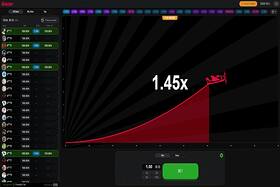
Aviator by Spribe
Bet limits: $0.1 - $100
Balance: $3,000


Watch the multiplier climb, feel your heart race, then decide - cash out now or push your luck further? Our Crash simulator delivers the full adrenaline experience without the financial freefall.
Practice timing your exits, understand multiplier patterns, and develop nerves of steel before your bankroll enters the equation. Your road to crash game mastery starts with the simulator below.
 Reset Credits
 Full Screen
 Close Full Screen
Bet limits: $0.1 - $100
Balance: $3,000
Bet limits: $1 - $100
Balance: $10,000,000
Bet limits: $0.01 - $100
Balance: $10,000
Bet limits: $0.1 - $100
Balance: $11,000
Bet limits: $0.1 - $100
Balance: $10,000
Bet limits: $0.1 - $100
Balance: $10,000
Bet limits: $0.1 - $100
Balance: $10,000
Bet limits: $0.02 - $50
Balance: $10,000
Bet limits: $1 - $20
Balance: $9,000
Bet limits: $1 - $100
Balance: $2,000
The interface captures everything you'll encounter in real crash games, minus the stomach-dropping losses during your learning curve.
Getting started is quite simple. Just select your bet value and press the Bet button.
Now, let’s explore more details.
The magic happens in those split seconds between 2x and crash. Your brain screams "more!" while logic whispers "enough!" - this internal battle defines crash gaming.
Auto Cash-Out Settings:
Statistics Dashboard Features:
Pro Tip
Activate "ghost mode" to practice without betting. Watch 50 rounds, calling your theoretical cash-out points. Compare your timing against actual crash points - most beginners discover they're either too greedy or too conservative.
The replay feature lets you rerun any previous round in slow motion. This reveals micro-decisions you make unconsciously. I discovered I consistently hesitate around 3.7x - a psychological barrier costing me numerous 4x+ wins.
Speed controls adjust how fast multipliers climb. Start at 0.5x speed to practice decision-making without time pressure. Gradually increase to 2x speed - if you can maintain discipline there, real games feel leisurely.
The pattern logger tracks your cash-out decisions across sessions. Export this data to spreadsheet for deep analysis. My logs revealed I play more conservatively on Mondays and more aggressively on Fridays - subconscious patterns affecting profitability.
The psychological warfare of crash games destroys unprepared players - simulation builds your mental armor while revealing hidden behavioral patterns.
Every successful crash player develops personal timing signatures. Mine emerged after 2,000 simulator rounds:
This distribution wasn't planned - it evolved naturally through trial and refinement. The simulator revealed my optimal balance between consistent small wins and periodic big scores.
Example Evolution Timeline:
Crash games trigger primal responses:
Important
The simulator lets you experience these emotional stages repeatedly until they lose power. By round 500, that 10x multiplier stops feeling special - exactly the mindset needed for disciplined play.
Crash games deliver variance that makes other casino games look tame. My documented simulator sessions include:
These experiences prepared me for real-money play where similar sequences occurred. Without simulator preparation, I'd have rage-quit during that 47-round disaster.
The simulator's data reveals brutal truths:
Understanding these probabilities through experience beats reading statistics. You'll internalize that chasing 50x multipliers guarantees long-term losses.
Advanced players often run multiple strategies simultaneously. The simulator's multi-account mode enables testing:
After 1,000 rounds each, results typically show Account A with steady 15% growth, Account B volatile but breakeven, and Account C down 60%. This visceral comparison prevents costly real-money experiments.
Behind the climbing multiplier lies elegant mathematics - provably fair algorithms generating truly random crash points.
Each round begins with the server generating a random crash point using cryptographic hashing:
Key Understanding
The crash point exists before the round starts. Nothing you do influences when it crashes - timing is everything.
Crash games follow exponential distribution:
Probability of reaching X multiplier = 1/X
This creates consistent house edge around 1-3% depending on implementation.
The formula: House Edge = 1 - (0.99/X) where X is target multiplier
Examples:
Paradoxically, higher targets face lower house edge percentages but exponentially worse probabilities. This mathematical quirk traps greedy players.
There are a lot of discussions on Reddit and other forums about Crash games and how to maximize your winnings. I tested all of them to see if any of them work. Here are the results:
The Conservative Method:
The Balanced System:
The Aggressive Hunter:
Recommendation
Start conservatively and gradually test higher targets. The simulator tracks success rates per multiplier range. Use this data to find your profitable zone.
Modern crash games offer sophisticated automation, but you need to use it carefully. My suggestions:
Fixed Multiplier Systems:
Progressive Strategies:
Hybrid Approaches:
Personal Testing Results Over 10,000 Rounds:
Simple fixed targets consistently outperform complex systems.
You've watched thousands of multipliers climb and crash. Your finger knows exactly when to hit that cash-out button. Those 47-round losing streaks? They don't faze you anymore - you've seen it all in the simulator.
Here's what separates you from the crowd now: you understand the game's rhythm. Crash rewards discipline, punishes greed, and delivers pure mathematical chaos wrapped in adrenaline-pumping suspense.
When you make the transition, choose one of the best online casinos and start microscopic. If you're planning $50 bets eventually, begin with $2. Your simulator timing transfers perfectly, but real money transforms that 3x decision from academic to heart-pounding. Suddenly every decimal point matters.
I bet you're a bit like me - ready to test those nerves against live multipliers. Just remember: the crash point doesn't care about your mortgage payment. Stick to your simulator-tested strategy, and let mathematics work in your favor.
The good news is you've already experienced every emotional trap crash games can throw at you. What happens next depends on your discipline, not the RNG.
Time to show those multipliers who's boss.
Other simulators you can try
Don't stop at crash mastery - the best players cross-train across multiple formats.
Plinko Simulator teaches patience in a completely different way. While crash demands split-second decisions, Plinko lets you watch probability unfold slowly.
Mines Simulator flips everything upside down. Instead of watching multipliers climb, you control every click.
Got questions about ?
Ask a Question