


 Casinos
 Bonuses


Craps Bets: A Beginner’s Guide to Understanding Every Bet

Peter Nairn
Casino Operations Specialist

- Over 3 decades of experience in casino operations management, with a focus on Table Games and Slots;
- Senior executive positions in both Native American and traditional casino markets for companies like Harrah’s New Orleans and Minnesota-based Grand Casinos;
- Hands-on experience as trainer and dealer of multiple casino games including: Blackjack, Roulette, Craps, and more;
- Profound knowledge of Title 31 regulations, State compacts, and Federal MICS.
 100%
100% 14 min
 Updated on Jan 21, 2025
Today, we’re going to take a deep dive into craps bets. Craps can appear to be a challenging game, overwhelming to a newbie with so much going on.
In fact, it’s 10 simple games all going on at the same time, so once you separate them out, it becomes much easier to understand and choose your playing style.
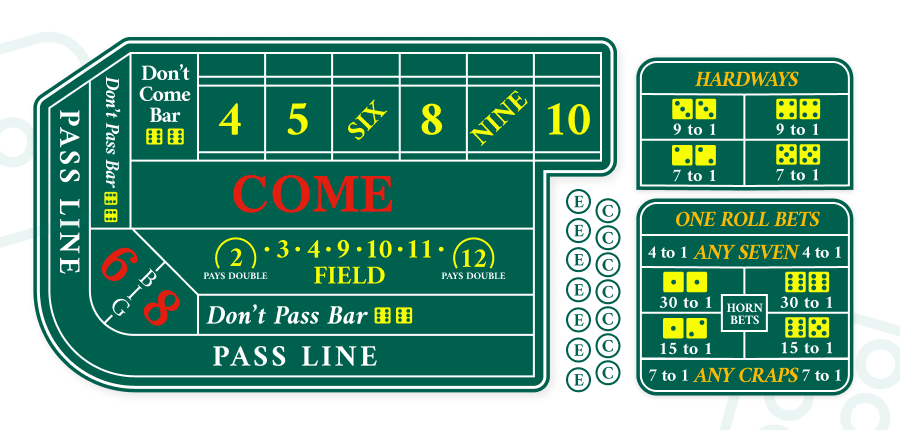
Once you finish this article, you will understand the various bets in craps, what they cover, the House Advantage of each of them, and what the best bets are for you.
Let’s get started.
- Pass Line Bet
- The Don’t Pass Bet
- The Odds Bets
- Come Bet
- Don’t Come Bet
- The Field
- Place Bets and Place Bets to Lose
- Buy Bets and Lay Bets
- The Big Six and Big 8
- Hardways
- The 2 and 12 Bets
- The 3 and 11 Bets
- Any Seven Bet
- Any Craps Bet
- Hopping Bets
1. Pass Line Bet
I’m starting with the Pass Line bet because it’s the most common bet made on a crap game.
On the Come-Out roll, most players bet the Pass Line.
This bet wins if the shooter rolls a 7 or 11, and loses on a 2, 3, or 12.
If the shooter rolls any other number (4, 5, 6, 8, 9, 10), it becomes the point, and the dealer will mark the number with the puck to remind everyone which number is the point.
The shooter must then roll the point again before a 7 to win even money.
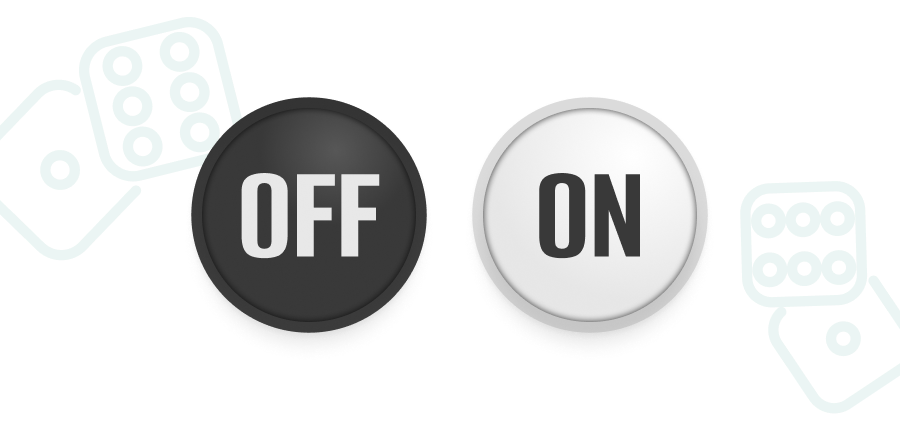
And btw – the puck is the big aspirin with ON written on one side, and OFF written on the other.
If the player bets $10 and wins, he gets paid $10 and keeps his initial bet, for a total of $20.
The House Advantage on this bet is 1.41%.
Pro Tip
When the puck says ‘ON’ and is on a number, that is the point. When the puck says ‘OFF’ and is on the Don’t Come, it’s a Come-Out roll.
2. The Don’t Pass Bet
This bet is the opposite of the Pass Line bet, and the player betting the Don’t is betting the shooter to lose.
On the Come-Out roll, if the shooter rolls a 2 or 3, the bet on the Don’t Pass wins even money. If he rolls a 12, it’s a push, so his bet neither wins nor loses.
That’s why it’s called the ‘Don’t Pass Bar 12’, because the 12 is barred on the Come-Out roll.
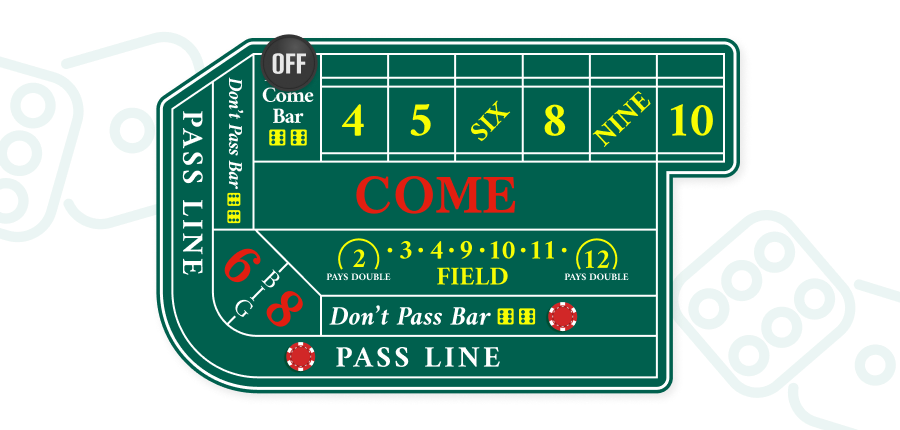
If the shooter rolls a 7 or an 11 on the Come-Out roll, the Don’t Pass bet loses.
If the shooter rolls any other number on the Come-Out roll, (4, 5, 6, 8, 9, 10), it becomes the point, and for the Don’t Pass bet to win, the shooter must roll a 7 before he rolls the point again.
Any other number apart from the 7 and the point has no effect on the Don’t Pass bet.
And he could roll all night, it doesn’t matter.
The House Advantage on this bet is 1.36%.
Fun Fact
The House Advantage on the Pass Line and Don’t Pass are so close that you would have to play 8 hours a day for a few weeks for it to make a noticeable difference to your win/loss.
3. The Odds Bets
This is such a great bet for the players that it’s not even marked on the layout.
The House Advantage on this bet is zero.
That’s right, the casino does not take a piece of this bet and pays the true odds of the number coming up before a 7.
Taking the odds behind a Pass Line bet allows the player to increase their bet on the point.
It used to be that the amount of odds allowed was a bit of a mystery, and each casino would choose its own version. Some allowed double, some allowed 5 times on some numbers but only double on others. It was very confusing for the players.
In the last 30 years or so, a very common odds multiplier has become widespread, and very popular, and it’s called the 3, 4, 5 odds package.
On the 4 and 10, the player can take up to 3 times the flat bet as odds.
On the 5 and 9, the player can take up to 4 times the flat bet as odds.
On the 6 and 8, the player can take up to 5 times the flat bet as odds.
The reason this works so well is because it makes the odds bet the most compatible for payouts, and its very simplicity makes it easier for the players to grasp.
And off the record, I would like to congratulate the guy who came up with this idea. It’s so much easier for the players to understand it now.
To bet the odds on the Pass Line, simply put your chips on where the 3a is on the layout below.
You don’t need to tell the dealer what the bet is, he’s going to know, and you will see many players taking the odds in this way.
You can also lay the odds if you’re betting the Don’t Pass.
To lay the odds means you’re betting on the favorite, because laying the odds means you’re betting on the 7 coming up before the point.
You would put your chips where it says 3b on the layout below. To lay the odds against the 4 and 10, you would need to bet $20 to win $10 because the true odds are 2 to 1 against.
To lay the odds against a 5 or 9, you would have to bet $15 to win $10 because the true odds are 3 to 2 against.
And against the 6 and 8, the true odds are 6 to 5 against, so the player has laid $30 to win $25 in the picture.
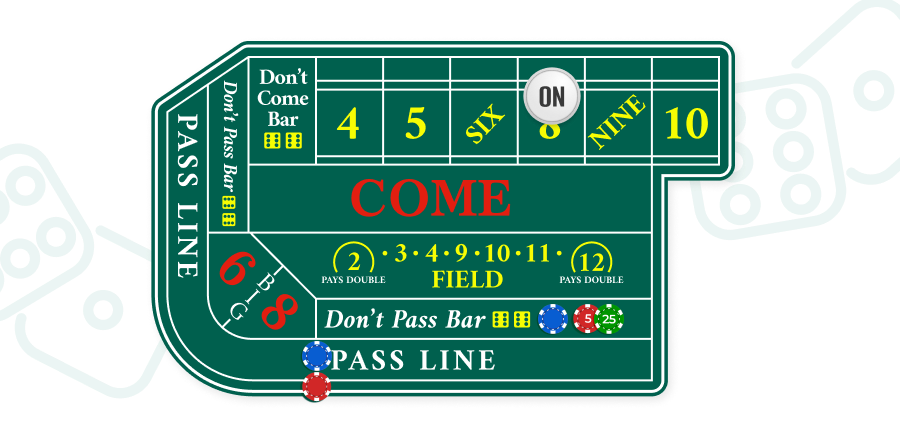
The odds always pay the true odds of the point coming up before a 7.
It’s a self-service bet, so the dealer will only touch it if it loses.
The House Advantage on the odds or lay bet is zero. That’s right, 0.00%.
4. Come Bet
Once the point has been established, some players like to play more numbers, so they bet the Come. You can only bet the Come after a point has been established for the Pass Line, and the Come works just like the Pass Line, but for the next roll.
It wins on a 7 or 11, and loses on 2, 3, or 12.
If the shooter rolls any other number, (4, 5, 6, 8, 9, 10), the dealer moves the Come bet to the number, and it becomes the point for the bet coming in from the Come, and the shooter must roll that number again before a 7 to win.
Only the point number for the Come bet and the 7 count for that money.
And the player can take the odds on their Come bet, too. The dealer will simply place the odds bet offset on top of the flat bet.
Odds on Come bets are automatically off on the Come-Out roll but can be called on if the player wants them to be working.
The House Advantage on a Come bet is 1.41%.
5. Don’t Come Bet
The Don’t Come bet is just like the Don’t Pass bet, but for the next roll.
It loses if the shooter rolls a 7 or 11 on the next roll and wins if the shooter rolls a 2 or 3.
If the shooter rolls a 12, it’s a push.
Any other number becomes the point for that money, the dealer will move the Don’t Come bet behind the number, and the shooter must roll a 7 before the point for that Don’t Come bet to win.
The player with the Don’t Come bet has the same opportunity to put a lay bet against the number which the dealer must place for him.
The House Advantage on a Don’t Come bet is 1.36%.
6. The Field
An easy to make, one-roll bet that is self-service.
A bet in the Field wins if the roll is 2, 3, 4, 9, 10, 11, or 12.
Usually, the 2 and the 12 pay double, but in some casinos, they pay the 12 triple, not double.
All the other Field numbers pay even money.
The House advantage on the Field bet is 5.56%, unless the 12 pays triple, in which case the HA is 2.78%.
7. Place Bets and Place Bets to Lose
Some players prefer choosing the numbers they want to bet on instead of allowing the dice to choose where the bet goes through the Come.
Place Bets pay reduced odds because they have not been put at risk through the Come:
- The 4 and 10 pay 9 to 5
- The 5 and 9 pay 7 to 5
- The 6 and 8 pay 7 to 6
The House Advantage on the Place bets is as follows:
- 4 and 10 = 1.67%
- 5 and 9 = 1.11%
- 6 and 8 = 0.46%
Place bets are off on the Come-Out roll but can be working if the player requests it.
Once a point is established, the Place Bets are automatically working.
There is also the opportunity for the players to place a number to lose. The bet is that the 7 will come up before the box number and is usually bet after a point is established. The Lay bet, paying the vig up front, is not that common a bet but I saw quite a few when I was dealing.
The Place Bet to Lose is an extremely unusual bet and I don’t remember ever seeing one in all my time dealing and supervising the game.
- The Place Bets to Lose are:
- Against the 6 and 8 - bet 5 to win 4 (no vig) with a House Advantage of 0.56%
- Against the 5 and 9 – bet 8 to win 5 (no vig) with a House Advantage of 0.69%
- Against the 4 and 10 - bet 11 to win 5 (no vig) with a House Advantage of 0.76%
8. Buy Bets and Lay Bets
A Buy Bet is identical to a Place Bet, except that the player pays 5% commission (called vigorish, vig. or juice) to buy the true odds of the number coming up before a 7.
Most casinos charge the vigorish as the bet is made.
In that case, the only numbers that it makes sense to buy are the 4 and 10, which have a House Advantage of 1.19% on the Buy Bet, reduced from the Place Bet HA of 1.67%.
The 5, 6, 8, and 9 all pay better odds as Place Bets, so it’s not in the player’s interest to buy them.
Some casinos take the vigorish after the Buy Bet wins, which is very good for the players.
| Numbers | Place Bet HA | Buy Bets Vig taken up front | Buy Bets Vig taken after winning |
|---|---|---|---|
| 6 and 8 | 0.46% | 1.46% | 0.69% |
| 5 and 9 | 1.11% | 1.32% | 0.56% |
| 4 and 10 | 1.67% | 1.19% | 0.42% |
As you can see, if the casino takes the vigorish after the bet has won, it reduces the HA by a lot.
This is why it’s very unusual to see the vig. taken after the bet has won because it reduces the casino’s opportunity to make money.
It’s better to place the 5, 6, 8, and 9, and never worth buying them, if the juice is taken up front, but it is worth buying the 4, 5, 9, and 10 if the juice is taken after the bet wins.
The players can also bet that the 7 will come up before the individual box numbers. It’s called a Lay Bet. Unlike the Buy Bets, the player pays the 5% vigorish upfront on the potential winnings, not on the bet.
You’ve heard about the sucker bets, right? Well, here they are...
Essentially, these bets give the casino license to reach into your pocket and take your money.
9. The Big Six and Big 8
These are self-service bets that pay even money. You win even money if they hit before a 7. They are there to increase the table’s revenue by taking advantage of inexperienced players.
Why would you bet these bets if you can make the same bet with the dealer and get paid 7 to 6 instead of even money?
The House Advantage on these bets is 2.78% vs. 0.46% on the regular Place Bets.
10. Hardways
When the dice come up as a pair of 2s, 3s, 4s, or 5s, it is called a Hardway, because there is only one way to roll those numbers, as opposed to the easy ways, which can be made two ways each.
The Hard 4, Hard 6, Hard 8, and Hard 10 are the Hardways.
They win if the shooter rolls a pair and lose if the shooter rolls the number ‘the easy way’ or a 7.
The Hard 4 and Hard 10 pay 7 to 1 and win with a pair of 2s or a pair of 5s respectively.
The Hard 6 and Hard 8 pay 9 to 1 and win with a pair of 3s or a pair of 4s respectively.
Why do they pay different amounts?
Because there are more ways to lose by rolling an easy way with a Hard 6 and 8 than the Hard 4 and 10.
The House Advantage on these bets is 2.78%.
In the UK and Australia, they pay more when they hit (7.5 to 1 and 9.5 to 1), so the House Advantage on these bets in other countries may be as low as 1.39%
11. The 2 and 12 Bets
These are the two ‘Craps’ bets that pay 30 to 1.
These two bets are one-roll bets, which means if you roll the number on the next roll, you win and if you don’t roll the number on the next roll, your bet loses.
The House Advantage on these bets is 13.89% when it pays 30 to 1.
This is an extremely high HA amount, and these bets are not recommended because of that.
12. The 3 and 11 Bets
The 3, the third ‘Craps’ bet, and the 11 both pay 15 to 1 in the US.
They are both one-roll bets.
The House Advantage on these bets is 11.11% when it pays 15 to 1.
Neither bet is recommended as the House advantage is so high.
13. Any Seven Bet
This bet is also called ‘Big Red’, because the players on a crap game are extremely superstitious and saying the word ‘seven’ is generally not appreciated by many of the players.
In the US, the bet pays 4 to 1.
The House Advantage on this bet is 16.67% in the US – which is just about the worst HA in the entire casino.
In the UK and Australia, the HA is 8.33% because the bet pays 4.5 to 1, versus the 4 to 1 it pays in the US.
14. Any Craps Bet
This is a one-roll bet on either 2, 3, or 12 coming up.
If any of those numbers comes up, it pays 7 to 1.
The House Advantage on this bet is 11.11%.
Again, a very high House Advantage and this bet is not recommended.
15. Hopping Bets
A hopping bet is a one-roll bet that the dice combination that the player chooses will come up on the next roll.
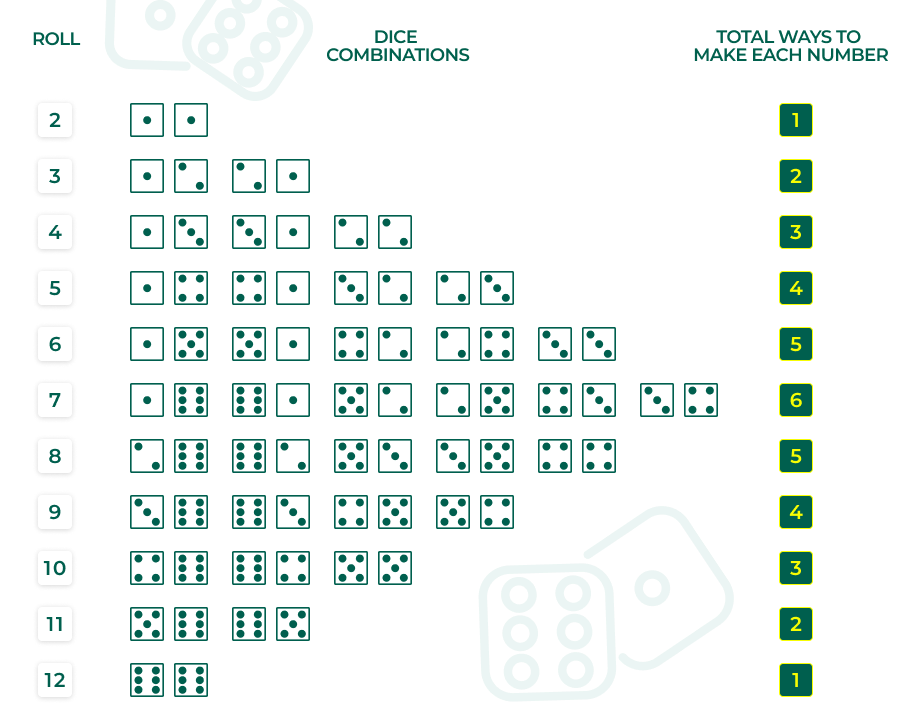
There are two possible payouts: 30 to 1 for any pair, and 15 to 1 for any other combination of numbers.
A Hard 4 (2/2), Hard 6 (3/3), Hard 8 (4/4), and Hard 10 (5/5) hopping all pay 30 to 1.
Easy 4 (a 3/1 or 1/3) or a 9 (5/4, or 4/5, or 6/3, or 3/6), or any other easy number all pay 15 to 1.
And the House Advantage is 13.89% for a 2, 12 or any hopping Hardway, and 11.11% for any other combination of numbers.
Again, a very high House Advantage, and these bets are not recommended because of that.
Conclusion
There you have it, the craps bets explained.
The best bets in craps are the Pass Line, the Don’t Pass, the Come, the Don’t Come, the Odds, the Place bets on the 6 and 8, and the Buy bets on the 4 and 10.
The worst bets are anything in front of the Stickman.
Those bets have some of the highest House Advantages in the entire casino, some in the low to middle teens – which will just kill your bankroll if you bet them with any regularity.
Having said that, there may be a reason to bet some of those bets occasionally.
For example, if you’re playing a Paroli system and find yourself with a massive bet on the Pass Line, you may want to bet ‘Any Craps’ to give yourself some coverage in case the shooter rolls a 2, 3, or 12 on the Come-Out roll.
It’s not recommended but it’s an understandable hedge, a ‘just in case’ bet.
We have many guides about craps in the Academy.
I love dealing and playing craps.
It was the first game I learned to deal, and even though it appears to be very complicated, it’s just a few simple games all going on at the same time.
It’s worth your time to learn about those simple games because it’s a fun and exhilarating game.
And you don’t have to learn all the simple games at once.
Start with the Pass Line, then add a Come bet or two.
Take the odds and spend some time seeing how that works.
Then perhaps Place the 6 and 8. And finally Buy the 4 and 10.
And good luck.
 3
3 0
0 Thank you for voting.
Peter Nairn
Explore More Craps Guides


Craps Q&As




 Level 8
Trying to understand the odds. What is the probability of getting craps or an even sum when rolling the dice once?
 2 Need Answer
 2 Answers


 Level 9
I've always wondered about this. Why is 11 referred to as "yo" in the game of craps?
3 Need Answer1 AnswersLevel 3I'm trying to calculate the odds. How many dice combinations in craps are possible?
3 Need Answer1 Answers