


 Casinos
 Bonuses


Roulette Strategy Guide: The Best Systems and Strategies to Win

Peter Nairn
Casino Operations Specialist

- Over 3 decades of experience in casino operations management, with a focus on Table Games and Slots;
- Senior executive positions in both Native American and traditional casino markets for companies like Harrah’s New Orleans and Minnesota-based Grand Casinos;
- Hands-on experience as trainer and dealer of multiple casino games including: Blackjack, Roulette, Craps, and more;
- Profound knowledge of Title 31 regulations, State compacts, and Federal MICS.

Vlad Mihalache
Online Gambling and Crypto Casinos Specialist
- Accomplished content strategist and editor with over 8 years of experience in the iGaming industry;
- Certified Cryptocurrency Expert (CCE);
- Specializes in blackjack strategies, slots, crypto casinos, and gambling addiction;
- Bitcoin casino expert with extensive knowledge of crypto trading and blockchain gaming;
- Online gambling expert with 7,000+ articles written and reviewed;
- Strong advocate for responsible gambling with complex knowledge of the latest trends;
 89%
89% 21 min
 Updated on Jan 21, 2026
Roulette is an exciting and seemingly simple game to play, and once you get a feel for it, you’ll find that there may be a lot more going on in the game than you thought.
There are various roulette strategies and systems that you can use, and after reading this guide, you’ll be more than ready to try them out at the table.
This article is about the intricacies of Roulette and hopefully will offer you some insights into how to play the game in a way that’s more in line with your goals. Make sure you check out the previous guides in the roulette training series to master the basics of the game.
It’s true that in Roulette the House Advantage (HA) is always working against you, but today we’re going to take a detailed look at some ways that you can bet to make sure you minimize the HA working against you.
For more info, you can watch our video below:
Here’s what you’ll learn:
- Popular Roulette Strategies and How to Play Them
- Conservative Strategies
- The Sections of the Wheel & Why They May Work Best for You
- How to Combine Section and Number Play
- Key Takeaways
- FAQs
Let’s get started!
Popular Roulette Strategies and How To Play Them
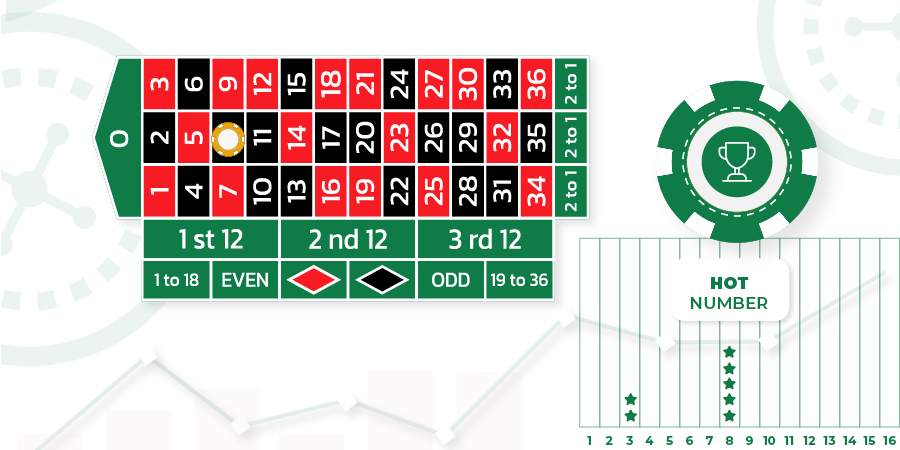
Today we’re going to talk about different betting strategies. We’re going to go through all the various options, and I’ll give you my opinion on which ones may work best for you.
Many roulette strategies have gained some notoriety over the past 100 years or so - and none of them is 100% guaranteed.
The most important strategy is choosing the right wheel. As we learned in the ‘Roulette for Beginners’ guide, the European wheel has a much lower HA than the American wheel and is therefore a much better choice to reduce the HA against you.
Pro Tip
Make sure that they give you half back if the zero hits. It’s not the end of the world if you can’t find the European game, but it is the preferred game.
Some players like to focus on the amounts to bet and strategies that are numbers-based, such as ‘The Martingale Strategy’ or ‘The Paroli Strategy’.
Other players like to focus on the way the numbers are laid out on the wheel, preferring to bet specific sections of the wheel, such as ‘Les Tiers’ or ‘Les Voisins’.
This point of view is tied to the dealer’s behavior.
Dealers are supposed to vary the speed of the wheel and the ball speed every spin, but often they don’t do that and go on ‘automatic mode’, not thinking about what they’re doing. This can result in them hitting certain sections of the wheel.
More about this later.
The Martingale Strategy
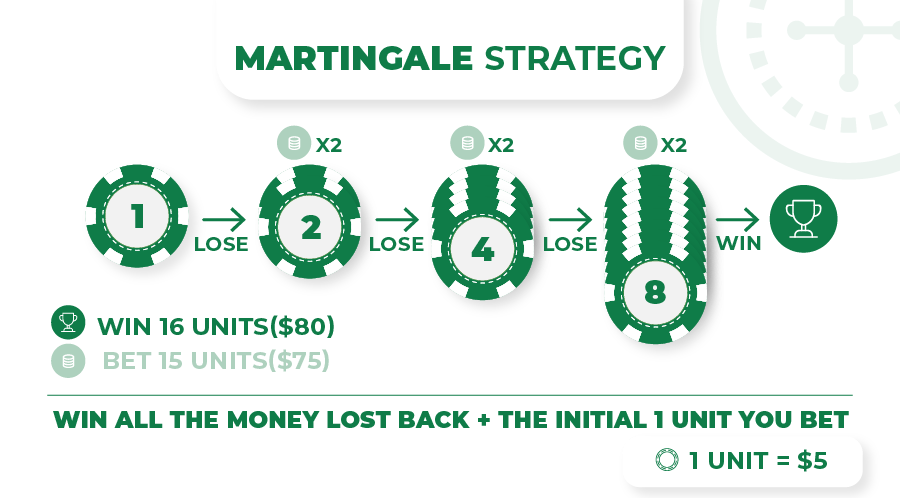
The most common strategy and the one most people may have heard of is ‘The Martingale Strategy’. It’s very simple and easy to manage. It’s called a ‘negative progression’ and here’s how it works:
Choose one of the even-money outside bets and bet 1 unit - let’s say you chose Black.
- If you win, bet the same amount again, 1 unit.
- If you lose, bet double the amount of your initial bet, so 2 units.
- If you lose again, bet double the amount again, so 4 units.
- If you lose again, bet 8 units, and so on, until you win.
The thinking here is that Black must hit again sooner or later, and when it does, you will win all your money back plus the initial 1 unit you bet.
Players choose this strategy because they think ‘Black must hit eventually because so many Reds have hit’.
This is called ‘the Gambler’s Fallacy’ and it’s simply not true.
The odds of Black hitting are precisely the same for every spin - because the ball and wheel do not know, do not remember, and certainly do not care what hit the last spin, or five or ten spins ago.
The Martingale means you will frequently be betting a lot of money to win one unit.
Here's how it works:
Let’s say your unit is $5 and you’re betting Black. And 7 Reds hit in a row. On your next bet, you will be betting $640 - and if Black finally hits, you will get back all the money you have bet and end up winning your original bet - the $5.
Here’s what that looks like: $5 + $10 + $20 + $40 + $80 + $160 + $320 … and the next bet in the sequence is $640.
The total of all these bets is $635. So when Black hits, you get paid $640. And win $5.
On a table that has a $500 maximum limit, you’ve already lost $135 because you can’t bet enough to cover what you’ve already lost.
And that’s the downside of the Martingale Strategy. If you hit the maximum before you win your money back, you can’t recover your money.
And having a streak of 7 of the even money bets like Red, or Even, or Low hit is not an uncommon occurrence.
The Paroli Strategy
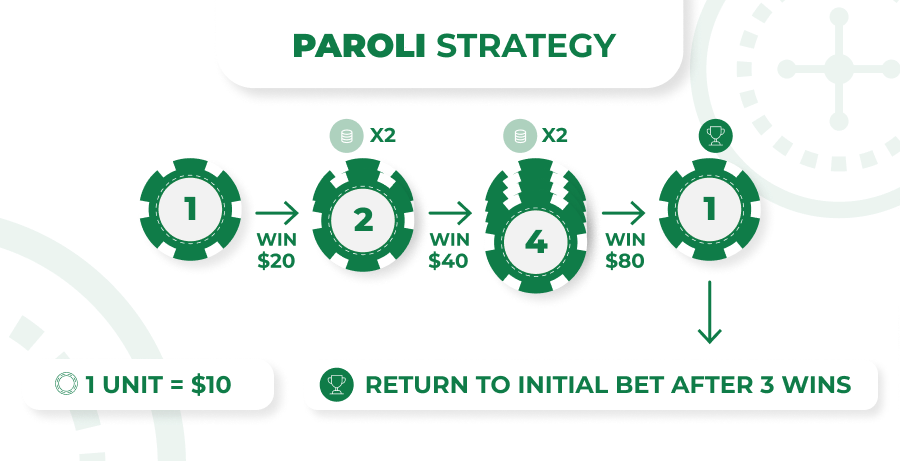
The Paroli Strategy is the opposite of the Martingale strategy.
This is known as a ‘positive progression’.
This is also what I call the ‘Go For The Throat’ (GFTT) strategy because it is very aggressive.
- You double your bet every time you win.
- Your initial bet is 1 unit, and let’s use $10 as your unit.
- If you win, bet 2 units - so $20.
- If you win again, bet 4 units, which is $40
- If you win again, bet 8 units, or $80.
- And if you win again bet the $160.
- If that wins, you keep the $320 and go back to your $10 initial bet.
After winning 5 in a row, you have $320, and 5 in a row is not that unusual on roulette.
Not bad for a $10 starting bet.
No, actually, it’s not the casino's money.
Now some folks would say you are betting with the casino’s money on the Paroli Strategy. But it’s not the casino’s money, because as soon as the dealer gives you the chips, they become yours.
Not convinced? Well, once the dealer gives it to you, can you go and cash out and receive actual bank notes? Of course, you can, and therefore it’s no longer the casino’s money, it’s your money.
The Fibonacci Strategy
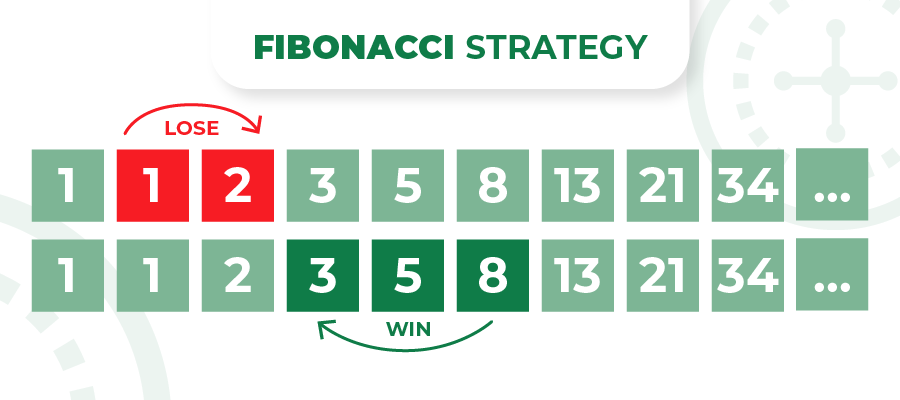
Another one that may work for you is the Fibonacci Strategy.
It uses a sequence of numbers initially designed by Leonardo Bonacci, a pre-Renaissance mathematician from Pisa in Italy. The sequence is determined by adding the current number and its predecessor to give you the next number, like this:
1, 1, 2, 3, 5, 8, 13, 21, 34, 55, 89, and so on.
When you win, you go back to two places in the sequence.
When you lose, you go on to the next number in the sequence.
For example, suppose your betting unit is $10. Here’s how you will use the Fibonacci Strategy in Roulette:
- You start by betting 1 unit on Black. You lose the first round. (-$10)
- Now, you move to the next number in the sequence, so you bet 1 unit. You lose this one as well.(-$10)
- Move to the next number, so your bet will be 2 units. You win, so you get back 4 units ($40)
- Now, move back two numbers in the sequence and bet 1 unit again.
And so on. In the example above, you lost $20 in the beginning, but you got it back on your next win.
The ‘Bond . . . James Bond’ Strategy
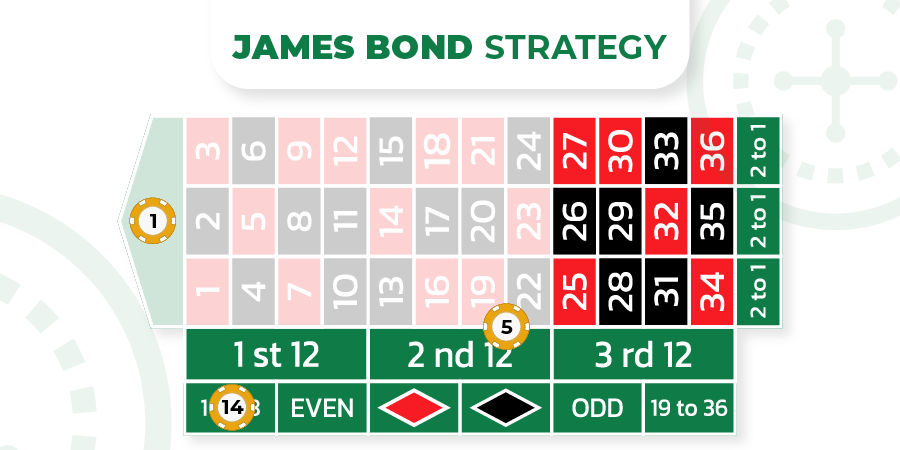
This is an interesting strategy and offers the possibility of not losing a lot, while perhaps having some small wins along the way.
It is a 20-unit bet, as follows:
- Bet 14 units on Low, the even money bet that covers 1 through 18.
- Bet 5 units on the 6-line of 19 through 24
- Bet 1 unit on the zero, or if playing a double zero wheel, on the Split between zero and double zero.
The only time you lose on these bets is if 25 through 36 hits. The rest of the numbers give you a small win.
Combining Bond Strategy with Martingale
Some say that adding a little of the Martingale Strategy to it makes it easier to keep even and possibly win a bit more.
When you lose, double your bets to a 40-unit bet, betting in the same locations but with double the bet. Of course, that means you’ve got a lot more of your bankroll in action, with the associated risks of losing more money.
Conservative Strategies
Always bet on the even money bets on the Outside.
These are:
- Red/Black;
- Odd/Even;
- Low/High.
The following betting strategies seem to be either too complicated or designed to play for as long as possible while limiting opportunities to lose a large amount.
They also reduce your likelihood of winning - but if you want to play for a while without losing too much, they may be exactly what you’re looking for.
The D’Alembert Strategy
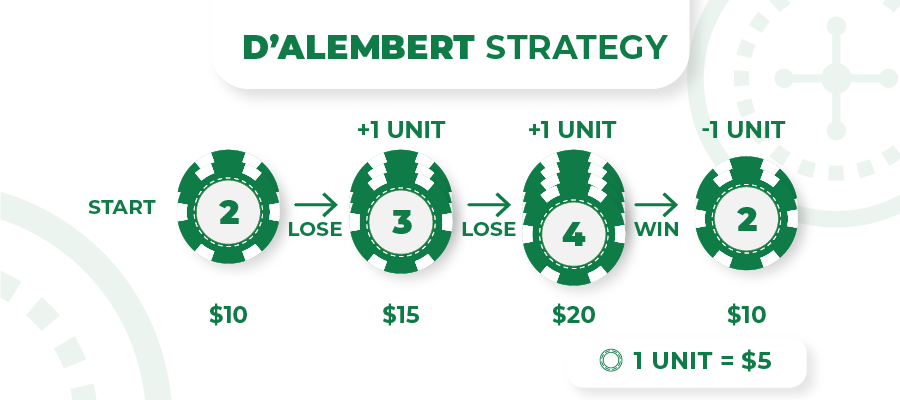
The D’Alembert strategy is very simple and should only be used on even money bets like Red or Black, Odd or Even, or High or Low. It’s a somewhat modified version of the Martingale Strategy.
- If your betting unit is $5, you start with a bet of 2 units, so $10.
- If you win the initial bet, decrease the next bet by one unit, so bet $5 and never go below $5.
- If you lose the initial $10 bet, increase the next bet by one unit, so go to $15.
- If that loses, your next bet would be $20, and so on.
- Once you win, your next bet would be back to your initial bet of $10, and so on.
As you might expect, the Reverse D’Alembert strategy is a twist on the original. Instead of increasing your bet when you lose, you increase your bet when you win.
You also decrease your bet when you lose.
Remember
If you’re following the D’Alembert strategy, you choose your units and follow the same rules by only ever increasing or decreasing your bets by one unit at a time.
The Andrucci Strategy
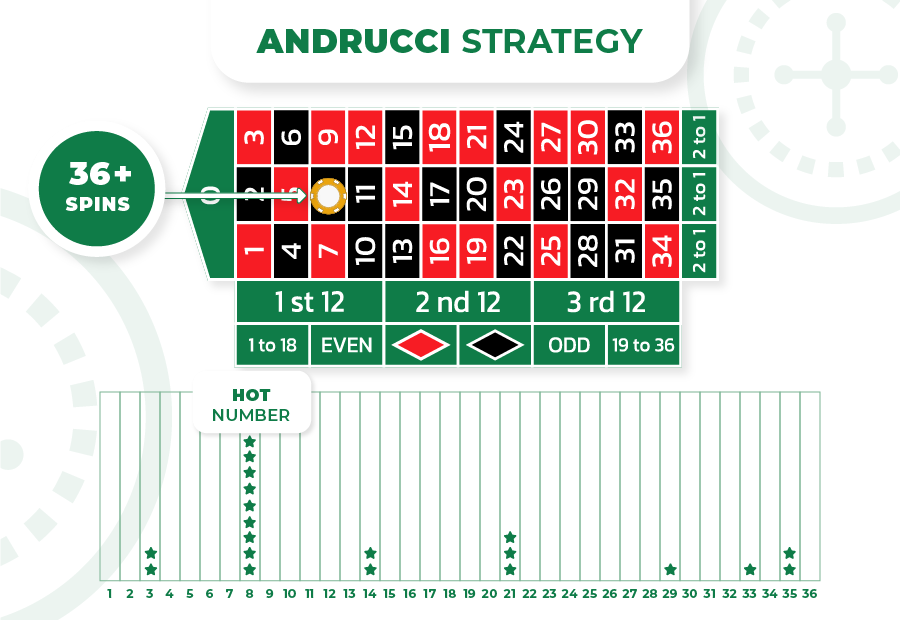
If the roulette table you decide to play on has a scoreboard, you can look back over the last 36 numbers or so and see if any numbers have repeated.
Please note
The number history and scoreboard are generally available in online roulette games. You can check out European Roulette iSoftBet for free and see how the scoreboard can work to your advantage.
Perhaps one has hit three times - let’s say 8 Black. This appears to be the hot number, so you start betting on it straight up.
Bet 1 unit on 8 Straight Up for another 36 spins or so. Look for other numbers that have hit more than once, and after 36 or so spins, move to betting on the other numbers that have repeated.
Pro tip
If there is no scoreboard, you can begin by keeping track of the first 36 or so numbers that come up.
You may want to bet the minimum roughly 36 times on random even bets like Red or Black, Odd or Even, or Low or High to get a feel for the game. Make sure you record which numbers the ball lands on each time.
Over the first 36 spins, see which numbers appear the most and then begin making Straight Up bets on the number that hits the most often. Repeat this bet on the same number for around 36 bets, then move on to the next number that seems to be ‘hot’.
This strategy is linked to the idea that there are ‘hot streaks’, which isn’t true. But some players like to follow the repeating numbers.
Key takeaway
Andrucci can seem difficult to win, but when you finally hit, you get the biggest payout on the wheel, the 35 to 1.
The LaBouchere Strategy
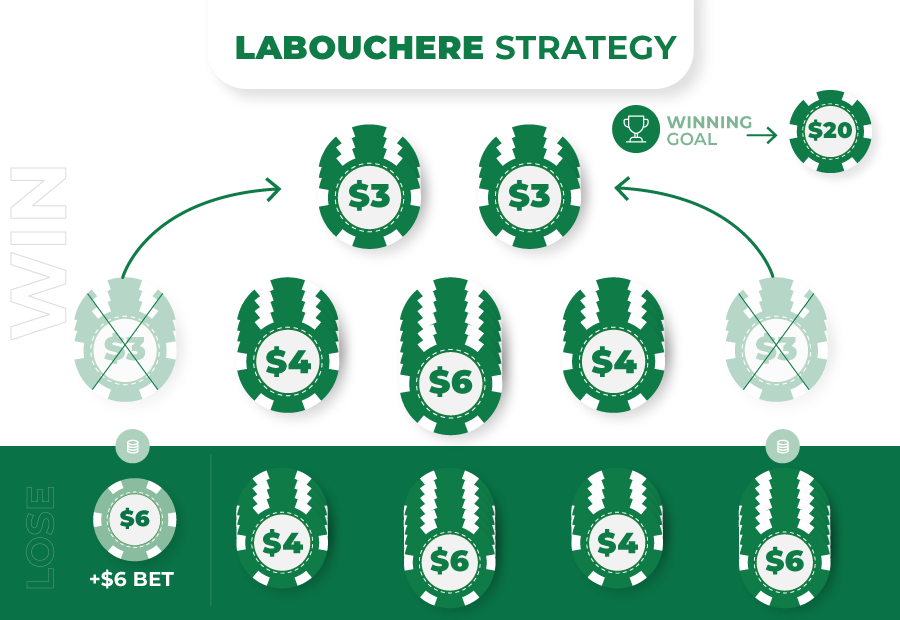
The LaBouchere strategy is a little more complicated.
Here’s how it works step-by-step:
- First, decide how much you want to win over the next few spins of the wheel. Let’s say $20.
- Now divide that number into five random numbers that add up to 20. For example, we go with 3, 4, 6, 4, 3.
- Now take the furthest right number, and the furthest left number and add them together to make your first bet. ($6).
- Place your bet on an even money bet - let’s say, Black.
- If you win, you remove the furthest left and furthest right numbers from the sequence and that would leave 4 6 4, which would mean that your next bet on Black is $8.
- If you lose your initial $6 bet, you add the $6 to the sequence on the right-hand end, which would now give you 4 6 4 6, and then repeat the action. So $10 would be your next bet on Black.
- Repeat until you’re winning $20, and then reassess what you want to win next, and reset your sequence to reflect that betting strategy.
Recommendation
Choose a strategy that matches your playing style and your goals. If you want to simply pass a couple of hours and not spend too much money, knowing you will also not win a lot, then choose the more conservative strategies to play, such as the D’Alembert Strategy, or the Fibonacci Strategy, or the Bond, James Bond Strategy.
To help you out, we created the roulette strategy simulator that allows you to test the strategies before you start to gamble.
On the other hand, you may want to bet more aggressively, knowing you may lose quite quickly, but also that you may win a lot in a short time.
In that case, you may want to choose the (GFTT) Paroli system - which could also be called the ‘Go Big or Go Home Strategy’.
The Sections of the Wheel and Why They May Work Best For You
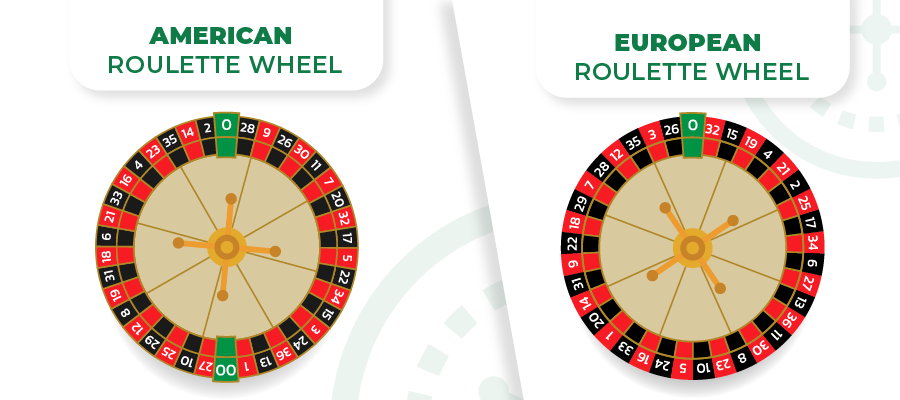
Nowadays, roulette wheels in land-based casinos are extremely well designed to very fine tolerances. The wheels are heavy and spin uninterrupted for a long time. In any sophisticated casino, they are routinely checked for balance and to ensure a completely random spin every time.
The order of the numbers is standardized across all European roulette wheels and they are in a completely different order compared to the numbers on an American wheel.
As you can see, in some ways, the European wheel looks very similar to the American wheel.
But look a little closer and you will notice that there is only one zero on a European wheel, vs the zero and double zero on an American wheel.
On an American wheel, the zero and the double zero are on opposite sides of the wheel.
The order of the numbers isn’t hugely significant but having only one zero on the European wheel changes the HA by cutting it almost in half.
This is very good for the players.
And here’s the ‘Fools Rush in, Where Angels Fear to Tread’ OR ‘Why You Should Never Play a Game With Three Zeroes on the Wheel’ tip:
Pro tip
Always play on a European wheel if possible.
Why? Because:
- The HA on a single zero (European or French) wheel is 2.70%
- The HA on a double zero (American) wheel is 5.26%
- The HA on a triple zero wheel is 7.69%! Yikes!
Make sure you choose the right game to play!
Playing the Sections on a European Wheel
Les Tiers du Cylindre and ‘The Racetrack’
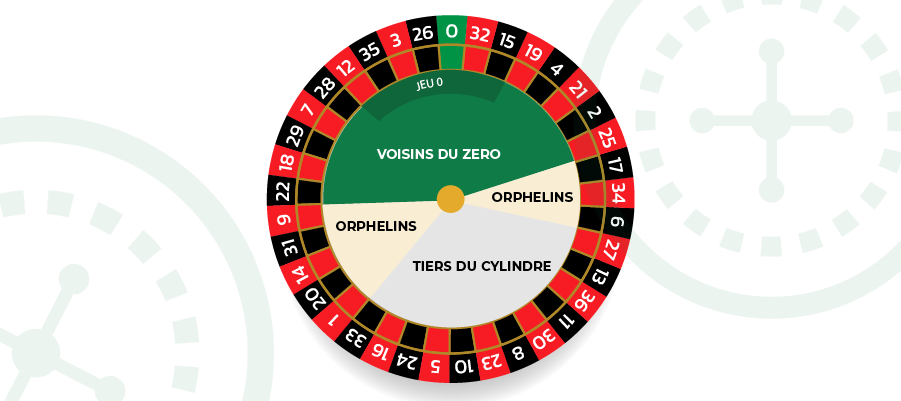
One strategy devised many years ago in France is to play sections of the wheel. On a European wheel, they have been given names that divide the European wheel into known sections.
In a live casino on a European wheel, you may find that the dealers are familiar with these bets and consequently will assist you in placing them.
Les Tiers du Cylindre (just called the Tiers - pronounced T-Air), which covers 1/3 of the wheel,
Les Voisins du Zero (the Neighbors of Zero), and Les Orphelins (The Orphans, which are the two areas between the two other larger groups) are the three groups of numbers.
Please note that these sections only exist on the European wheel.
The Tiers, Les Voisins and Les Orphans
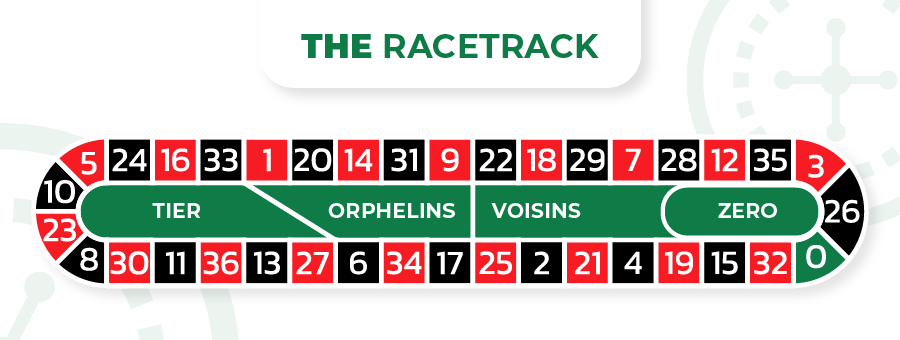
For ease of betting, and to make them easier to see, the wheel numbers and the French sections have also been laid out in a different format, but in the same order.
This is referred to as ‘The Racetrack’.
It is a representation of the numbers in the correct order as they appear on a European wheel.
It is printed on the layout and allows the dealer to place these bets quickly and easily.
The European Wheel Racetrack
Sometimes the player would prefer the dealer to place the bets on the layout rather than on The Racetrack (because it’s luckier etc), and then the dealer would put the chips in place on the layout as follows:
The Voisins du Zero bet is a 9-unit bet.
- 2 units on the 0-2-3 Trio
- 1 unit each on the 4-7, 12-15, 18-21, 19-22, and 32-35 Splits, and
- 2 units on the 25-29 Corner
The Les Tiers du Cylindre bet is a 6-unit bet.
- 1 unit each on the 5-8, 10-11, 13-16, 23-24, 27-30, and 33-36 Splits
The Orphelins bet is a 5-unit bet.
- 1 unit each on the 6-9, 14-17, 17-20, and 31-34 Splits
- 1 unit straight up on 1
Fun Fact
Some online roulette games allow you to access these French bets, so look for them if you would like to bet them.
The Racetrack also allows the player to see and request the 5-unit neighbor bets easily.
So for example, 17 and the neighbors includes 17 and the 2 numbers on each side of it on the wheel, 34 and 6, and 25 and 2.
And then the players end up choosing their sections to bet.
It’s a fun game to deal with knowledgeable players.
How to Combine Section and Number Play
One of the other strategies to think about is on a double zero American wheel.
Dealer behavior is a part of this strategy because dealers get into ‘a groove’.
In a European game, the wheel direction and ball direction are alternated every spin. This automatically changes the speed and weight of the wheel and the ball every spin.
In an American game, the wheel is always spun counter-clockwise and is never reversed. The ball is always spun clockwise, in the opposite direction to the wheel spin.
Many dealers routinely give the ball a full power spin, to give the dealer more time to clean up the chips and check the layout, and to give the players more time to complete their bets.
The dealers are not thinking about the game, and they get comfortable with the speed of the wheel because ‘it just looks right’, and the speed of their release of the ball.
Consequently, on an American wheel, you may discover that the dealer is hitting a section of the wheel more frequently than other sections. This section may be as much as a third or up to half of the wheel.
It may be that the dealer is hitting the section but advancing around the wheel every spin.
Pro tip
Pay attention to where the ball is landing, and you may discover that there is an overall pattern to the winning numbers.
This may help you identify where the ball may land. This is especially true in US casinos.
Expert’s Advice: How to Think in Roulette

If you look at the picture of the wheel (below) and note the way the numbers are laid out, you will see that there is a section of approximately 1/4 of the wheel where there are 6 red numbers that are all in the 2nd dozen.
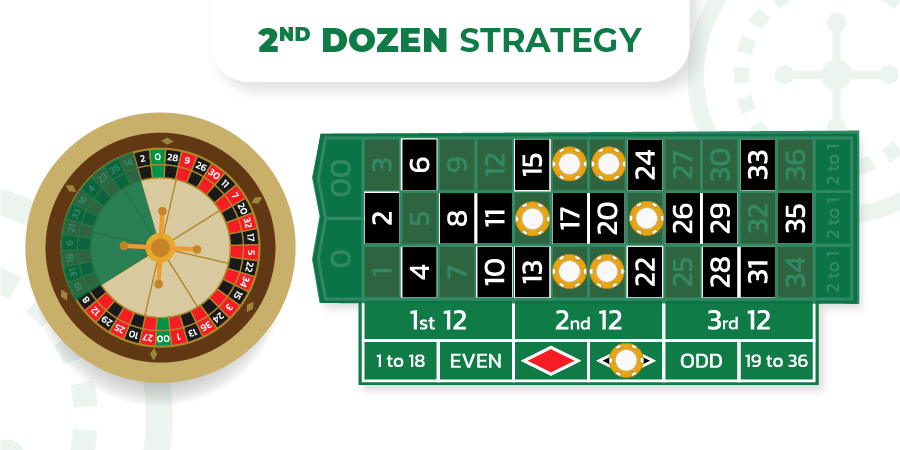
The section starts at the single zero at the bottom of the wheel and goes counterclockwise and to the right.
The red numbers are 14, 23, 16, 21, 18, and 19.
If you bet 1 unit Straight Up on each of those, and then 6 units on ‘Black’, you have covered almost half the wheel with the bet on ‘Black’, and ¼ of the wheel with the red numbers.
If you hit a black number, you will get your 6 units back and can replace your Straight Up bets on the six 2nd Dozen Red numbers.
If you hit one of the Straight Up bets, you will get paid 35 units for the 1 you bet. If you notice that the dealer is hitting that section, this is a great bet to make.
Please note
There is a complementary section on the other side of the wheel, too. Starting at the double zero and going counterclockwise and to the left, there are the 6 black numbers from the 2nd dozen.
The numbers are 13, 24, 15, 22, 17, and 20. If you observe a similar section hitting and playing the same way, your bet on the outside should be on ‘Red’.
There is another way to play this 2nd Dozen section game.
You bet the 6 red Straight Ups in the 2nd Dozen, but instead of betting 6 units on Black, you bet 6 units each on the 1st Dozen and 3rd Dozen, and one chip on the 0, 00 Split.
If you hit one of the Straight Ups, you get paid 35 chips and can replace the losing 18 chips, leaving you with a win of 17 chips.
If you hit the 1st or 3rd Dozen, you get paid 12 chips, replacing the losing Straight Ups and the other Dozen bet. All you need to do then is add the single chip on the 0, 00 Split.
For more info on 0 vs 00 in Roulette, you can watch our video guide below:
Key Takeaways
- The European Wheel is the best wheel to play because it offers better odds to the player. With only one zero, it has 37 numbers and consequently has a low House Advantage (HA) of 2.7%
- Whatever you decide to bet on, the HA is always working against you, so choosing the wheel with the lowest HA is always your best choice.
- The Gambler’s Fallacy may show up strongest on roulette. Let’s say you’re betting Black, and Red has hit 5 times in a row. The Gambler’s Fallacy would seem to indicate that Black is due to hit, right? Wrong! It’s not. The odds of Black hitting are exactly the same for every spin because the wheel doesn’t know what number hit last spin, the spin before that, or 10 spins ago.
- Roulette is a more popular game in Europe because the odds against the player are lower on a European wheel. This has led to the game being studied more, and more sophisticated betting strategies have been developed.
- Experienced European dealers are very familiar with the call bets such as Les Tiers, The Voisins, and the Orphans. These bets are routinely made by European players, and rarely by American players who simply have never seen those bets because they don’t exist on an American wheel.
 16
16 2
2 Thank you for voting.
Peter Nairn
Vlad Mihalache
Explore More Roulette Guides


Roulette Q&As





 Level 6
Trying to turn $0.40 into $40.00, any advice?
Thanks!
 5 Need Answer
 8 Answers


 Level 3United States
No problem, just asking for some advice as to what game should I play.
5 Need Answer3 Answers

 Level 433 Need Answer6 Answers
 Accepted answer