


 Casinos
 Bonuses


Roulette Cheat: Legal Loopholes or Foul Play?

Peter Nairn
Casino Operations Specialist

- Over 3 decades of experience in casino operations management, with a focus on Table Games and Slots;
- Senior executive positions in both Native American and traditional casino markets for companies like Harrah’s New Orleans and Minnesota-based Grand Casinos;
- Hands-on experience as trainer and dealer of multiple casino games including: Blackjack, Roulette, Craps, and more;
- Profound knowledge of Title 31 regulations, State compacts, and Federal MICS.

Carol Zafiriadi
Senior Content Writer
- Specialised in video poker, table games, RNG, land-based casinos, and promoting responsible gambling;
- Over 6 years of experience in presenting and analyzing the latest trends and innovations in the world of gaming and tech;
- BA in English and German Language and Literature and MA in Literary Translation, both from the University of Bucharest, resulting in sharpened critical thinking and quality iGaming content.
 100%
100% 21 min
 Updated on Sep 20, 2024
In this guide, we’re going to explore the ways in which people try to cheat when playing roulette.
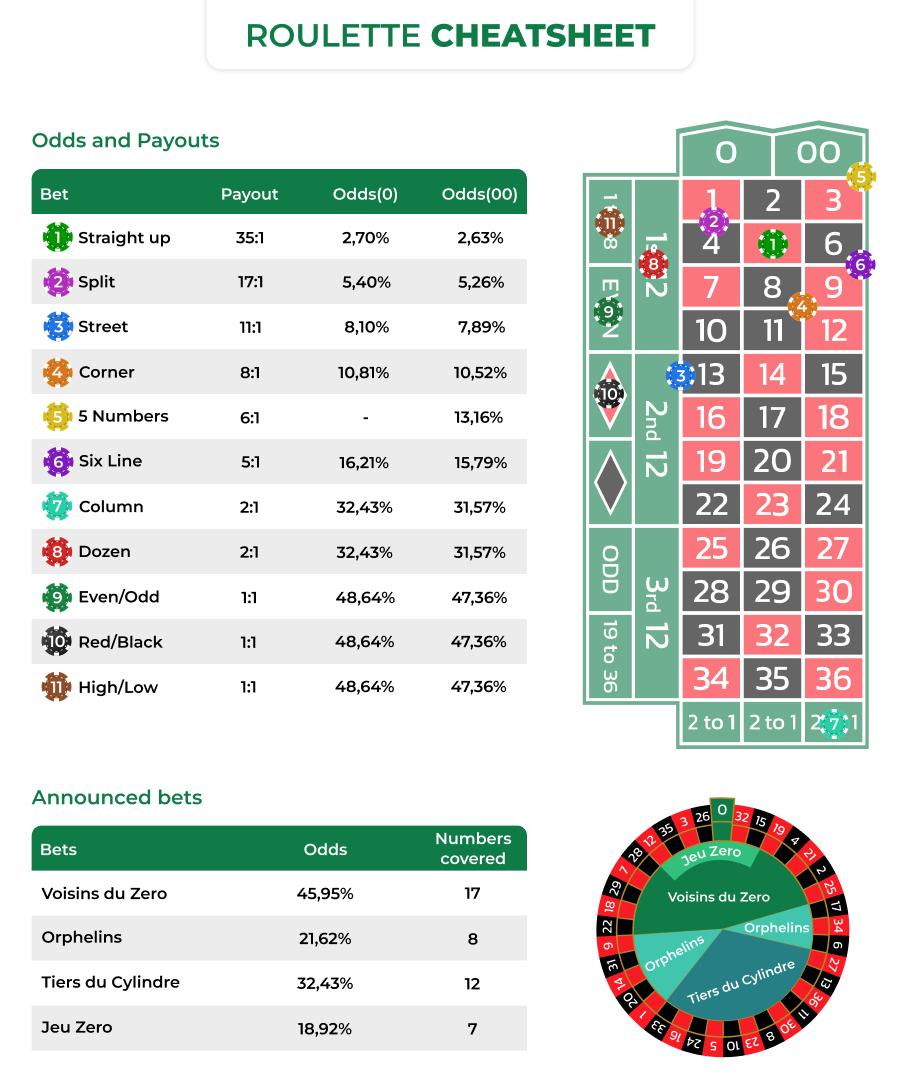
We’re also going to put together a roulette cheat sheet, which is an informational pamphlet (mostly for beginners but experienced players may find some new information they didn’t know, too) which describes the base game, the bets you can make, what the odds of hitting those bets are, and how much you can expect to get paid for winning bets.
When you have finished reading this guide, you will know the most common ways that people try to cheat at roulette in casinos, and all the bets that are available to you on both American and European roulette.
You will know how much they pay, and what the true odds are of each of those bets hitting.
Is cheating okay in a casino?
Of course not.
A casino is a legitimate business, and you wouldn’t try to cheat your local Starbucks barista, would you?
Same thing with a casino. It’s just not okay!
Generally, all the people who work in casinos regard cheats with a great deal of contempt.
And that includes me. The classic roulette scam that feels like seeing an old friend after many years.
Oh, there you are – still popular after all this time!
And we arrest them, just the same!
Cheating in Roulette: An Overview
Why do people try to cheat on any game in the casino?
It’s because they seem to feel that the casino is taking unfair advantage of them, and they’re trying to even things up.
Which is nonsense, of course.
Famous Cheating Cases
Obviously the most famous one is the legendary ‘Man Who Broke the Bank in Monte Carlo’.
There are a few different claims about who this person was, but they happened in the late 1800s, or early 1900s. Was it Charles Deville Wells? Or Joseph Jagger? Or both?
This legendary figure apparently had discovered a biased wheel that he exploited.
Or did he bring a big enough bankroll to be able to Martingale his way into casino history because at that time, there was no maximum bet, and so on. I suspect the most famous modern one is the Croatian/Serbian/Hungarian roulette computer team who beat the Ritz in London for over £1 Million in 2004.
These days, they would still be in jail, but back then, the laws governing roulette were written in the 1840s, and didn’t include cell phones or computers, so they walked away.
Or is it Phil Ivey, who beat Crockford’s in London for millions by edge sorting the cards on a Baccarat game, and then lost the case in a lawsuit.
Edge sorting at that time was a well-known scam, and I can’t imagine how Crockford’s management didn’t know about it, and perhaps more surprising, how they allowed it to happen under their noses!
Common Roulette Cheating Methods
There are a few different ways that people cheat at roulette. And please note that 99.9% of these scams are players cheating the casino, not the casino cheating the players.
Here are some of the most common:
Mechanical Devices (Roulette Computers; Magnets and Hidden Devices)
The thieves will use a roulette computer to try to determine where the ball is likely to land.
Simply put, the computer tracks the ball speed and the wheel speed, and then supplies the scammer(s) with a number where the ball is likely to land.
Here’s how it works
The computer tracks the ball speed and wheel speed, and determines what number is likely to be under the ball as it drops from the track. And then it assesses how many numbers away from that spot the ball is likely to bounce to before it settles.
Hitting one specific number is really difficult to do – but the scammer learns the order of the numbers on the wheel and uses that information to cover a section of the wheel, perhaps up to 10 numbers around the computer-selected ‘likely to hit’ number.
The laws governing casinos are still trying to catch up with modern technology, and the laws sometimes are woefully behind the cheats.
A case in point is the use of roulette computers.
They’re still not definitively illegal in the UK. The UK is still working under the laws from the 2005 Gambling Act. But I suspect that will change in the near future as they’re rewriting the laws as you’re reading this.
Magnets, or Adjusting the Size of the Pockets, or Loosening Some of the Inner Workings of the Wheel
These scams are to assist the ball into a specific number or numbers. It’s very difficult to pull off, and usually requires access to the wheel when the casino is closed. Most modern casinos have 24-hour surveillance coverage of all gaming areas, even when the casino is closed.
Dealer Collusion
This happens more often than you think. The dealer colludes with a player to overpay the player or forget to take a losing bet, or even pay a losing bet. It’s difficult for the casino to prove because dealers are human and make mistakes.
Sometimes the dealer will insert their own magnetic ball onto the game.
Again, very difficult to do without getting spotted, and once the magnetic ball is on the table, now what?
It requires that the wheel’s magnets can be turned off and on at will.
And then you have to retrieve the ball from the wheel without anyone noticing.
(This always reminds of the time I was dealing craps in the Bahamas, and one of the cocktail waitresses came up to the table and had a pair of our dice in her hand. She told us she had found them in a Bloody Mary glass. Things that make you go, ‘…Hmmmm…’
Top-Hatting is when the dealer surreptitiously adds a couple of chips to a winning bet and pays his accomplice who is playing on his table. It’s becoming more difficult to do that as the surveillance guys are getting better and better.
Post-Bet Manipulation (Late Betting / Past Posting and Chip Sleight of Hand)
There are several scams that involve placing a bet after the winning number is announced.
I’ve never seen this particular one happen live, only on video.
A player seated at the bottom of the table will flick a $100 chip, knocking out the bottom $5 chip from a small stack of $15 or $20 that is on the winning Column or Dozen.
The $100 chip is flicked across the apron and replaces the bottom $5 chip.
The displaced $5 chip ends up in the salad (the losing chips that are ultimately swept away), and basically disappears.
And when the dealer comes to pay the winning column, there is a black chip on the bottom.
Late betting and past-posting are both based on the same idea.
Once the ball has dropped, the player places their bet on the winning number(s) while his partner is distracting the dealer, and he hopes that the dealer won’t notice.
And sometimes the cheating player gets away with it.
Richard Marcus
Something of a legend in Las Vegas, Richard Marcus was a former dealer who went over to the dark side. He found a way to ‘hide’ a $5,000 chip in a betting area that the dealer thought was a $5 chip.
It’s a bit more complicated than that, but he had a partner and had perfected his sleight-of-hand to where he could pull off his scam fairly easily by replacing the $5,000 chip with a $5 chip if his bet lost.
(And by the way, it’s a testament to the incompetence of the staff that nobody spotted a $5,000 chip sitting in a betting area. Standard Operating Procedure for having that kind of action is for the dealer to make sure the supervisor was aware that they had that much money on the layout, and for the Floorman to call Surveillance to let them know).
Go here for the details of how he did it
Here’s my favorite scam.
I don’t know why this one appeals to me, and maybe it’s because of the audacity of the move, but I enjoy seeing it show up every few years, like seeing an old friend unexpectedly.
It’s similar to ‘top-hatting’ but with a lot more audacity and daring.
Here’s the set up
The team has either two or three members, who arrive at the casino separately, sometimes as much as 20 minutes apart. They enter through different doors, elevators, parking areas etc. and never speak to each other.
They’re scouting the dealers for poor procedures or lazy technique – and sometimes they come one night to find their incompetent or lazy dealers, and then try their scam the next night.
They’re also looking for a wheel where the numbers face the outside of the wheel, rather than the inside of the wheel.
Did you know that on some wheels the numbers face outwards, and on some they face inwards? Well, they do, and now so do you.
What are the scammers looking for?
They’re looking for a dealer who doesn’t walk their game or pay attention to the layout when the ball is dropping, and a wheel where the numbers face outwards, not inwards.
What does ‘walking the game’ mean?
On roulette, it means that as the ball is dropping, the dealer moves back from the layout and more towards the wheel so that he can see the winning number that’s hit more easily.
Simultaneously, with his peripheral vision, he can watch the layout to ensure that no one is adding a bet to the winning number (past posting) while he has his head turned, checking to see which number won.
Why Would the Scammers Look for This Weak Dealer?
Let’s say Scammer 1 has yellow chips worth $5 each. He plays one or two chips early on every spin on the end of the layout away from the wheel.
He’s betting straight-ups on the high numbers, usually 28 through 36 with an occasional chip on a low number or two.
Scammer 2 is standing next to the dealer, but on the player’s side of the crowd control bar.
Scammer 2 has different color roulette chips, let’s say blue, and they’re worth $1 each.
Scammer 3 may be there merely to create a distraction, and often the scam only involves 2 players, not 3.
The first thing is, it’s quite common on a busy game for the players to continue betting when the ball is spinning and dropping.
Experienced dealers will allow the players to bet very late even after they’ve called ‘no more bets’, and sometimes the players will bet after the ball has dropped.
The dealer can hear by the changing sound when the ball is about to drop, and will hear the ball drop, and any bets that she determines have been placed after the ball has dropped will be removed and handed back to the player, with an apology, “I’m sorry sir, this bet was too late…”
It’s not a big deal and it’s not considered a cheating move because it happens so often on a busy game with experienced players and dealers.
The players are not watching the wheel, they’re focused on getting their bets down on the layout.
After a time, Scammer 1 leaves the table, and goes to the restroom, surreptitiously taking a few chips with him. A few minutes later, Scammer 2 heads for the same restroom, too.
Again, they don’t talk to each other, or acknowledge each other in any way. Once in the restroom, Scammer 1 gives the yellow chips to Scammer 2, who goes back to the table.
A few minutes later, Scammer 1 returns to the table and they both continue playing.
And this is where it gets interesting
Scammer 2 has 2 of his blue chips in his hand, as well as 4 of Scammer 1’s yellow chips hidden in the same hand. They’re in a short stack, with the yellow chips on the bottom of the stack.
Scammer 2 is watching the ball drop, and the dealer turning his head to see what the winning number is.
As the ball drops into a number between 31 and 36, he places the chips on the winning number.
Let’s say it’s number 32.
The dealer, as he turns his head back to the game, just catches the hand movement of Scammer 2 placing the bet too late on the winning number and hands his 2 blue chips back to him, saying, ‘I’m sorry sir, this bet was too late.’
Scammer 2 apologizes to the dealer, ‘Oh, I’m sorry, I didn’t realize’.
Meanwhile, Scammer 1’s 4 yellow chips are sitting there on the winning number.
If Scammer 2 is really good, Surveillance may have a hard time seeing the yellow chips hidden in his hand when they run the video back.
On camera it just looks like one second they’re not there, and the next second they are.
The other yellow chips are in Scammer 2’s pocket.
If the scammers are successful with the first run through of the scam, they will try it again with the remaining chips a few spins later.
They may try and put all the yellow chips on 32, but that may be too many, and make the dealer suspicious. 3 or 4 chips is usually the maximum that won’t get noticed.
If something goes wrong, the remaining yellow chips will end up on the floor under the table.
The four yellow chips on 32 get paid 140 pieces – and they just beat the casino for $700.
The scam involves past posting the dealer, and with numbers that face outwards, the dealer has to get closer to the wheel in order to be able to read the winning number clearly.
The rim of the wheel obscures the numbers as they are on the side of the wheel closest to the dealer, unless the dealer is right on top of them.
As the dealer is closer to the wheel, his head is turned more away from the layout so that he is less likely to catch the movement of the scammer past-posting the winning number.
With inwards-facing numbers, it’s easier for the dealer to read the numbers at a glance, and from further away as they go by on the opposite side of the wheel.
Hacking in Online Roulette
It’s highly unlikely on any legitimate online casino website that the games are rigged against the players.
Some of the more famous names include Caesar’s Palace, the MGM, Draft Kings and so on.
There are many more.
Between the two major companies, Caesar’s and MGM, they own perhaps half of the casinos in Las Vegas, and across the country.
Their annual revenues together are about $10 billion. Yes, with a ‘B’.
Can you imagine how much money they would lose if it was discovered that they were rigging their games? To beat an average player out of their $150? Never going to happen.
If you’re playing online at a no-name casino with no history or background, it may be that it’s owned and operated by some shady characters.
But the world-famous casinos? Not a chance.
So always look for a website that is legitimate and run by someone you’ve heard of.
Roulette Cheat Sheets: Legitimate vs. Illegal Use
A roulette cheat sheet is pretty much a list of all the odds, payouts and bets that are available on an American and a European roulette game. It can be used by a veteran player, or a beginner, and they are completely legal to be used in any land-based casino.
And any online casino, too.
Legal Use of Cheat Sheets
Any casino in the world will allow you to use a roulette cheat sheet. There is simply no reason to disallow a player from using one.
Bet Types and Odds
The cheat sheet will list all the bets, from Straight-Ups to the Even Money bets like Red and Black. It will list the odds of each type of bet hitting on a European (sometimes called French) wheel, and the American wheel.
Roulette Strategies That Border on Cheating
Here’s my opinion on whether some strategies ‘border on cheating’ or not.
And the answer comes in the form of a question.
Can you be a little bit pregnant?
No? You are either pregnant, or you are not pregnant, right?
And roulette strategies operate the same way.
Either you’re cheating, or you’re not.
Some strategies may seem to be cheating, but once the casino has seen it and determined that it’s not cheating, you’re free to play the strategy for as long as you like.
Because if the casino allows you to play it, it’s not cheating
You can read our guides on the various roulette systems, including the Martingale Strategy, the Romanovsky system, the Paroli, the James Bond Strategy, the Fibonacci Strategy and a couple of the other more popular ones.These are legitimate systems, and not cheating at all.
Wheel Bias and Advantage Play
Wheel bias is not cheating.
If you find a wheel where certain numbers come up more often than they should, that is a problem for the casino to deal with, and if you notice and take advantage of that bias, it’s not cheating.
What is casino cheating?
If the information you’re using is available to everyone, it’s not cheating to use it.
You will find a lot of information that you may have never seen before, and again, if the information is publicly available, it’s not cheating to use it.
So ‘Dealer Signature’ is a real thing, and you can exploit it if you see it.
And no, it’s not cheating.
Here are a couple:
Did you know that the six red numbers in the second Dozen on an American wheel are all on one side of the wheel? You can learn more here.
There’s also a section that includes the six black numbers in the second Dozen on the opposite side of the wheel, too.
Of course, you know that all the columns have 12 numbers in them.
And as you would expect, the first column has 6 red numbers, and 6 black numbers in it.
But did you know that the 2nd column has 8 black numbers and only 4 red numbers?
Or that the 3rd column has 8 red numbers and only 4 black numbers?
So you may be able to figure out a way to get more coverage by betting on a column and either red or black.
And it’s not cheating to do it, because it’s public information.
Casino Security Measures to Prevent Cheating
A modern mid-sized casino has approximately 1,000 cameras set up to watch the casino floor.
And the Surveillance guys to watch them.
It’s a fact that most Surveillance rooms these days look like the bridge of the Starship Enterprise.

Source: xybix.com
And in fact, one of the Surveillance rooms I designed looked pretty much exactly like this.
It used to be that the cameras were recorded 24/7 on VHS tapes.
Very inefficient and it took forever to find a specific incident you were looking for.
But not anymore.
These days, they’re all digital, and it takes a few seconds to find an incident.
Because memory is so cheap, most casinos keep their video for a minimum of 2 weeks – even though most regulators only require it to be kept for one week.
Many large casinos have facial recognition software, and any incident or occurrence is indexed and can be found in a few seconds.
In the (not so good) old days, monitors had a 20+ millisecond refresh rate. And all you ‘Call of Duty’ guys know that gives you a ghostly picture.
These days, monitors have a minimum of 5 milliseconds refresh rate, and often as low as 1 millisecond.
And the cameras?
No point in having a 1 millisecond monitor if the image can’t display that fast, right?
So the cameras are state-of-the-art, too.
Dealer and Floorman Vigilance
Sometimes you will read articles that say that the folks who work in casinos aren’t that smart, and they’re lazy, and often don’t know what they’re looking at.
And very occasionally, those articles are right.
More often, though, it’s the writers who don’t know what they’re looking at.
Some of them have never even worked in a casino.
I was reading an article by a popular writer recently, who had more than 30 articles published, who took the opinion that a new casino roulette wheel could easily cost more than $1,000.
And you just have to laugh!
Try more than $20,000 – and some even more than that.
Most people in our business are all over the latest technology and spend time in training rooms, learning the latest scams and how the bad guys are constantly trying to take us down.
The equipment is getting better, too.
New roulette wheels are technological marvels, manufactured to really fine tolerances.
We have electronic surveillance that searches out Bluetooth signals, RFID signals and so on.
Consequences of Cheating
Back in the day, perhaps 60+ years ago, sometimes a cheat or scammer would disappear.
They would find their hands out in the desert on the north side of town, their feet on the south side and their head on the east side of town.
It doesn’t work that way anymore and rightly so.
But jail time is a real thing.
After New Jersey legalized casinos in 1978, and the big corporations started taking over the casino business, the corporations started using the law to discourage cheats and scammers.
And we’re all better off for it.
Why Cheating Doesn’t Work in the Long Run
With increased communications, and the casinos are now networked together, electronic files can be sent in seconds all over the world.
When I had an advantage player in a casino in New Mexico, it only took me a few minutes to identify him as a card counter that had been banned all over Las Vegas. A simple email with a .jpg attachment to a friend who was the Director of Surveillance at a well-known Strip casino was all it took.
My favorite scam that I mentioned earlier happened when I was the Director of Table Games at a large casino near Los Angeles.
This team had hit a casino close to us, so when they showed up, we already knew they were probably coming.
We allowed them to run their scam until we had plenty of detailed videos, and we had the police and a Gaming Commission representative waiting.
I believe they’re still in jail.
The risk versus the reward for cheating is simply not worth it.
Conclusion
Ever since there have been casinos, there have been attempts to cheat the casinos in roulette, and in all the other games, too.
As soon as one method of cheating becomes successful, the casino finds a way to thwart it, and so the crooks find another way to try and cheat the casinos.
And then the casinos find a way to stop that.
And the beat goes on. . .
Is it worth cheating in a casino?
Overall, I would say absolutely not, because the cost of cheating can be as high as ending up in jail, being banned from playing in casinos for life, and so on.
And ultimately, you may get away with it for a while, but eventually, the casino finds a way to stop you.
And you end up in jail or banned for life. Or worse. So don’t waste your time cheating. Go to the casino for fun and enjoy yourself.
And good luck.
 3
3 0
0 Thank you for voting.
Peter Nairn
Carol Zafiriadi
Explore More Roulette Guides


Roulette Q&As





 Level 6
Trying to turn $0.40 into $40.00, any advice?
Thanks!
 5 Need Answer
 8 Answers


 Level 3United States
No problem, just asking for some advice as to what game should I play.
5 Need Answer3 Answers

 Level 433 Need Answer6 Answers
 Accepted answer