


 Casinos
 Bonuses


Fibonacci Roulette Strategy Explained: A Player’s Guide

Peter Nairn
Casino Operations Specialist

- Over 3 decades of experience in casino operations management, with a focus on Table Games and Slots;
- Senior executive positions in both Native American and traditional casino markets for companies like Harrah’s New Orleans and Minnesota-based Grand Casinos;
- Hands-on experience as trainer and dealer of multiple casino games including: Blackjack, Roulette, Craps, and more;
- Profound knowledge of Title 31 regulations, State compacts, and Federal MICS.

Liliana Costache
Online Gambling Content and Localization Manager- Over 10 years of experience in the iGaming sector, including 5 years as a Content Manager.
- Holder of certifications in German, Swedish, and the EU Gambling Regulatory Framework from the iGaming Academy.
- Over 15 years of specialization in creating compelling and SEO-optimized content.
- Brings 25+ years of experience in translation and localization.
- Over four decades of fluent French proficiency.
 100%
100% 12 min
 Updated on Oct 01, 2025
Today, we’re going to look at one of the most famous and world-renowned system for playing roulette, the Fibonacci sequence. As a roulette system, it’s been around since the 1200s, although Indian mathematicians have been using it since 200 BCE.
Once you have read this guide, you will know how it compares to other systems, how effective it is, and why you may have some interest in playing it.
Over the years, many systems have been developed to help players maximize their winnings on roulette and other games with even money betting opportunities.
Of course
No system has ever been guaranteed to overcome the House Advantage on a roulette game, even though many systems have been tried over the years.
You can check out this short video first to get the basics of the Fibonacci strategy before exploring the details in the article.
What is the Fibonacci System?
The Fibonacci System is a sophisticated system which allows the player to protect their bankroll with minimal risk and without the large bankroll required by other systems such as the Martingale.
Fibonacci: A Safer Alternative to the Martingale System
We’re going to do a straight comparison between the Fibonacci Sequence and the Martingale System.
Like the Martingale, the Fibonacci is a negative progressive system.
Which means that when you lose, you increase your bet.
Pay attention!
The Martingale can be quite a dangerous system because the player needs a large bankroll to be competitive, and the system may force the player to bet a large amount of money and yet still only win one unit when (if?) they eventually do win.
The Martingale player may also be exposed to reaching the table maximum before he wins that one bet that will get all his money back.
The Fibonacci is the perfect system to protect your bankroll against any major losses and is much less likely to end in catastrophe because it develops in a much more controlled way than many systems, including the Martingale.
The Martingale is a nuts-and-bolts way to (hopefully) ultimately win your money back – but the Fibonacci gets you there with a lot less risk, a much smaller bankroll, and is, quite honestly, a far more elegant solution than the Martingale.
The Fibonacci is a far more elegant system than the Martingale
And there’s a lot to recommend the Fibonacci over the Martingale.
Let’s take an in-depth look.
Understanding the Fibonacci Sequence
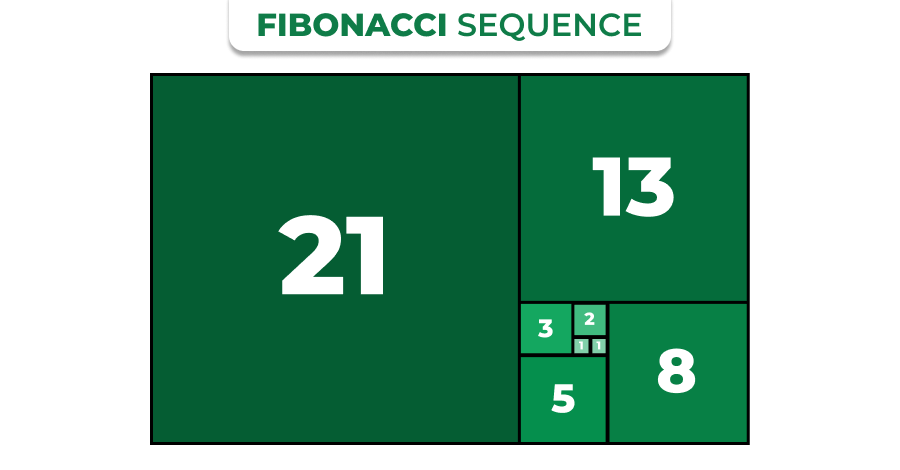
The Fibonacci Sequence in roulette is a sequence in which each number is the sum of the two preceding numbers in the sequence. The system occurs in nature, for example, in the way the curve of a Nautilus snail shell develops, or flower petals expand and grow.
Here is a simple example of the Fibonacci Sequence, showing the first eight numbers of the sequence in an expanding array of tiles.
How the Fibonacci Sequence is Used in Roulette Betting
Let’s use a simple example to help you get started. It’s easy and straightforward.
- You start with an initial bet of $1.
- If you win, you continue to bet $1 until you lose.
- Once you lose the first bet, you continue with the Fibonacci Sequence, making the second bet of $1.
- If that loses, you then add the first two losing bets together, and bet $2.
- Then add the previous two bets together and the sum becomes the next bet - $2 + $1 = $3.
- And then the next bet is $3 + $2 = $5.
- And then the next bet is $5 + $3 = $8.
- And as you continue to lose, you keep betting the sum of the previous two bets.
- At any point when you win, you go back two bets in the sequence.
- So if you win the $8 bet, you would go back past the $5, and settle on the $3 bet.
- And start again from there.
So, what does this mean?
As you can see, the Fibonacci does an excellent job of protecting your bankroll.
In the example above, even with a 5-loss streak, you came out with only a $4 loss.
Let’s take a look at how the Fibonacci performs with a losing streak, a winning streak and a choppy, back and forth streak
| Hands win/loss | Bet Value | Bankroll (Start at $100) |
|---|---|---|
| Loss | $1 | $99 |
| Loss | $1 | $98 |
| Loss | $2 | $96 |
| Loss | $3 | $93 |
| Win | $5 | $98 |
| Win | $2 | $100 |
| Loss | $1 | $99 |
| Loss | $2 | $97 |
| Final Result | $3 lost | End Bankroll: $97 |
Now, let's see the winning streak results:
| Fibonacci System - Winning Streak | ||
|---|---|---|
| Hands win/loss | Bet Value | Bankroll ($100) |
| Win | $1 | $101 |
| Win | $1 | $102 |
| Win | $1 | $103 |
| Win | $1 | $102 |
| Win | $1 | $103 |
| Win | $1 | $104 |
| Win | $1 | $105 |
| Win | $1 | $106 |
| Final Result | $6 won | End Bankroll: $106 |
And here are the win/loss streak results:
| Fibonacci System - Even number of wins and losses | ||
|---|---|---|
| Hands win/loss | Bet Value | Bankroll |
| Win | $1 | $101 |
| Loss | $1 | $100 |
| Win | $1 | $101 |
| Loss | $1 | $100 |
| Win | $1 | $101 |
| Loss | $1 | $100 |
| Loss | $1 | $99 |
| Win | $2 | $101 |
| Final Result | $2 lost | End bankroll $101 |
Roulette Fibonacci vs Martingale
Let’s take a look at the Martingale System and compare it to the Fibonacci System.
As you know, the Martingale is a negative progressive system where you double your bet every time you lose.
Ultimately, you will find yourself with a very large bet, and you will be betting that large amount to win the same amount as your very small first bet – usually just one unit.
The Fibonacci looks a little more complicated than the Martingale, but it’s really quite simple when you take a closer look.
Comparison of Fibonacci and Martingale Systems in Roulette
The Fibonacci has a much gentler slope to it.
If you were to start with a $1 bet - after a 10-bet losing streak of the Fibonacci, you would have lost $143.
| Bet | Outcome | Profit |
| $1 | Lose | -$1 |
| $1 | Lose | -$2 |
| $2 | Lose | -$4 |
| $3 | Lose | -$7 |
| $5 | Lose | -$12 |
| $8 | Lose | -$20 |
| $13 | Lose | -$33 |
| $21 | Lose | -$54 |
| $34 | Lose | -$88 |
| $55 | Lose | -$143 |
| $89 | Lose | -$232 |
| $144 | Win | -$144 |
And starting with the same $1 bet - after a 10-bet losing streak of the Martingale, you would have lost $1,023.
| Bet | Outcome | Profit |
| $1 | Lose | -$1 |
| $2 | Lose | -$3 |
| $4 | Lose | -$7 |
| $8 | Lose | -$15 |
| $16 | Lose | -$31 |
| $32 | Lose | -$63 |
| $64 | Lose | -$127 |
| $128 | Lose | -$255 |
| $256 | Lose | -$511 |
| $512 | Lose | -$1,023 |
| $1,024 | Lose | -$2,047 |
| $2,048 | Win | +$1 |
And the further you get into the sequence, the greater the disparity between the two becomes.
Clearly, and as you can see, you need a much bigger bankroll to play the Martingale than the Fibonacci, and the Martingale can get you into really deep water very quickly.
The Martingale requires a large bankroll to stay afloat, and inevitably, you may hit the table maximum before you have the opportunity to get out.
And that’s what makes the Martingale so dangerous – you can quickly run out of money before you have the opportunity to hit the one bet that is going to get all your money back in one fell swoop.
| Strategy | Advantages | Disadvantages |
|---|---|---|
| Fibonacci |
|
|
| Martingale |
|
|
Scenarios Where One System May Be More Effective
As with all systems, there is no guaranteed way to win.
The House Advantage on a European (single zero) wheel is 2.7%, so the Return To Player (RTP) is 97.3% on this game.
On an American wheel, it is 5.26%, and with an RTP of 94.74%, always try to play on a single zero wheel.
(Oh – and avoid the triple zero wheel like the plague – it is absolutely not your friend with a House Advantage of 7.69% - so has an RTP of only 92.31% - Ouch!).
Heads up
Both the Fibonacci and the Martingale are negative progressive systems, and ultimately the Fibonacci does a better job of protecting your bankroll than the Martingale.
The Martingale doubles your bet with every loss, and ultimately you will end up with a massive bet and will only win the equivalent of your first bet.
So, for example, you may find yourself betting $2,048 to win $1.
Hardly appetizing, is it?
And you may have already run into the table maximum or run out of money – because to get to that $2,048 bet, you would have already lost $2,047. Which means that your bankroll would have to be $4,095.
Given the same numbers and the same number of losses in a row (11 losses in a row), you would have lost $232 using the Fibonacci system, and your next bet would be $144.
Which would require a bankroll of $376 – a lot more accessible for the average retail player than the Martingale’s required bankroll of $4,095.
Common Mistakes of Using the Fibonacci Strategy
The Fibonacci is a very simple system, and the only real downside is if you make a mistake with the mathematics. And the math is always simple addition.
Practical Steps to Implement the Fibonacci System in a Casino or Online Roulette
Here's how to put this strategy to good use. Follow the steps and you'll get the hang of it very easily.
- Decide how much your session bankroll is going to be.
- Let’s say it’s $100, divided into 100 units of $1 each.
- And then just start betting with the first number of the sequence, the first of the $1 bets.
- If you win, you keep betting the $1.
- If you lose, you go to the next bet in the sequence, which is the second $1 bet.
- And if that loses, you go to the next bet, which is the $2 bet.
- And then keep going.
Managing Bankroll and Betting Limits with the Fibonacci System
The system is perfect for protecting your bankroll. It mitigates your risks, but by doing so, it also limits your ability to hit a big win.
My two cents
It’s ideal for the player who wants to play for a couple of hours, without risking too much money.
The only downside is if the player runs into a very long losing streak – say more than 10 or 11 losing events in a row.
The Fibonacci is not recommended for long-term use – because the longer the losing streak goes on, the bigger the numbers get. So the bankroll protection it offers is limited to short-term streaks, say of less than 5 or 6 losses in a row.
Apart from that, it offers the opportunity to play for a long time with minimal losses.
Reverse Fibonacci Sequence Roulette
The Reverse Fibonacci is exactly the opposite of the Fibonacci System.
Instead of being a negative progressive, it becomes a positive progressive.
Which means that every time you win, you increase your bet up to the next number in the sequence.
Like this:
1 1 2 3 5 8 13 21 34 55 89 144 233 377
As you can see, the numbers of the Reverse Fibonacci Sequence are identical to the regular Fibonacci Sequence, but it is a positive progressive system instead of a negative progressive one.
The Reverse Fibonacci isn’t as safe a system as the regular Fibonacci system, but it does offer the opportunity to ride a winning streak to greater winnings than the regular system.
And it really does come down to each player’s risk profile.
Many players want to play for a couple of hours with minimal risk, so opt for the regular Fibonacci because it offers minimal bankroll risk.
Other players will prefer the Reverse Fibonacci because you can win more, but it comes with the associated additional risk.
Examples of Bets Using the Reverse Fibonacci Sequence
- The first bet is $1 and when you win, you get paid $1.
- There is zero surplus.
- The next bet is $1. When you win, you get paid another $1.
$1 surplus
- And your next bet is $2.
- And if you win, you get paid $2.
$2 surplus.
- And your next bet is $3, and if you win, you get paid $3
$3 surplus.
- And your next bet is $5. And if you win, you get paid $5.
$5 surplus.
- Your next bet is $8. And you get paid $8.
$8 surplus.
- And your next bet is $13.
- And if you win, you get paid $13.
$13 surplus.
- And your next bet is $21. And if you win, you get paid $42.
$21 surplus.
And so on, and so on.
And you continue to get a small bonus payout every time you win.
What’s fascinating to me is that as you continue to win, your surplus winnings follow the Fibonacci Sequence, too!
The Fibonacci Strategy in Roulette - Final Thoughts
Given the choice between the Fibonacci System and the Martingale System, the Fibonacci offers a better choice for the player in that it requires a much smaller bankroll to be competitive, and it has a significantly smaller risk profile than the Martingale System.
 3
3 0
0 Thank you for voting.
Peter Nairn
Liliana Costache
Explore More Roulette Guides


Roulette Q&As





 Level 6
Trying to turn $0.40 into $40.00, any advice?
Thanks!
 5 Need Answer
 8 Answers


 Level 3United States
No problem, just asking for some advice as to what game should I play.
5 Need Answer3 Answers

 Level 433 Need Answer6 Answers
 Accepted answer