


 Casinos
 Bonuses


A Day in the Life of a Roulette Dealer: Learn About the Man Behind the Wheel

Peter Nairn
Casino Operations Specialist

- Over 3 decades of experience in casino operations management, with a focus on Table Games and Slots;
- Senior executive positions in both Native American and traditional casino markets for companies like Harrah’s New Orleans and Minnesota-based Grand Casinos;
- Hands-on experience as trainer and dealer of multiple casino games including: Blackjack, Roulette, Craps, and more;
- Profound knowledge of Title 31 regulations, State compacts, and Federal MICS.

Carol Zafiriadi
Senior Content Writer
- Specialised in video poker, table games, RNG, land-based casinos, and promoting responsible gambling;
- Over 6 years of experience in presenting and analyzing the latest trends and innovations in the world of gaming and tech;
- BA in English and German Language and Literature and MA in Literary Translation, both from the University of Bucharest, resulting in sharpened critical thinking and quality iGaming content.
 0%
0% 25 min
 Updated on Oct 25, 2024
Today, we’re going to do a deep dive into what it takes to be an actual roulette dealer in a casino. There is a lot more to it than you would think.
Each casino has a set of policies and procedures that must be followed. They have been developed and written to make sure the games are being dealt in accordance with the rules the
casino has reported to the regulators.
What is the difference between Policy and Procedure?
Policy is what we do; Procedure is how we do it.
The dealer must follow the procedures very closely. There is no ‘wiggle room’, and certain procedures are a ‘must have’, never a guideline.
The short version of ‘how to be a dealer’ is make sure the supervisor and the camera can clearly see what you’re doing, and to follow procedures carefully.
What Is a Roulette Dealer?
A roulette dealer is a casino employee who is responsible for running a live roulette game in a land-based casino.
Their job is to run the game in accordance with the casino’s policies and procedures, to manage the players’ bets and payouts and to ensure the game is run with integrity and fairness for the casino and the players at all times.
Roulette is a fun game to deal, and requires solid mental arithmetic skills, some patience and the ability to create a friendly and welcoming environment, working with many different player personalities.
Interacting With Live Roulette Dealer vs. Land-based Roulette Dealer
There are several videos on YouTube that will give you an overview of what the dealer’s function is in ‘Live Dealer’ roulette online.
All the dealer does is spin the ball and mark the winning number with the dolly.
Being the dealer in ‘Live Dealer Roulette’ must be the world’s most crushingly boring job.
What was interesting to me was that the few I saw on YouTube weren’t very good at spinning the ball.
There is a technique to it that they simply had not mastered. It’s entirely possible that they may have been recruited without any real roulette dealer experience or skills.
Which is fine, because the computer in a ‘Live Dealer’ game calculates all the payouts, deposits their winnings in their bankrolls, and exchanges the cash for the players buying in and so on.
Buckshot Roulette
Oh, and while we’re talking about ‘no roulette dealer experience’, a quick word about ‘Buckshot Roulette’.
Buckshot Roulette is a video game that has nothing to do with actual roulette as played in a bricks and mortar or online casino.
Buckshot Roulette is a video game. It is a strategy game.
It was developed by Mike Klubnika and was released on Steam in April 2024. In short, it’s like a game of Russian Roulette but it’s played with a shotgun, not a revolver.
Some of the shotgun shells are live rounds, and some are blanks, but you don’t know which is which until you pull the trigger.
The game has two players – you and your antagonist, who is called ‘The Dealer’. The object of the game is to win by ‘killing’ the Buckshot Roulette Dealer.
The only similarity between Buckshot Roulette and actual roulette is the use of the word ‘Roulette’ in the title, and that one of the players is called ‘The Dealer’.
Becoming a Roulette Dealer
During the 1990s and on into the 2000s, I was part of the opening team for Grand Casinos.
Altogether I opened about 15 tribal and traditional casinos, both as the Director of Table Games Training with Grand Casinos, and then as a consultant, working with several tribes to open and operate their casinos in different Western states in the US. It was a great job, a huge amount of work, and I loved doing it.
One of the most interesting parts was working with the different tribal leadership teams. Their goals for their casino weren’t necessarily what one would expect.
After multiple openings, we had created a very efficient opening system.
Here’s how it works for roulette dealers.
Training and Certification
We would offer free training to successful applicants, none of whom had any casino experience.
In fact, most of them had never even visited a casino.
The dealer’s school was set up to have two four-hour classes per day, Monday through Friday.
The training was all done by experienced Pit Managers, who were hired earlier than most Pit Managers to run the dealer’s school. Every Pit Manager who trained a game had solid experience dealing that game.
(Note that they were not Floormen. Please note that they are different titles. And I’m going to say ‘Floormen’ here instead of the clumsy ‘Floorperson’. This is not to denigrate the women who did the job. Most of them were the match of the men, and some were highly skilled, and better than the men they worked with).
Attendance for the students was mandatory for whichever class you were signed up for. You were allowed two unexcused absences. If you had more than that, you were cut from the class.
Once hired, the dealers would make minimum wage, and the tips (tokes in casino jargon) once the casino was open were usually about $15 - $20 an hour.
For the dealers’ school, we hired folks who had a fun and engaging personality, with good eye contact and a friendly, outgoing demeanor.
There was an easy math test that we used to separate out the folks who couldn’t do simple math. They didn’t make it through the interview process.
In short, it was called ‘hire for attitude, train for skill’.
Skills and Qualifications
Those who were good at mental arithmetic, and had fine motor skills in their hands were either put into the craps or roulette class. Everyone else was put into blackjack class.
Roulette class was 10 weeks. Craps was 12 weeks. Blackjack was 8 weeks, and the plan was to have them all graduate one week or so before opening.
What inevitably happened was we had a few ‘rock stars’ who outperformed the rest of the class. In every class, in every opening it was the same story.
The craps rock stars were left in the class and got better. It takes about 6 months for a rookie craps dealer to start getting the hang of the game. After a year or so, they’re getting to be okay.
After about 7 – 8 weeks, some of the roulette dealers were ready to learn their second game.
And most of the blackjack dealers were ready for a second game after 6 weeks of blackjack, too.
So we trained the roulette dealers to deal blackjack, and the blackjack dealers to deal either Mini-Baccarat, or Pai Gow Poker. The ones who were naturals, we trained them on both the other games.
There was an audition process where the trainee dealers were auditioned by a Pit Manager (although never one of the trainers).
Working Environment and Expectations
For the audition, we expected them to be nervous. We expected them to make mistakes.
We expected them to be slow.
What we were looking for was good procedure and the friendly, optimistic personality we had hired.
I never allowed any audition to include a ‘gotcha’ moment.
I remember auditioning for a dice dealer job when I first got to Las Vegas, and the guy auditioning me tried to trick me with a bet. It left a very negative impression with me, and I never forgot it.
If the applicant has good procedure and a good attitude, all the rest comes with experience.
Once the trainees passed the audition, they were ready to go on a live game, but they certainly didn’t know how to deal the game.
Sounds wrong, doesn’t it?
But here’s the analogy.
Remember when you got your driver’s license?
Could you drive? Hardly! But as you drove more and more, you learned how to really drive, and now you can.
But right after you passed your test? Right – not at all.
And it’s the same with dealing roulette, or any casino table game.
Daily Responsibilities of a Roulette Dealer
The most important part is to show up on time, in a clean and pressed uniform, hair neatly combed, and ready to go to work.
Clean hands, nails taken care of, minimal make up, the men freshly shaved and so on.
These are perhaps the most important things to do.
- Making change;
- Spinning the ball;
- Clearing the layout;
- Making up the payouts;
- Protecting the game.
There are a lot more, but those will do for now.
Managing the Game: Spins, Bets, and Payout
The dealer must manage the game. That includes the game speed, making sure the players have enough time to make their bets and that the game runs quickly and smoothly.
The way this is accomplished as follows:
In Europe, the players are free to place their bets once the dealer has cleared the layout and paid the outside bets. Bets on the inside cannot be placed within a street of the winning number until after the dolly has been removed.
In the US, once the dealer removes the dolly, the players are free to place their new bets.
The dealer must strike a balance between the game running at a comfortable speed so that we’re not waiting too long between spins, but also to make sure that the players have enough time to get all their bets down.
Making change (both cash and exchanging chips) is done immediately after the dolly is removed.
The dealer will often be alone on a table, so she is also responsible for ‘mucking’ the chips which lost from the last spin. Mucking means picking up and sorting the multi-colored ‘salad’ that has been swept from the losing numbers.
Having paid out all the winners, the dealer will start mucking the losing chips, and then assess how long the players will take to complete their betting, and how long it will take for the ball to complete the next spin.
He will then spin the ball so there are about 3 revolutions left once all the players have completed making their bets.
It’s a balancing act that experienced dealers seemingly do without too much thought.
Once the ball drops, the dealer will announce the winning number and mark it with the dolly (and that’s sometimes not that easy, because the entire layout is completely covered in chips, so you can’t see the numbers.
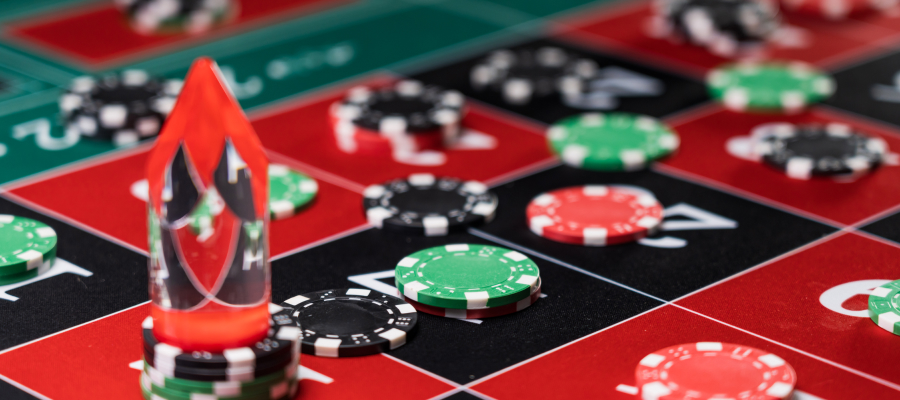
She will then sweep the losing bets, pay the winning bets in a pre-determined order (Winning column, High, Odd, 3rd Dozen, Red, Black, 2nd Dozen, Even, Low, 1st Dozen, then pay the winning number, top chips to bottom, outside in).
It sounds a lot more complicated than it is.
The dealer is responsible for making sure the players have enough chips to bet, and for securing the cash that players have used to buy more chips.
The dealer is also responsible for enforcing the rules of the game in a polite and non-threatening way.
Ensuring Game Fairness and Integrity
Late bets are not allowed, although there is some leeway with that.
Many players like to bet after the dealer has released the ball, and the dealer must strike a balance between game security and guest satisfaction.
Usually, the dealer will call ‘No More Bets’ when the ball has approximately 3 revolutions left before it drops from the track.
Any bets made after that point will usually be politely handed back to the player with a ‘sorry Sir, this one was too late’ comment from the dealer.
Once the dealer has called ‘No More Bets’, he will check the entire layout for bets that are ambiguous. Bets that have been misplaced, for example, in between two betting areas must be correctly placed.
Dealers are trained to move the bet to one location, saying to the player, ‘You wanted this straight up on 17 sir, didn’t you? and immediately moving the bet onto the 17.
If the dealer says, ‘Did you want this on the 17/18 split sir, or straight up on 17,’ by the time the player makes a decision, the ball may have dropped and then it’s too late.
The dealer will hear the ball leaving the track and dropping into the numbers as he watches the layout.
After the ball has dropped into the winning number, the dealer will take a quick look at the columns and the outside bets at the bottom of the layout, then glance into the wheel to confirm the winning number.
Challenges Faced by Roulette Dealers
99.99% of players are totally honest and would never consider doing anything suspect.
Occasionally, players will attempt to cheat, and the dealer must recognize that attempt and deal with it immediately.
Sometimes it’s difficult to tell if the player is simply inexperienced and made a mistake or is really trying to cheat.
Some players come to the casino looking for a confrontation. Some truly believe they’re right even when they are wrong, because they don’t know the game very well.
And the dealer must recognize which it is quickly, and handle the issue with diplomacy and tact.
The supervisor overseeing the game will sometimes make the decision that it’s quicker to give the player a few dollars even though the player is making a wrongful claim.
Why would they do that?
Because in the time it takes to argue about the bet, call Surveillance, wait while they run back the video and determine what happened, we could have had 2 or 3 more spins and won a lot more than the amount the player is claiming.
And after 2 or 3 more spins, where is the $10 the player was arguing about likely to be? cob
That’s right, it’s back in the casino’s bankroll.
Sometimes it’s better for the casino to give the player the $10 they’re claiming, even though we know they shouldn’t be getting it, and keep the game going.
And then the supervisor must calm the dealer down.
Experienced dealers know how this works, but sometimes the less experienced dealers have to be assured that the supervisor knows the dealer was right.
An inexperienced dealer may get upset because if the supervisor agrees with the player, it makes it look like the supervisor thinks the dealer made a mistake.
Sometimes the game is really busy. As in ‘really busy’.
Often the game is dealt by one dealer. Then if it’s a busy game, there may be another dealer mucking cheques to help the dealer.
On a really busy game, there may be two muckers in addition to the regular dealer.
(That’s how I got to learn to deal roulette. At the Playboy Club in London, we often had massive roulette games, and I was borrowed from the craps pit to be the second mucker on a buried game).
The layout might look like this:
But the whole layout is covered like that. It’s referred to as a ‘Manhattan Skyline’.
Mmmm – lots of fun!
It’s actually quite easy to deal a game like this.
Just finish clearing the winning number, follow your procedures, make sure you tell your supervisor what you’re doing (who will be watching you as you pay everything), don’t panic and
you’ll be fine.
Casino Surveillance and Security Collaboration
Dealers have no interaction with Surveillance. Occasionally a floorman may call Surveillance to say they have big action on a game, but there’s almost no interaction between dealers, floormen and Surveillance.
So don’t worry about that at all.
Pit Managers may have some interaction, but it’s usually the Assistant Shift Manager, or Shift Manager that talks to Surveillance.
I always had a good relationship with ‘The Eye’.
Some guys didn’t because they felt that the Surveillance guys were out to get them or throw them under the bus. That was never my view, because it’s simply not true.
They were my backup, making sure no one took advantage of me or the casino.
Whenever a dealer or floorman saw something a bit questionable, it was reported up the chain of command.
A dealer would say something to his floorman as he went on a break It might go like this, ‘the guy in the blue shirt playing the orange cheques may have tried to past post me a couple of spins ago’.
Depending on the reporting structure, the floorman might call Surveillance, but usually she would call the Pit Manager. The Pit Manager would then say, ‘I’ll call the eye, stay away from the game for a few minutes’.
The Pit Manager would then call Surveillance, and they would run the video back, and also watch the game live to see if anything was going on.
Why would the Pit Manager tell the floor to stay away from the game?
Because if the floor is watching the game closely, the potential cheat isn’t going to try anything questionable.
Roulette Dealer Techniques and Best Practices
The ball and the wheel are always spun in different directions. On an American game, the wheel spins counterclockwise on a right-handed table, and the ball spins clockwise.
On a left-handed wheel, the opposite is true.
On a European game, the direction of the wheel is alternated every spin. This is done purposely so the wheel speed is changed between spins.
The dealers must spin the ball forwards and backwards with both hands. There is a technique to spinning the ball – it’s a bit like the finger snap when you’re the coolest guy in town.
The dealers on both the American and European game are told to change the speed of the wheel and the ball speed every spin to ensure a random spin every time.
Sometimes they don’t do it, but the supervisor should remind them.
Chips are always stacked in 20s, so they’re easy to count.
There is a technique to pushing multiple stacks of chips to a player, too. Essentially, it comes down to making sure you are pushing the bottom cheque of each stack, and the rest of the cheques will be along for the ride.
In the US, it is often acceptable to pay bets off individually.
For example
If the winning number has five corners, five straight ups and five splits, it is okay to pay 40 cheques for the corners, then 85 for the splits, and then 175 for the straight ups.
Some dealers would make up the payout by putting 40 cheques, then 85 cheques and then 175 cheques in the dealer’s work area, and then consolidating the payout into 300 cheques before pushing it all out together. Both of those methods take forever and slow the game down a lot.
In Europe, the dealer would make up the 300 total and push it out to the winning player. It would not be okay to do it separately or ‘in installments’.
There is a sense of pride among the dealers that it simply wouldn’t be acceptable to do that.
Dealers are taught how to use ‘picture bets’ as part of their training.
They are a bit of a misnomer, because once you get past one or two chips high, the bet almost never looks like the picture. It is more of a ratio than a picture.
As a player, you may want to learn some of the more common picture bets, because they are easy to use, and you will be able to check and make sure the dealer is paying you correctly.
We also have many articles about the most popular casino table games in our Academy.
They’re written by experts and cover everything you need to know from beginner to expert on how to play the games, the best practices and how to maximize your chances of winning and minimizing your losses. And the best part is they’re all free.
Common Mistakes Made by Roulette Dealers
Dealers are human, and consequently they make mistakes.
As they get more experienced, the mistakes get fewer and fewer, but they’re still susceptible to making mistakes.
The most common mistakes that roulette dealers make that I’ve seen are:
- Marking the wrong winning number, especially on a very busy game where it’s difficult to see the numbers because there are so many chips on the layout.
- Another area to watch carefully is when the dealer is making a big payout which includes a mix of the player’s non-value color and value chips. Because they represent different amounts per chip, dealers sometimes can confuse the exchange rate and include the wrong amount of value cheques.
- Occasionally, a dealer may miscalculate the amount a player should get paid for a winning bet, particularly on a very big game.
- Giving the wrong amount of chips for a cash buy-in does happen once in a great while.
One of the coolest things I’ve ever seen on a live game in a casino.
This happened on a roulette game at the Playboy Club, and the supervisor averted a disaster.
Let’s call him ‘Malcolm’ – because that was his name!
It was a massive game, the layout completely covered in what we referred to as a ‘Manhattan Skyline’.
There were three dealers on the game. I was one of the two dealers mucking cheques on the game and just as the mistake was discovered, the players were all up in arms about the mistake.
The dealer had marked and cleared the wrong number. Malcolm immediately stepped up to the table, holding a small sheaf of papers.
‘Don’t worry folks, I’ve got it all here. Everyone’s going to get paid correctly’.
And he then proceeded to tell the dealer to pay the players one at a time, while referring to the top sheet of the papers in his hand.
Mr. G, with the blue cheques gets 342. Ms Dolly, with the orange cheques, she gets 477, and went around the table, paying all the players.
What the players couldn’t see was that the sheet of paper he was referring to was completely blank.
I noticed that he was paying the players more than they should have been paid based on their typical bets. And of course, they knew they were getting paid more generously than they should have been, so they never said a word and just accepted their payouts.
It was a thing of beauty.
I had been dealing craps for about a year at that point, and it was definitely a big learning experience for me.
Sometimes people try to cheat. It’s a fact of life in a casino
And usually, the dealer or supervisor will see it and correct it immediately, always giving the player the benefit of the doubt the first time.
Go here to read our ‘How People Cheat at Roulette Guide'.

Ethical Considerations for Roulette Dealers
Almost everyone I ever worked with in a casino was as honest as you can imagine.
Perhaps one employee in a thousand might try to cheat the casino, but inevitably, they would get caught and taken out in handcuffs.
I don’t think I ever ran into a casino employee who tried to cheat a player. As far as honesty goes, there is a sense of community among the employees in a casino.
Everyone has a license, because they couldn’t work there if they didn’t, and it’s simply not acceptable to consider cheating in any way.
Of course, the one in a thousand was always a shock. The boxman who took $500 cheques off the crap game under his wristwatch.The break-in dealer who paid pushes and didn’t take losing bets for her accomplice on a blackjack game and told us she was making mistakes because she wasn’t very well trained.
Or the shift manager who ran a marker scam with his outside accomplice and took a few thousand from us before he was arrested.
And the thieving dealer who made me laugh out loud
He stole cheques from our blackjack games for a couple of years, and about a year after he got out of jail, he sent us a letter asking for his job back as he was having trouble getting a job.
He promised he wouldn’t do anything illegal again. He had a sense of humor, that one.
Bias and Favoritism
Just as in any other business, there is always the possibility of running into favoritism and bias.
It was the same in the traditional casinos and the tribal casinos I worked in.
Sadly, that’s just the way it is.
What it does is make your organization less effective. It reduces the morale of your entire crew, and unless you stamp it out as soon as you see it, you can lose some very high potential junior staff who won’t stick around once they’ve been passed over for someone not as qualified as them.
Importance of Confidentiality
Quite often when there is a big player on the retail floor, some spectators will watch the game, once they realize how much he is betting. And sometimes, he appears to be winning.
A typical example is a guy who was playing at Harrah’s in New Orleans when I was a Shift Manager there. He was betting three hands at $2,000 to $3,000 a hand and played for a few hours.
At one point, he had over $200,000 in front of him. The spectators would ask the dealer or floorman, ‘How much is he winning, or ‘Who’s that guy?’.
And we always told them to respond with ‘I don’t know’. Because in this particular case, I knew the guy had lost almost half a million the previous day.
So while it appeared that he was winning a lot, in fact he was still losing hundreds of thousands of dollars.
And who was he? He was (and probably still is) the owner of a large frozen seafood company. If you live in the USA, you’ve almost certainly eaten his frozen fish, and you’ve definitely seen his ads on television.
But we always tried to maintain the confidentiality of our players.
Do Roulette Dealers Cheat?
No they don’t. It really doesn’t make any sense at all, and even if they could, they don’t. You can read more in your guide that discusses whether the roulette is rigged or fair.
The real concern from the players is if the dealer can cheat them. I suppose a dealer could if she wanted to. She could underpay them, or sweep a winning bet, but why would she do that?
There is no financial gain for the dealer if they do that. Dealers get paid the same whether the casino wins or loses.
And in the US, dealers live on their tips. And the only people who tip are those who are winning.
The reality of the situation is if a dealer is capable of cheating in front of a table full of players who are watching them like hawks, he’s going to cheat the casino, not the players.
And the unspoken part of the question is ‘And get away with it’.
And as you will see in the ‘Is Roulette Rigged’ article, it simply doesn’t make any sense for a dealer to cheat the players.
Conclusion
So, there you have it.Dealing roulette is a lot of fun. It requires strong mental arithmetic skills, the ability to handle the cheques quickly and accurately, and also being able to manage some strong personalities in a high-pressure situation with alcohol flowing and money at stake.
As a player, seeing the dealers’ training manual in the Appendix of this guide will help you understand what the dealer is expected to be able to do, and the limitations that are placed on her as she’s working.
I loved dealing roulette. It is a challenging game but with knowledgeable players and a good supervisor, you can have a lot of fun. The Bunny Colette, my sponsor at the Playboy Club who taught me the game was really good. I didn’t realize just how good she was until I’d been dealing long enough to appreciate what she knew. So many thanks to her.
And good luck to you.
 0
0 0
0 Thank you for voting.
Peter Nairn
Carol Zafiriadi
Explore More Roulette Guides


Roulette Q&As





 Level 6
Trying to turn $0.40 into $40.00, any advice?
Thanks!
 5 Need Answer
 8 Answers


 Level 3United States
No problem, just asking for some advice as to what game should I play.
5 Need Answer3 Answers

 Level 433 Need Answer6 Answers
 Accepted answer