


 Casinos
 Bonuses


How to Buy Crypto for Casino Deposits: A Beginner's Guide

Vlad Mihalache
Online Gambling and Crypto Casinos Specialist


- Accomplished content strategist and editor with over 8 years of experience in the iGaming industry;
- Certified Cryptocurrency Expert (CCE);
- Specializes in blackjack strategies, slots, crypto casinos, and gambling addiction;
- Bitcoin casino expert with extensive knowledge of crypto trading and blockchain gaming;
- Online gambling expert with 7,000+ articles written and reviewed;
- Strong advocate for responsible gambling with complex knowledge of the latest trends;
 100%
100% 11 min
 Updated on Oct 12, 2026
To buy crypto for casino deposits, the fastest option is a centralized exchange, which takes 5-30 minutes once you've verified your identity. The peer-to-peer route skips KYC, but costs 3-8% more.
You've decided to try a crypto casino. The bonuses look better, the withdrawals are faster, and you can skip KYC at many platforms. There's just one problem: you don't own any crypto yet.
Below, I will walk you through buying crypto specifically for casino deposits. I'm not going to teach you portfolio strategy or long-term investing here. I'm going to get you from fiat in a bank account to crypto in a wallet ready to deposit in the shortest, cheapest path possible.
Key Takeaways
- For most beginners, a centralized exchange like Coinbase or Kraken is the fastest option, with verification taking 5-30 minutes;
- To skip KYC entirely, peer-to-peer markets and Bitcoin ATMs work but cost 3-8% more on average;
- Buy a small test amount first, send it to your wallet, then top up only after you've confirmed the full flow works;
- Stablecoins like USDT and USDC protect your deposit value from price swings during the deposit process;
- Network fees vary wildly. USDT on Tron costs around a dollar. Ethereum mainnet can cost $10-30 during peak times.
How to Buy Crypto for Casino Deposit (the Short Version)
Starting from zero, here's the path that works for nearly everyone.
- Sign up for Kraken or Coinbase, whichever is available in your country;
- Verify your identity. Have your passport ready, the process takes 5-30 minutes, including the selfie check;
- Deposit fiat via bank transfer (cheaper) or debit card (faster);
- Buy USDT or USDC depending on what your target casino accepts. The full fiat to USDT conversion walkthrough covers each exchange's quirks if you want the deeper steps;
- Set up a self-custodial wallet. MetaMask casinos work for most networks;
- Withdraw $20 to your wallet first as a test;
- Send the test amount to the casino. Confirm the deposit lands.
- Top up your bankroll only after the test deposit succeeds.
For ongoing deposits, you'll save time by keeping a small balance in your wallet rather than re-buying every session. If you're playing at SOL casinos or BNB gaming sites, the same logic applies: buy on the cheapest network, test small, then top up.
Be aware
The test deposit step is the one beginners skip and regret. From my experience, sending $500 directly without testing is how people lose money to typos or wrong-network deposits.
What Crypto to Buy: Choose Before You Spend
The single most expensive mistake beginners make is buying the wrong crypto for their target casino. Bitcoin is supported by most crypto casinos, but it's slow and can get expensive during network congestion. Stablecoins are usually the smarter choice for gambling.
There are 3 rules that help you pick the right crypto asset consistently:
1. If the Casino Accepts Stablecoins, Use Them
Your deposit value stays fixed at $100 regardless of what the market does in the next 20 minutes. USDT on the Tron network has the lowest fees and fastest confirmations, and most major casinos accept it.
My recommendation
See USDT crypto casinos for platforms that support it natively, or my stablecoin explainer for why they work so well for gambling specifically.
2. Check for Lightning Network Support
On Bitcoin gambling sites, Lightning means near-zero fees and instant deposits. On-chain Bitcoin is fine but plan for $1-5 in network fees and 10-60 minute confirmations.
Lightning-friendly platforms are available at most fast payout crypto casinos.
3. Use Layer 2 like Base, Arbitrum, or Optimism (If Available)
Ethereum casinos are well-known for being more expensive. But that doesn’t mean you should avoid them entirely. Let me explain how Layer 2 comes into play.
Fees on Layer 2 are usually under $0.10. Mainnet Ethereum can hit $15-30 per deposit during peak times, which is brutal for smaller amounts.
The asset matters more than the casino at this stage. A great casino with a $25 deposit fee will lose to a mediocre casino with a $0.50 fee on your bankroll over time.
If you're stuck between Bitcoin and Ethereum specifically, our Bitcoin vs Ethereum for casino deposits guide weighs the trade-offs side by side.
How Do You Buy Crypto for a Casino Deposit?
There are four routes that get you from fiat to crypto: a centralized exchange, a peer-to-peer market, a Bitcoin ATM, or a direct on-ramp service.
Each method comes with different fees, speeds, and KYC requirements. The right choice depends on what you prioritize: cost, speed, or privacy.
Method 1: Centralized Exchanges (Easiest)
The most common path. You sign up, verify your identity (passport or driver's license plus a selfie), connect a bank card or transfer, and buy crypto in a few clicks. The major exchanges that work well for casino-bound buyers are listed below.
Coinbase
Coinbase is the best for first-time buyers. Clean interface, supports debit card buys (high fees, around 4%), and bank transfers are cheaper at roughly 1.5%. Withdrawal to external wallets is straightforward. Available in the US, EU, UK, and most of Latin America.
The catch is that Coinbase hides a 0.5-2% spread inside the displayed price on its consumer interface. Switching to Coinbase Advanced (the pro version on the same account) gets you the actual market rate with lower fees, around 0.4% per trade.
My experience
Most beginners stay on the main interface and pay the spread without realizing it.
Kraken
Kraken has lower fees than Coinbase (around 0.16-0.26% taker fee), more crypto options, slightly more technical interface. Strong reputation, no major hacks in over 12 years of operation. Strong choice for US-based and EU users alike.
Funding options include SEPA bank transfer for EU users (free, takes 1-2 business days) and Fedwire for US users. Withdrawals to external wallets are processed within minutes for most assets.
Binance
Binance is the largest by volume globally, with the lowest fees (around 0.1%), but availability varies by country. US users get the limited Binance.US version, which has fewer assets and slightly higher fees.
European users get full Binance with broader asset support, including direct USDT-Tron withdrawals at a $1 fee. If your country supports full Binance, it's usually the cheapest option for high-volume buying.
Pro tip
If you’re on Binance already, BNB casinos are quite popular, so you can start wagering right away using the platform’s native token.
Bitstamp
Bitstamp is a veteran European exchange, regulated, with slightly higher fees than Kraken but a strong non-US choice if you're based in the EU.
Bitstamp's strongest selling point is its track record: founded in 2011, no major security incidents, consistently regulated across multiple jurisdictions. For risk-averse buyers who prioritize exchange reliability over fee optimization, Bitstamp wins.
Important
The pattern for all of these is the same: deposit fiat, buy crypto, withdraw to your wallet. The crypto sitting on the exchange is technically the exchange's, not yours, until you withdraw it. Always withdraw before depositing at a casino.
Withdrawal fees vary by asset and network. Bitcoin off Coinbase costs $1-2. USDT on Tron is usually under $1. USDC on Base or Arbitrum is often under $0.50. Check the fee before withdrawing because some networks like USDC on the Ethereum mainnet can cost $5-15.
Method 2: Peer-to-Peer Markets (No KYC Path)
To avoid identity verification, peer-to-peer is your route. Three main platforms worth knowing.
Binance P2P still requires a Binance account, but you can buy directly from another user without exchanging fiat through Binance itself. Some sellers accept cash deposits, bank transfers, or even gift cards. Prices are 1-3% above market.

Sellers carry reputation scores, and Binance holds the crypto in escrow until you confirm payment, so the counterparty risk is low.
HodlHodl runs no central custodian. You and the seller agree on terms, the crypto sits in a multisig escrow until payment confirms, then it is released. Yes, it is slower, but fully non-custodial and Bitcoin-focused.
Bisq is the most extreme option: a fully decentralized P2P exchange running over Tor, with no central servers and no KYC ever. The learning curve is steep but for serious privacy users, it's the gold standard.
My advice
P2P works well when your destination is a no-KYC casino, because the entire chain stays outside regulated KYC databases. The trade-off is convenience. Expect to spend 15-45 minutes per trade, with slightly higher prices for accepting privacy-preserving payment methods.
Method 3: Bitcoin ATMs
You walk to a machine, insert cash, scan your wallet QR code, and receive Bitcoin (or sometimes Ethereum or Litecoin). No bank account, no ID for small amounts in some jurisdictions.

The catch is brutal fees. Bitcoin ATMs typically charge 8-15% above market price. For a $100 buy, you're paying $108-115. For occasional small purchases where privacy matters more than money, fine. For regular casino deposits, this method drains your bankroll.
Pro tip
CoinATMRadar lists locations globally if you want to check what's near you. Some ATMs accept small amounts (typically $100-300) without ID. Anything above usually triggers verification.
Method 4: Direct On-Ramp Services
Services like MoonPay, Ramp, and Transak let you buy crypto with a card and have it sent directly to your wallet, without an exchange account.

Fees are higher than with CEXs (typically 3-5%), but the experience is smoother for total beginners. Some crypto casinos integrate these on-ramps directly into the deposit flow. You enter your card details, and the crypto lands in your casino balance straight away.
This works, but it's not ideal. I sometimes use it for convenience, but the fees rarely justify it. You pay a premium, and the on-ramp still does KYC. Use it as a fallback if the CEX route isn't available in your country.
How Do the Fees for Buying Crypto for Gambling Compare
Let’s have a look at the fees for the different ways to buy crypto:
| Method | Free Range | Time | KYC Required |
|---|---|---|---|
| Coinbase (bank transfer) | 1.5% + spread | 5-30 min | Yes |
| Kraken (bank transfer) | 0.16-0.26% | 10-60 min | Yes |
| Binance (bank transfer) | 0.1% | 10-60 min | Yes |
| Binance P2P | 1-3% above market | 15-45 min | Light KYC |
| HodlHodl | 0.5% protocol + spread | 30-90 min | No |
| Bitcoin ATM | 8-15% | 5 min | Often none for small buys |
| MoonPay / Ramp | 3-5% | 5-15 min | Yes |
Common Mistakes with Crypto That Cost Real Money
From my experience, a handful of mistakes account for most beginner losses during the buying and depositing process. These include:
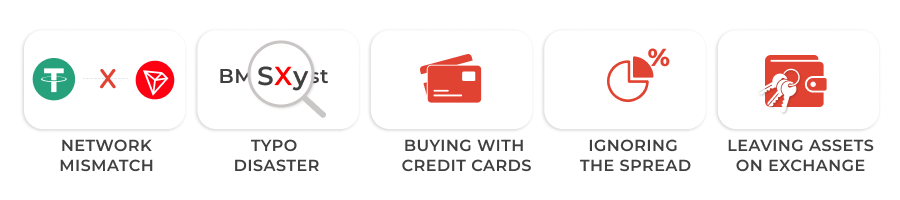
Choosing the Wrong Network Is the Worst One
Sending USDT-ERC20 to a USDT-Tron deposit address (or vice versa) usually means lost funds. Always match the network exactly. The asset name on the exchange and the casino has to match, and so does the network.
Some recovery is possible if the casino runs both networks and can manually credit, but expect support tickets, KYC requests, and a 50/50 chance of getting your funds back.
Mistyped Address Kills the Funds Permanently
One wrong character and the money is gone. Always copy-paste, then verify at least the first four and last four characters before sending.
Hardware wallets like Ledger or Trezor display the destination address on the device itself, which adds a second verification layer that catches clipboard hijackers.
Buying with a Credit Card Costs More Than You Think
Most credit cards charge crypto buys as cash advances, adding 3-5% on top of the exchange fee. Use a debit card or bank transfer instead. Some banks block crypto purchases entirely, particularly in the UK and parts of the EU, so test with a small amount before planning around it.
Ignoring the Spread Is Another Quiet Drain
Coinbase's main interface hides a 0.5-2% spread inside the displayed price. Kraken and Binance show this more transparently. If you're buying often, the spread alone can cost more than the exchange fee over a few months.
Sitting on the Exchange Too Long Is a Silent Risk
Crypto on a centralized exchange is technically the exchange's, not yours. FTX customers learned this the hard way in November 2022. The rule is simple: buy, withdraw, deposit. Don't park a balance on the exchange between sessions.
Closing Thoughts: What Is the Best Way to Buy Crypto for Gambling?
For most players, the path to buy crypto for casino deposits is straightforward: Kraken or Coinbase, buy USDT or USDC, withdraw to a self-custodial wallet, deposit at the casino. The whole flow takes 20-40 minutes the first time and 2-5 minutes thereafter.
For privacy-focused players, peer-to-peer via Binance P2P or HodlHodl, paired with a no-KYC casino, keeps the entire chain out of any single regulated database. Expect to pay a 2-3% premium for that privacy.
For high-volume players, Binance (where available) plus stablecoin withdrawals on Tron or Base is the cheapest combination, often clearing under $1 per deposit cycle once you're set up.
Final recommendation
Browse our vetted list of crypto casinos once you've set up your wallet. The complete crypto gambling guide covers everything from there.
 1
1 0
0 Thank you for voting.
Vlad Mihalache
Explore More Crypto Gambling Guides




Crypto Gambling Q&As
Got questions about Crypto Gambling?
Ask a Question