


 Casinos
 Bonuses


Poker Bankroll Management: Your Guide to Sustainable Play

Ashley Adams
Professional Poker Player


- Author of 3 poker strategy books, including "Winning Poker in 30 Minutes a Day" (D&B Poker, 2020) and Winning No-Limit Hold’em;
- Over 5 decades of playing poker, starting in 1963 and turning pro in 1993;
- Prolific poker writer with over 1,000 poker articles to his name for well-known publications like 888 and PokerNews;
- Has played poker in all 50 US States and 27 countries;

Vlad Mihalache
Online Gambling and Crypto Casinos Specialist
- Accomplished content strategist and editor with over 8 years of experience in the iGaming industry;
- Certified Cryptocurrency Expert (CCE);
- Specializes in blackjack strategies, slots, crypto casinos, and gambling addiction;
- Bitcoin casino expert with extensive knowledge of crypto trading and blockchain gaming;
- Online gambling expert with 7,000+ articles written and reviewed;
- Strong advocate for responsible gambling with complex knowledge of the latest trends;
 100%
100% 23 min
 Updated on Jun 02, 2026
Dive into the essentials of protecting your stakes in our complete Poker bankroll management guide. Are you ready?
Want to keep playing poker without going broke? Managing your bankroll the right way is key! In this video, poker expert Ashley Adams breaks down the must-know tips to help you stay in the game. Check it out below, and use the timestamps to jump to the parts that interest you most!
In this written guide, pro player Ashley Adams seeks to help you answer the following questions and curiosities:
- What is Poker Bankroll Management?
- How to Manage Your Bankroll in Poker
- What Happens When You Play Poker for A Living
- The Importance of Discipline and Emotional Control in Poker Bankroll Management
- 8 Pro Tips for Managing Your Bankroll Efficiently
- 6 Factors that Affect the True Size of the Game Other Than Stakes
These simple questions often lead to some very complicated answers. I’m going to try to keep things simple.
Let’s start with some definitions.
What is Poker Bankroll Management?
Bankroll management in poker is the process of protecting and building your poker bankroll. It seeks to ensure that the vagaries of chance do not cause you to go broke.
It helps you find the appropriate game to play based on how much money for poker you have. Looked at another way, bankroll management answers the question of how much money you need to properly play poker at a particular level.
Now, there are some additional terms associated with proper bankroll management, which I will discuss below:
Scared Money

There is a poker truism, “Don’t play with scared money.” It’s meaning is fairly obvious.
You don’t want to play in a game where the stakes are so high that they make you nervous, preventing you from playing your best game.
While there are some limited exceptions to this truism, it’s generally correct.
You don’t want to play poker with scared money.
This is true for two reasons:
- First, you’re probably scared for a reason. It is dangerous to your overall financial health to be gambling with so much money that it makes you scared. For reasons of personal financial safety, you are best to avoid gambling that large.
- From the perspective of poker playing, such fears may chill the appropriate aggression you should be using to win. Playing with scared money may cause you to play in a way that is other than optimal, as you are cowed into timidity and passivity, checking and calling when you should be betting and raising.
Risk of Ruin

There is another poker bankroll phrase of which you should be aware: risk of ruin. This is the risk that you will go broke, losing your poker bankroll, rendering you unable to play poker at all, for lack of funds.
Your risk of ruin increases the higher the ratio of the stakes you are playing is to your total bankroll.
If you are playing with a high percentage of your poker bankroll you have a high risk of ruin.
For example
If you are a tournament player with $10,000 set aside for playing poker, you have a nearly 100% risk of ruin if you put it all into one $10,000 tournament.
Even if you were the best poker player in the world, you’d have a very small shot at the prize money; and, having spent the entire bankroll on this one tournament, you’d be left without the means with which to enter another tournament.
Compare this to playing in $100 tournaments with that same $10,000 bankroll.
In this case you’d have a bankroll that could fund 100 such $100 tournaments – giving you numerous opportunities to make money and avoid ruin.
If you were a better than average tournament player, and if the rake were not too high, you would have a reasonable chance of making money before you ran out of money.
Similarly, with that $10,000 you’d have a much greater risk of ruin if you entered a $100/200 cash game instead of a $1/2 game.
All things being equal, you have a greater risk of ruin the greater the percentage of your bankroll you are playing with in any particular tournament or session. The smaller the stakes, the smaller risk of ruin.
Variance
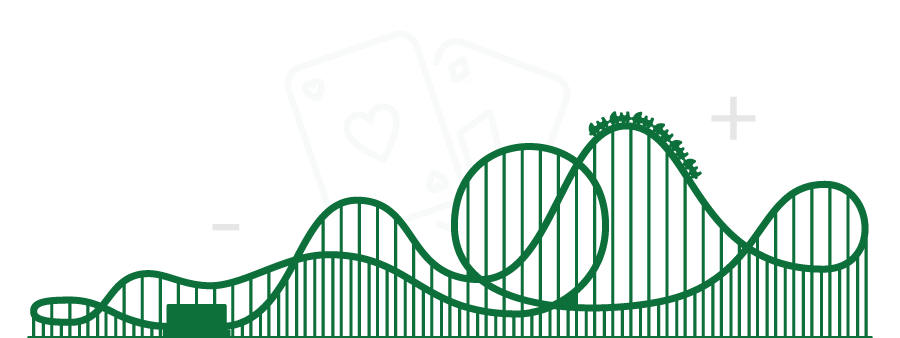
The term “variance”, when it is used in the context of gambling, refers to the winning and losing streaks that can take place when you play.
High variance means the possibility of long and dramatic ups and downs in fortune. When you think of large variance think of a huge roller coaster. Low variance means less likelihood of big swings. Think of the kiddie ride at the local fair.
Pro tip
Variance is best understood by thinking of a graph plotting your wins and losses. Overall, looking at the graph, if you are a winning player, there should be an upward trajectory, as you demonstrate your superiority over time.
There will be ups and downs in the graph, reflecting your wins and losses in individual sessions, even as there is a generally upward direction over time.
Those ups and downs are the variance.
Poker players must make sure that they are able to stay capitalized even with the inevitable downswings in the graph.
Without good bankroll management, an otherwise winning player might be unable to sustain a long downward trend, as it exceeds his poker bankroll.
Even though, theoretically, he may be a winning player, if he doesn’t have enough bankroll, he will not be able to play through the inevitable variance, going broke before the vagaries of chance eventually turn around.
How to Manage Your Bankroll in Poker
Bankroll management cannot overcome losing play.
While poor bankroll management can hurt a winning player’s ability to make money, good bankroll management cannot turn a losing player into a winning player.
In other words, if you are not beating the game, no amount of money management will help you show a profit.
It’s critically important for you to have a clear and simple way of determining whether in fact you are beating the game; or whether your wins are more the product of variance than skill. The key is to think long-term rather than per session.
The worst players can win over one session, but they will be overall losers in the long run. Similarly winning players overall will surely have losing sessions.
How Long Is the Long-run?
Poker strategists like to talk about the long-run. They opine that we should be concerned not so much with individual sessions, but with the long-run. But how long is the long run?
There’s no definitive answer, but there is a general rule of thumb.
It holds that you cannot properly determine whether you are beating the game until you have played 500 hours in a brick-and-mortar casino or 100,000 hands on-line.
Keeping Accurate Poker Records
You will need to keep accurate records, accounting for the duration of your session, the stakes, the location of the game, and your win or loss for the session.
Do this for a year or so, play the requisite number of hours or hands as outlined above, and you’ll be able to determine whether you are beating the game.
You’ll see that you win for some sessions, lose for others, and sometimes break even.
But overall, you’ll have a win or a loss for every stake and every game you play. Divide this total number by the total number of hours you’ve played and you’ll get an hourly rate. If the hourly rate is positive, you are a winning player in that game. If negative, you are a losing player.
Important Note
No amount of number manipulation will change whether or not you are an overall winner or loser.
You need to be honest with yourself about these numbers.
There’s a temptation to discount losing sessions when you went on tilt or when you suffered a horrendous bad beat or when you were coolered. Don’t do that. Count everything.
Should You Move Up in Stakes?
Some players, seeing that they are winning over a period of time at a certain level of play, jump to the conclusion that they should move up in stakes.
They think that if they played bigger they’d win more, surmising:
“Hey, I’ve played a month at $1/2 and I’ve won $4500 in 90 hours of play. That’s $50 an hour!
I should move up to $2/5, double my win rate to $100 an hour, devote 50 hours a week to playing, and I’ll be winning $20,000 a month.
I should quit my day job and just start grinding $2/5 poker!”
Not so fast Stu Unger!
While that might look good on paper, there are some serious problems with the logic.
First of all, the 90 hours of play over a month is not nearly long enough to be a good measure of whether you’re really beating the $1/2 game – or whether you’ve just had a nice run of good fortune.
I’d be a lot more confident that you were beating the game after you played for five or six months, 400 to 500 hours or 100,000 hands.
I’d also be very concerned about the adequacy of your bankroll.
While $4,500 over 90 hours of $1/2 is an impressive and tidy sum, it’s hardly enough to sustain grinding at $2/5.
You’d want at least 20 buy-ins at that level – probably at least $10,000 before giving this a fair shot.
My Personal Opinion
And, by the way, the quitting your job part is just sheer lunacy.
Before you can even start to think about playing poker full time (like 50 hours a week), you’d need to account for six months or so of living expenses – and that’s in addition to your poker bankroll.
In short, your bankroll of $4,500 is less than half of what you should have to start grinding at $2/5. And you have no money set aside to pay your bills while you’re playing.
I’d also be concerned about the math that went in to figuring out the expected win rate. You’re being much too optimistic.
While $4,500 divided by 90 hours is in fact $50 an hour, that doesn’t mean that you’re likely to make that every hour over a 50 hour week.
Nor does it mean that you’ll make $100 an hour by effectively doubling your stakes and moving up to $2/5.
First of all, the $2/5 game is likely to be much tougher that $1/2 game. (The same thing is true when moving from micro stakes $.02/.05 games to bigger games on line). Generally speaking, bad players stay at lower stakes. Better players move up. Accordingly, the bigger the game, the tougher the game.
I’m also concerned about assuming that your wins over 90 hours a month will be sustainable over a full-time schedule of 50 hours a week.
What Happens When You Play Poker for A Living

Three things tend to happen when you play longer and for a living – all of them negative.
First, you find that you will be playing when you aren’t at your best.
We tend to be best for brief bursts of time – when our focus and energy are at their highest. Our skills tend to diminish after that. 50 hours a week is a lot of hours.
If you play 50 hours every week, you’ll be playing some long sessions. You’ll also have to play when you’re tired, sick, sleepy, anxious, angry, and whatever.
Your play during those times is likely to be less profitable than when you’re playing at your best.
Second, you won’t be playing just when the games are most profitable.
As a part-timer, you probably go down to play when you’re not working your day job – on weekends, holidays and at night and the wee hours of the morning.
That’s when games are best, opposing players tend to be at their loosest and worst, and when you’re most likely to make money.
But when you play 50 hours a week, you’re including many hours of play that are not likely to be as profitable – when you’re against other grinders like yourself or against short-stacked, risk averse, nits and rocks.
It’s unlikely that you’ll be as profitable for all 50 hours a week as you are during your weekend, holiday and late-night sessions.
Finally, playing for a living creates a pressure that can also have a detrimental effect on your bottom line.
Like a runner who tenses up for a big meet, the pressure of having to earn a living from your play is likely to have a dampening effect on your play – as you avoid the aggressive and loose style of play that may have contributed to your winning ways when you were playing part-time for fun.
You might well become more risk averse, as you seek to lock in wins you need to pay the rent, payoff the car, and buy groceries.
The Importance of Discipline and Emotional Control in Poker Bankroll Management
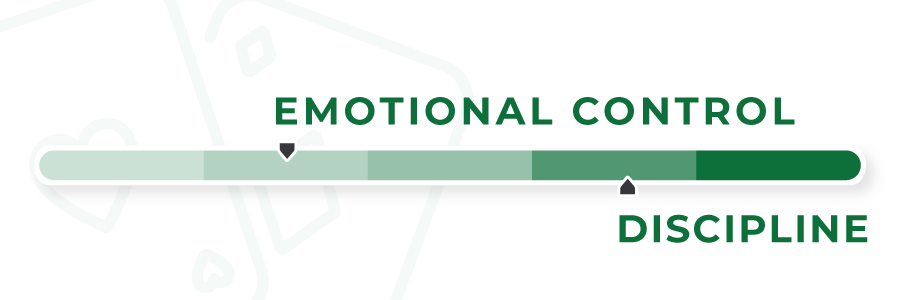
Poker players are human. As such, they are given to emotional reactions to long periods of negative variance.
Put another way, long losing streaks can cause otherwise profitable players to play worse than their best game – infused with fear, self-doubt, fatalism, and other negative emotions that torpedo their best game. This is known as going on tilt or steaming.
Keep in mind
Bankroll management is a means by which good players help to guard themselves from tilt., Having sufficient capital insulates them from the fears that come with playing with scared money.
Imagine being given $10,000,000 with which to play poker.
You have a horrendous session of $2/5, losing $5,000. Any chance that loss will have you go on tilt?
Now imagine a bankroll of $10,000 and the same horrendous session causes you to lose half of it?
See what I mean about a solid bankroll helping you avoid tilt?
When you are well capitalized, you can focus entirely on how you are playing, ignoring the fears of going broke that might have hindered your game with a short bankroll.
8 Pro Tips for Managing Your Bankroll Efficiently
Here are a few of my top recommendations for bankroll management done right:
Tip 1. Segregate Your Money

You want your poker money to become as much like play money as possible, so poker is a strategic game.
This requires segregating your poker bankroll from the money it takes to live your life.
The first step in proper bankroll management is to clearly establish a poker bankroll. You don’t want the weight of your real-world budget to tie down your correct betting action.
For example
If $400 represents a child support payment, two weeks of groceries, or a car payment, it becomes all the more difficult for you make those strategic plays that are often necessary at the poker table.
Tip 2. Count Your Poker Money

How much money do you have for poker? Everyone’s situation is different. I know that I started by seeding my account with some of an insurance settlement that I had.
My Bankroll Example
I added to that sum by selling off some back issue comic books. I also had a small account left over from my college days, that I never put into my family’s checking account when I got married. I lumped it all together and came up with about $5,000. That was my poker bankroll.
You need to know what yours is. It’s helpful to have it in one place.
Tip 3. Pick a Starting Stake
There are no hard and fast rules about this, because each player has a different comfort level when it comes to risk. Even so, as a general rule of thumb, you can safely play poker at a limit game for which you have no less than 400 big blinds, or a no limit game for which you have 20 full buy-ins.
That means that if you have a starting stake of $2,000 you can play in a $2/4 limit game or in the $.50/1.00 no limit game.
When it comes to tournaments, the generally accepted number is 50 to 200 buy ins. If you have $2,000, and you’re quite conservative about money, you can play in $10 tournaments; if you’re more risk tolerant you can play $40 tournaments.
Tip 4. Be Willing to Move Down in Stakes

Generally speaking, the lower the size of the game, the easier the competition.
If you have moved from $1/2 to $2/5 and find that you’re losing, it may well be that you’re being outplayed by the better players in the $2/5 game.
Maybe you’re not ready for them, and should move back down to face easier competition. But even if you’re not being outplayed, if you’ve lost a chunk of your bankroll, you may want to move back down to rebuild it.
Tip 5. What’s Your Comfort Level?

Moving up and down in stakes is not just a matter of doing the math. Having enough money is necessary to play bigger, but it’s not sufficient.
You also need to have the skill for it, the stomach for it, and the heart for it.
Go through each of those criteria and see if you’re ready.
- SKILL: You need to keep track of how you’re doing to assess whether you have the skill. If you win at $1/2 and lose at $2/5, perhaps you haven’t mastered the skills necessary to win among the better players in the bigger game.
- STOMACH: Some players just get anxious above a certain level of play. The absolute amount of money they are playing for matters to them. It was said that Bill Gates, then the richest man in the world, just didn’t feel comfortable gambling for more than $3/6 limit stakes. You may be the same way. Even with a relatively large poker bankroll, mathematically sufficient to play $25/50 no limit, you might still be out of your comfort zone playing anything bigger than $1/2.
- HEART: Finally, you just might not have the courage to play bigger. Though your bankroll can absorb the loss, your ego might keep you from wanting to face the risk of losing.
Tip 6. Playing Above Your Bankroll

All the rules about bankroll management that we’ve just covered notwithstanding, there may be occasions when you want to play above your typical comfort level.
This is the case when such a game appears to be particularly profitable.
A bigger staked game might appear more profitable than typical for a few reasons.
The players might be especially bad, making the game easier and the likelihood of your success greater. That’s why it always pays to check out the games and see who is in them.
You might see players you know to be soft, perhaps even ones you have dominated in a lower staked game.
The bigger game itself might be playing smaller than usual.
This could be the case because particularly loose, wild, or aggressive players are missing from the lineup.
Or it may be the time of day or the day of the month causes the game to play smaller (The end of the month, before players’ monthly pension checks come in tends to shrink the size of some games).
For whatever reason, don’t assume that just because the game is at a higher stake that it is playing bigger than what you are comfortable with.
Your regular lower-staked game might be especially tough, or wild, or otherwise undesirable, making the bigger game more appealing by contrast. With this, however, you have to be careful.
Sometimes desire distorts our vision.
Our aspiration to play bigger might be fueling a distorted vision of either the difficulty of our game or the desirability of the bigger game – helping us rationalize a move we would like to make but perhaps shouldn’t be making.
Tip 7. Other Bankroll Considerations

There’s another reason that numbers alone don’t tell the tale. Earlier, you may recall that I referred to having a certain multiple of the big blind to be properly bankrolled. This bankroll requirement may increase more than linearly as the stakes go up.
You may want $100 to play $.02/.05. It might then seem logical that you’d need $1,000 to play .2/.5 and $10,000 to play $2/5, and $100,000 to play $25/50. But I counsel against that thinking. You’ll probably want relatively more money for the bigger games.
For most people, it’s much, much harder to put together a bankroll of $100,000 than it is to scrape together a hundred bucks.
Losing $100,000 has potentially much more dire consequences because it would typically take so long to replenish it.
Since you can pull together $100 much more easily than $100,000, you don’t have to protect the $100 poker bankroll as carefully as you would a $100,000 bankroll.
Accordingly, you might set a higher relative threshold for how big your bankroll needs to be to play at the bigger level. Instead of an arithmetic progression, you might follow a more geometric one.
Instead of this progression:
- $.02/.05 $100
- $.25/.50 $1000
- $2/5 $10,000
- $25/50 $100,000
It may be better to follow this progression:
- $.02/.05 $100
- $.25/.50 $2000
- $2/5 $40,000
- $25/50 $1,000,000
Tip 8. Taking a Shot Exception

These minimum poker bankroll requirements all assume that you’re looking for the bankroll necessary to move permanently to the bigger game.
But nothing stops you from taking a shot at a bigger game any time you feel like it. Play for a couple of hours or until you lose a predetermined amount, and then go back down to your comfort level.
Who knows, maybe you’ll get hit by the deck, make a ton of money, and move up permanently.
6 Factors that Affect the True Size of the Game Other Than Stakes
Games with the same stakes don’t necessarily require the same bankroll, even if the table maximums are the same. There are many factors that affect how “large” the game plays and how much money you need to have to comfortably play in them.
1. Straddles

Some games allow straddles from under-the-gun, the button, or any seat location. Some limit them to double the big blind; others have larger limits on their size, or no limit.
Some limit the ability to re-straddle. Some games, as a practical matter, have what amounts to a third blind, either from under-the-gun or on the button, as straddling is the rule rather than the exception.
Games play bigger the more and the larger the straddle.
Though you might feel comfortable with a $10,000 bankroll playing in a $2/5 game with no straddles; playing in such a game with an automatic UTG $15 straddle and then regular re-straddles to $50, might not feel comfortable unless you have $50,000.
2. Frequency of Pre-flop Raises

I’ve played in very sedate games where players habitually call pre-flop, and don’t show any aggression until after the flop. On the other hand, some games are always raised pre-flop. Watch a game for at least half an orbit to get a sense how often the pot is raised pre-flop.
The more pre-flop raising, the bigger the game and the larger the requisite bankroll.
3. 3-bet, 4-bet, and 5-bet frequency

Games with regular 3-betting, play much bigger than passive games with little raising and re-raising. I’ve seen games that have players 3 and 4 betting very light – almost as if it’s required.
Other games rarely have more than a raise pre-flop – if they have any pre-flop action at all.
Obviously, the more 3, 4, and 5 betting there is, the larger bankroll you’ll need to ride out the swings of variance.
4. General Aggressiveness of the Players

Aggressiveness often continues through all betting rounds. While some games typically start out with a lot of pre-flop fireworks, they may settle down once the flop or turn hit.
Others keep up the wild play until someone is all in (typically PLO games today, though some NLHE games play this way as well). If you’re playing for stacks every hand, you’ll need a bigger bankroll.
5. Match the Stack Rule

Some public poker rooms and many private games allow a player to buy in or re-buy into the game for the largest stack at the table, or for some large fraction of that stack (75% seems to be fairly common).
The bigger the buy-ins, the bigger the bankroll you’ll need to feel comfortable.
6. Short Buy-ins

The inverse of the standard above is that you need less of a bankroll if many of the players have short stacks. (I played in a $1/2 game in a Sacramento poker room where players bought in to the $1/2 game with $20 in white chips! (As you might expect, it was a nit-fest!).
If many of the players have short stacks, you don’t need as large a bankroll as you would normally require.
Conclusion
Learning how to play winning poker is critically important . Other guides here at Chipy should help you with those pursuits.
But even if you become a world-beater at the game, you run the risk of torpedoing your chances to succeed if you don’t master proper poker bankroll management.
This guide should give you the necessary skills to protect your bankroll from the vagaries of chance, while also giving you the winning formula for buying into and moving up to the appropriate level of play.
Remember
You consider these ingredients of bankroll management, that there’s no shame in moving back down to an easier and safer level if you find that you start losing when you move up in stakes.
 2
2 0
0 Thank you for voting.
Ashley Adams
Vlad Mihalache
Explore More Poker Guides


Poker Q&As





 Level 12
How do you get the password for the poker tournament at 1win online casino?
I asked support on live chat but they have no idea what is happening around them.
 7 Need Answer
 1 Answers


 Level 9
What is the best free no deposit bonus poker casino?
15 Need Answer14 Answers


 Level 4
which is better Blackjack tournaments or Poker tournaments for recreational players ?
I think Blackjack tournaments give you more opportunity to win using Blackjack Strategy against other players. Card counting does not give you edge in Blackjack tournaments. Not enough hands to get a good card count. Poker is a skill of reading other players bets and body emotion language. I think being agressive or passive in BJ makes a difference in a short round, say 10 hands. What do you think?
2 Need Answer2 Answers