


 Casinos
 Bonuses


Poker All In, Table Stakes, and the Big Stack Advantage Myth

Ashley Adams
Professional Poker Player


- Author of 3 poker strategy books, including "Winning Poker in 30 Minutes a Day" (D&B Poker, 2020) and Winning No-Limit Hold’em;
- Over 5 decades of playing poker, starting in 1963 and turning pro in 1993;
- Prolific poker writer with over 1,000 poker articles to his name for well-known publications like 888 and PokerNews;
- Has played poker in all 50 US States and 27 countries;

Vlad Mihalache
Online Gambling and Crypto Casinos Specialist
- Accomplished content strategist and editor with over 8 years of experience in the iGaming industry;
- Certified Cryptocurrency Expert (CCE);
- Specializes in blackjack strategies, slots, crypto casinos, and gambling addiction;
- Bitcoin casino expert with extensive knowledge of crypto trading and blockchain gaming;
- Online gambling expert with 7,000+ articles written and reviewed;
- Strong advocate for responsible gambling with complex knowledge of the latest trends;
 0%
0% 18 min
 Updated on Aug 07, 2025
This guide explains the all-in poker move, a strategy that can make or break your game. This move, often shrouded in drama and suspense, is a pivotal point in any poker match.
Ashley Adams, a pro poker player and prolific writer who boasts the unique achievement of having played in all 50 US States is here to shed some light on the topic
This guide is addressed to one of the biggest such misunderstandings – the nature of an all-in bet and why understanding its nuances is crucial for your gameplay.
Here’s what you’ll learn:
- What is All In in Poker?
- All-in Bet in Popular Culture
- The Reality of the All-in Bet
- Table Stakes
- Betting Considerations Stemming from All-in Bets
- Tournament Considerations – Shove/Fold Charts
- The Psychological Impact of Going All In
- The Myth of the Big Stack Advantage
Here you can watch an informative video with our poker expert Ashley Adams on what "All In" means in Poker:
Let’s dive right in!
Author’s note
"I enjoy the intersection of the poker world with the rest of the world. It is a place of wonderful misunderstanding and mistaken views.”
What is All In in Poker?
In the game of poker, going "all-in" is one of the most dramatic and strategic moves a player can make. It signifies that a player is betting all of their remaining chips on the current hand.
Once a player goes all-in, they cannot make any further bets in that particular hand, but they remain eligible to win the portion of the pot they have invested in.
Let’s explore more definitions of the “all in” concept and how it applies to the game of poker.
All-in Bet in Popular Culture

When poker is presented in popular culture – in theater, movies, or television – there will invariably be a scene of the hero sitting at the poker table with his opponents.
It will typically involve an all-in bet – someone literally pushing a giant mound of chips forward, and dramatically saying “I’m all in!”
Typically, the bet will be called, the players will compare their hands, and the villain, with some absurdly strong hand like Quads, will lose to the Hero’s even more absurd hand like higher quads or a straight flush.
Ah, the movies!
The public loves these moments because they correspond with their view of no limit hold’em as the apex of the poker world, and an all-in bet as the sine qua non of that no limit game.
It is the ultimate representation of poker in the imagination of many non-poker players.
And so, in a poker-themed movie, it is the centerpiece of the action.
The Reality of the All-in Bet
For experienced players, however, this is all silliness. Players go all in all the time, sometimes from positions of strength, sometimes in weakness.
Sometimes they do so aggressively, sometimes passively; sometimes value betting, other times bluffing.
Going all-in is just a tool, like any other tool, to be wielded and used as circumstances require.
Even so, there are many interesting aspects of the all-in bet that players need to understand if they want a thorough understanding of no limit poker.
For that, we need to understand first the nature of no limit poker.
No limit is a misnomer
No one today actually plays no limit. True, we call a variety of poker “no limit hold’em”. And it is surely different from the game of limit hold’em. But it isn’t really a no limit game at all.
No limit has many limits
There are a couple of limits in no limit hold’em. The first limit is the amount of the buy-in.
Most no limit games come with a cap to the buy-in – either stated in the rules themselves or as a matter of structure.
For example
Consider the most common form of no limit hold’em played in a casino or other public brick and mortar poker room. That would be either the game with $1 and $2 or $1 and $3 blinds.
Typically, you are limited in how much you can actually buy in for. That limit is most frequently $300, though in some places it is as little as $80, and in others as much as $1,000.
Those limits to the buy-in greatly limit the game.
Players are only risking the amount of their buy-in. They are prohibited from putting more on the table when they start.
And so, this limits the action – keeping the games going longer than they would go if people put all of their poker bankroll on the table at once.
Table Stakes

Betting is limited in another way – a more direct way. No limit games are always (or nearly always) played table stakes.
What that means is that you may wager only that amount that is in front of youon the poker table at the start of the hand.
For example
Under the rules of a table stakes game, if I have $1,000 in chips in front of me, I can’t bet $2,000 by going into my pocket for an additional $1,000.
I can only bet up to that $1,000. Similarly, if I have $1,000 and you have $300, and I bet $1,000; you may call my bet for only $300, since this is all you had in front of you at the start of the hand.
This would entitle you to win up to $300 from me.
You could not be forced to fold if you couldn’t call the full $1,000. Nor would you be allowed to borrow money to call the bet.
This table stakes has become the norm – though it wasn’t always so.
Poker Without Table Stakes
As poker was sometimes played, and still is typically played in small limit-poker home games, players can “go light” on a bet –owing the amount they could not call from their chip stack. This is most common in limit versions of the game.
For example, when I was in high school, we played dealer’s choice, $.05/.10/.25 poker.
In some versions of those games, with replacement cards and mutual cards, and high-low declare, and a bet after the declare, there were six, seven, or even eight betting rounds.
You might start a hand with $3.00 only to find that the betting and raising had gotten so fierce that you ran out of money before the last betting round.
But you didn’t have to fold to a bet, even if you didn’t have any more money left in your stack.
You could, “go light” and owe the pot (and the eventual winner) the amount you wanted to call. You’d indicate this by stacking up chips from the pot to indicate how much you owed, “I’m light this amount”; meaning you owed it to the pot.
If you won, you just raked in the pot. But if you lost, you’d have to make good on your “lights” before being dealt in to the next hand.
In bigger games, like the one I played regularly in a private Boston club, players could call bets for more than they had, and then make up what they owed by the start of the next session, writing a check to the person whom they owed.
At first this might seem like a very generous concession to a losing player. But in reality, it was an enormous cudgel for the deep pocketed sharks.
We played “double the bet” stakes. This allowed a player to bet or raise by double the last bet or raise. We started with a $2 ante.
A player could initiate a bet for $4, which could in turn be raised by $8, creating a $12 bet to call which could itself be raised by $24. If that $24 was called, on the next betting round a player could commence the betting at $48; he could be raised by $96, and then that bet of $48 + $96 could itself be raised by $146.
There was a three raise limit in the game.
But some of the games had seven betting rounds. I figured out that if every raiser took advantage of the double the bet structure, and made the maximum raise that was allowed, that the last bet could be for more than $100,000,000. Bets never got within four zeros of that amount.
But it was scary nevertheless.
But the most extraordinary part of the game was that it wasn’t played table stakes!
If someone bet $5,000, for example, and his opponent had only $1,000 on the table, he was obliged to either call the $5,000 or fold. There was no “all in”, since there was no limit to what you could bet.
Similarly, if you had $2,000 on the table, but because of prior betting and raising, the limit was now $12,000, you could bet $12,000 – pushing your $2,000 forward and then going into your pocket and pulling out another $10,000 or writing a check or just saying, “and another $10,000”.
At the end of the hand, and then again at the end of the night players were expected to confirm what they owed. And at the start of the next session, players were expected to make good on their debts. From what I observed, they always did.
As you can see, the deep-pocketed had a huge advantage over the rest of the players. If my opponent bet $3,000, and I didn’t have the ability to pay him if I lost, I’d have to fold unless I had an absolutely unbeatable hand – a rarity in any game.
Players with great resources had the ability to bet or raise someone out of a pot – since the amount I had in front of me was no shield to having to call their bet. Scary indeed!
Table stakes, and all-in bets actually limit the craziness.
Table stakes ends all of that craziness by limiting how much you can bet, or be required to call, to the amount you have in front of you at the start of the hand. Ironically, perhaps, the all-in bet is the product of that method of limiting betting. It serves as a restriction on betting, not an accelerant.
Betting Considerations Stemming from All-in Bets
Pot odds and implied odds are affected by the all-in bet.
Implied Odds May Be Eliminated
The first effect an all-in bet has on your calculations in when considering implied odds. Implied odds modify pot odds by adding in to the calculation money that you expect to win if you win the hand, but that is not in the hand when the bet is made.
For example
When considering whether to draw for a flush, you examine the pot and see that it has $100 in it. Your opponent bets $50. You are inclined to fold since you are only 3 to 1 on your call, while the drawing odds are a little worse than 4 to 1, making it a bad bet.
But then you realize that your opponent has a large stack and is likely to call a river bet of $100 or so, meaning you’ll win not just $150 if you hit your hand but $250.
That gives you implied odds of 5 to 1 – making a call make sense.
But if you or your opponent is all in as a product of that bet on the turn, there won’t be any more money to be won after you call the bet on the turn; and so there are no implied odds to consider.
If, for example, your opponent goes all-in with his bet of $50, then you would only be getting 3 to 1, with no chance of making more money if your flush hits.
And so a fold would be in order.
All-in Bet’s Effect on Pot Odds
Pot odds are affected as well.
When you figure out the size of a pot created by a bet, and hence your pot odds, you have to factor in the fact that some bettors may be unable to call the full amount of a bet.
Consider a pot of $100 and a bet of $100. If you only have $50, your pot odds will be different from what they would be if you had $100.
Instead of getting 2 to 1 odds, ($200 in the pot to your $100 call) which is what you would be getting with a full stack, you are instead getting 3 to 1 odds, since you are calling only $50 of your opponent’s bet. ($150 in the pot to your $50 call).
All in and Effective Stack
The all-in rule totally changes the effective size of your stack. In the example above, with a stack of $50, you diminish your opponent’s effective stack to $50.
Whatever else he has doesn’t matter – since with you as his lone opponent, for practical purposes, he cannot bet more than $50.
Tournament Considerations – Shove/Fold Charts
This is especially important in tournaments, as your chip stack cannot be replenished after the re-buy and add on phase is over.
Unlike in a cash game, you do not have the ability to increase your stack.
You must think about using your depleted stack while it still has the power to get opponents to fold.
This necessitates a strategy of going all-in, known as “shoving” based on your hand strength and stack size – recognizing that if you wait too long, your all-in bet will not be large enough to get opponents to fold, causing a player to be blinded off as they wait for a strong hand.
Toward that end, many poker theorists have created optimum shove/fold charts, to help players recognize when they should shove.
These charts are used especially in sit & go tournaments, that are quickly structured, necessitating that a lot of the game is played with a shove/fold strategy.
One player’s All In Often Creates a Side Pot
Consider a hand with three players. Player A has 2,500, Player B 2,000 and Player C 500.
As it happens, Player B has Qs Qh and starts the action. He decides to shove his 2,000. Player C has Ah Kh and decides to call.
He doesn’t have 2,000 – only 500. But he can go all-in for 500, with a chance to win the 500 of Player B.
To complicate matters, Player A looks down and sees Js Ts. He decides to call as well. But since he has 2,500, he must call Player B’s full $2,000.
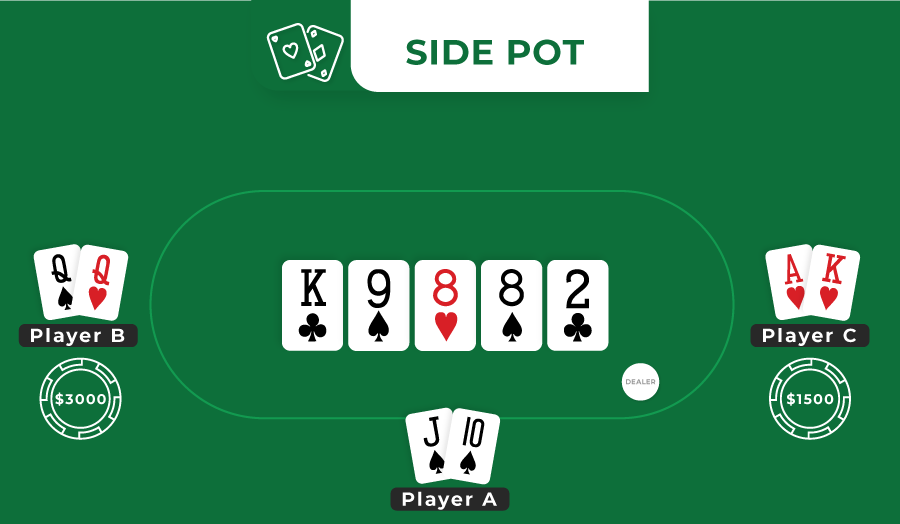
The dealer then divides the money as follows:
- Main Pot: 500 from Players A,B, and C: 1500
- Side Pot: 1500 from Players A and B: 3,000
As it turned out, the runout is Kc 9s 8h 8s 2c
- Player A: Js Ts
- Player B: Qs Qh
- Player C: Ah Kh
Main Pot of 1500 goes to Player C with a pair of Kings.
Side Pot of 3,000 goes to Player B with a pair of Queens.
Hands can sometimes develop with multiple side pots.
The Psychological Impact of Going All In
Beyond the actual mathematical amount of the bet, the act of going “all in” carries with it certain psychological effects that can affect your betting strategy.
While this probably doesn’t matter much to experienced and otherwise highly skilled players, it can surely matter when playing against inexperienced or otherwise poor or mediocre opponents.
- Some players are more likely to be intimidated by an all-in bet – just because it sounds powerful. This is surely true in tournaments, when it represents the possibility of knocking out a player, since their tournament life is at risk when they go all in. But it’s also true in cash games, especially lower stakes cash games.
- Some players may view your all-in bet as being more likely to be a bluff. Ironically, against poor or even some mediocre opponents, it sometimes makes more sense to shove with a monster than to make a small bet, as your opponent may be triggered to call what he incorrectly sees as an effort to buy the pot.
The Myth of the Big Stack Advantage

I was going to a private game a while back. My host talked to me ahead of time about the game.
“There’s no cap to the buy-in in this game. Though it’s just $1/2, some players buy in for $1,000 or more because they want to bully other players with smaller stacks.”
When we got to the game, the host announced that they were imposing a $500 maximum buy-in.
It was explained that this was being done to prevent a couple of really deep-pocketed players from bullying the smaller stacked players.
I didn’t say anything, being a first-time guest. But I realized that this was ridiculous, as any experienced no limit player will tell you.
This notion of big stacks bullying small stacks is a myth.
In fact, small stacks can’t be bullied by big stacks. And, what’s more, it may well make sense for a player to deliberately buy in short against equal or superior players, as a strategy to bully them!
Imagine a table stakes no limit game with no cap to the buy in. One rich guy buys a huge stack of $10,000 in this game, with every other player at $500.
Does the $10,000 stack have an advantage?
No. None. Zero advantage.
He has no advantage because he cannot bet any more than $500 in any one hand. The remainder of his stack is just for show.
It is meaningless.
It might as well be in his pocket because, with a table stakes rule, that is universal in every public poker room in the world, the additional $9,500 cannot come into play in the hand. Put another way, his effective stack is just $500.
You might argue that it creates a psychological edge, since no one can force him to go all in, but he can force anyone else to go all in.
But that would be true if he had $501. And, there is no advantage to not being all-in. In fact, if he had $500, he’d be in the same situation as he is with $10,000 – no stronger and no weaker.
But maybe you argue that he can go all in 200 times with his $10,000, compared with everyone else only being able to go all in only once, giving him an advantage.
But that’s also not the case.
For all we know, everyone else might have $10,000 in their pocket, ready to buy in for $500 on the very next hand as well, and every hand after that, 200 times over.
The fact that one guy put his 200 buy-ins on the table at one time doesn’t mean he has any greater ability to use his bankroll than players keeping the money in their pocket.
If anything, the short stack may have an advantage.
Imagine one player at the table with only $100. He can go all-in for just $100 and see the entire board without facing any more betting pressure, while his opponents may be forced to call an additional $400 to see the hand play out.
You could surely argue that this gives the short-stacked player an advantage.
Conclusion
All-in bets are a necessary part of any game that is played table stakes, as table stakes games allow players to go all-in for the amount they have in front of them at the start of a hand.
This affects pot odds, implied odds, and strategy in many ways, as we have seen.
They necessitate the use of side pots. The developing player should recognize the all-in bet for what it is – a tool in the vast array of tools of successful no-limit play.
Of course, the all in is just a small component of your arsenal of poker skills that you need to master. Explore more of my guides in the Academy
 0
0 0
0 Thank you for voting.
Ashley Adams
Vlad Mihalache
Explore More Poker Guides


Poker Q&As





 Level 12
How do you get the password for the poker tournament at 1win online casino?
I asked support on live chat but they have no idea what is happening around them.
 7 Need Answer
 1 Answers


 Level 9
What is the best free no deposit bonus poker casino?
15 Need Answer14 Answers


 Level 4
which is better Blackjack tournaments or Poker tournaments for recreational players ?
I think Blackjack tournaments give you more opportunity to win using Blackjack Strategy against other players. Card counting does not give you edge in Blackjack tournaments. Not enough hands to get a good card count. Poker is a skill of reading other players bets and body emotion language. I think being agressive or passive in BJ makes a difference in a short round, say 10 hands. What do you think?
2 Need Answer2 Answers