


 Casinos
 Bonuses


How to Play Caribbean Stud Poker: The Ultimate Guide

Ashley Adams
Professional Poker Player


- Author of 3 poker strategy books, including "Winning Poker in 30 Minutes a Day" (D&B Poker, 2020) and Winning No-Limit Hold’em;
- Over 5 decades of playing poker, starting in 1963 and turning pro in 1993;
- Prolific poker writer with over 1,000 poker articles to his name for well-known publications like 888 and PokerNews;
- Has played poker in all 50 US States and 27 countries;

Vlad Mihalache
Online Gambling and Crypto Casinos Specialist
- Accomplished content strategist and editor with over 8 years of experience in the iGaming industry;
- Certified Cryptocurrency Expert (CCE);
- Specializes in blackjack strategies, slots, crypto casinos, and gambling addiction;
- Bitcoin casino expert with extensive knowledge of crypto trading and blockchain gaming;
- Online gambling expert with 7,000+ articles written and reviewed;
- Strong advocate for responsible gambling with complex knowledge of the latest trends;
 100%
100% 13 min
 Updated on Aug 16, 2023
Ready to learn how to play Caribbean Stud Poker, a popular house-banked poker variant that combines strategy and luck? Ante up!
In this guide, you will get actionable insights from Ashley Adams, a seasoned poker pro with years of experience at the table.
Ashley's expertise will ensure you're well-equipped to play the game with confidence.
Here's what you'll discover:
- What is Caribbean Stud Poker?
- How to Play Caribbean Stud Poker: The Basic Rules
- Payouts in Caribbean Stud
- Betting Strategy for Caribbean Stud Poker
- Bonus: Tipping in Caribbean Stud
- Expert’s Advice: Why Play This Game?
Let's get started!
What is Caribbean Stud Poker?
Caribbean Stud Poker is a popular casino game, played in brick-and-mortar casinos worldwide and online.
It is a house-banked game, with each player playing individually against the house, like in blackjack or baccarat.
It should not to be confused with any of a number of competitive poker card games, such a Texas Hold’em or Omaha Hi Lo, where players compete against each other.
How to Play Caribbean Stud Poker: The Basic Rules
There are two required betting rounds in Caribbean Stud, an ante rond and a raise.or fold round.
Ante Round
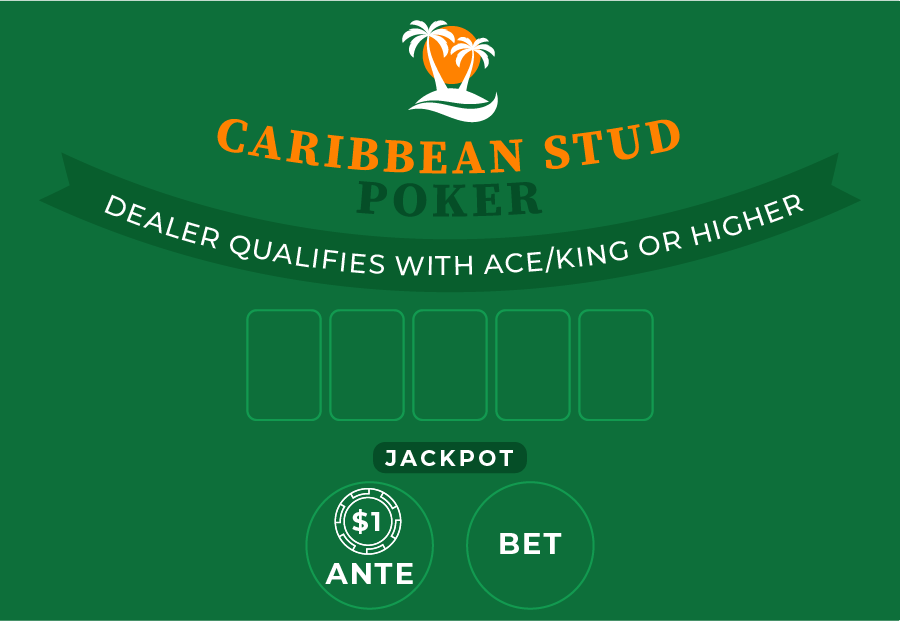
In Caribbean Stud, each player places an initial bet, known as an ante, in a designated space on the layout.
The dealer then deals each player and themselves five cards, one a time, face down.
The dealer then turns one of their cards face up.
Raise or Fold Round
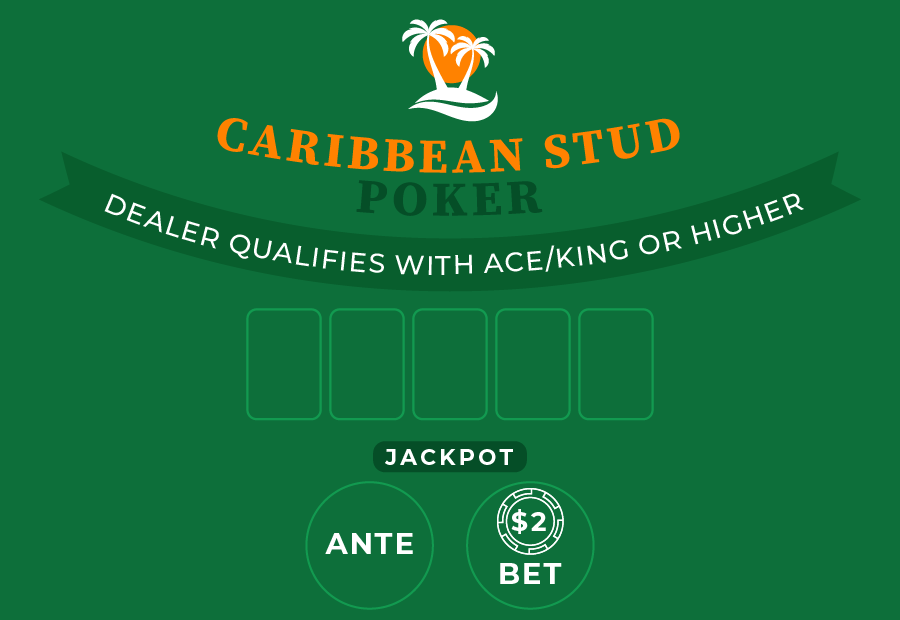
Each player, examining their individual hand of cards (but not looking at any of the cards of the other players), may elect to either fold their hand or to place an additional bet twice the size of the ante.
If they fold, they lose their ante.
If they bet, they place an amount twice their ante into a designated space marked on the layout.
Reveal and Compare
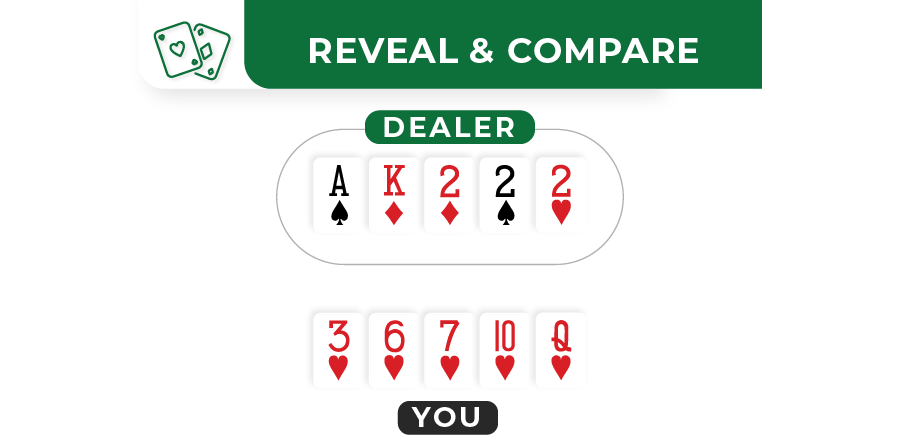
The dealer then reveals their hand.
Does the Dealer Qualify?
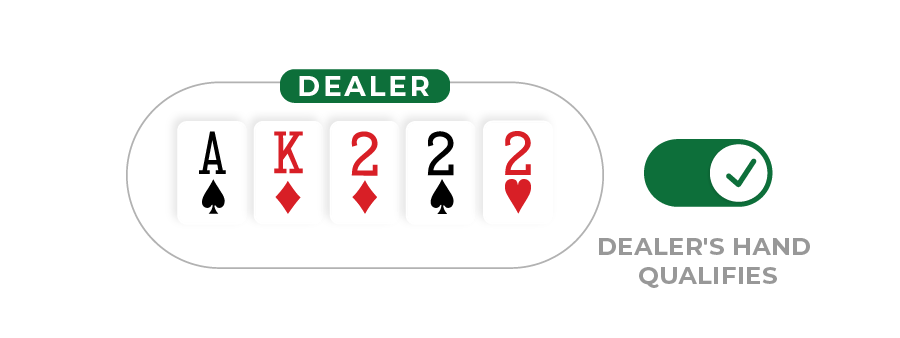
The dealer first determines whether they have a qualifying poker hand.
To qualify, the dealer must have at least an A K high poker hand.
That is a hand with an Ace and a King, a pair, two pair, three of a kind, a straight, a flush, a full house, four-of-a-kind, or a straight flush.
Payouts in Caribbean Stud
The payouts differ based on the different situations.
Let’s explore them:
If Dealer Does Not Have A Qualifying Hand
If the dealer does not have a qualifying hand, not having at least an AK, then players win their antes, and their raise is returned.
If Dealer Has a Qualifying Hand
If the dealer has a qualifying hand, then the dealer’s hand is compared to the player’s hand.
If Dealer Hand Beats Player’s Hand
If the dealer hand beats the player’s hand, then the player loses the ante and the raise.
If Player Hand Beats Dealer’s Hand
If the player beats the dealer they win their initial ante bet, paid out at even money. ($5 paid to a $5 wager, with the initial $5 returned to the player as well).
Their additional bet of double the ante is paid according to a posted pay table.
The pay tables for the US are standardized and listed below. (Other brick-and-mortar casinos as well as online casinos may have different pay tables. Make sure to check them.)
Jackpot Bet
Players may also make a small wager, usually $1, 1 Euro, or 1 Pound, on a progressive jackpot.
The jackpot grows with each jackpot bet that is made.
Sometimes casinos are linked together to create a large jackpot. If the player gets a hand of a flush or greater, they win a part of the jackpot, according to a pay table. The standard pay table for most US casinos is listed below.
Please note
Some US casinos, casinos outside the US, and on-line casinos, may have different pay tables. Make sure you review and understand the pay table where you are playing.
There are also sometimes additional side bets that are offered to a player. Make sure you know what side bets, if any are available, and how they are paid out to winning players.
Progressive Jackpot Payouts for Most US Casinos
Typically, a player wins 100% of the progressive jackpot if they hit a royal flush.
They win 10% if they get a straight flush.
They win $500 for four of a kind, $100 for quads, and $50 for a full house. But jackpot payout schedules may differ.
Be sure to ask for the payouts, including the progressive jackpot payout, wherever you play.
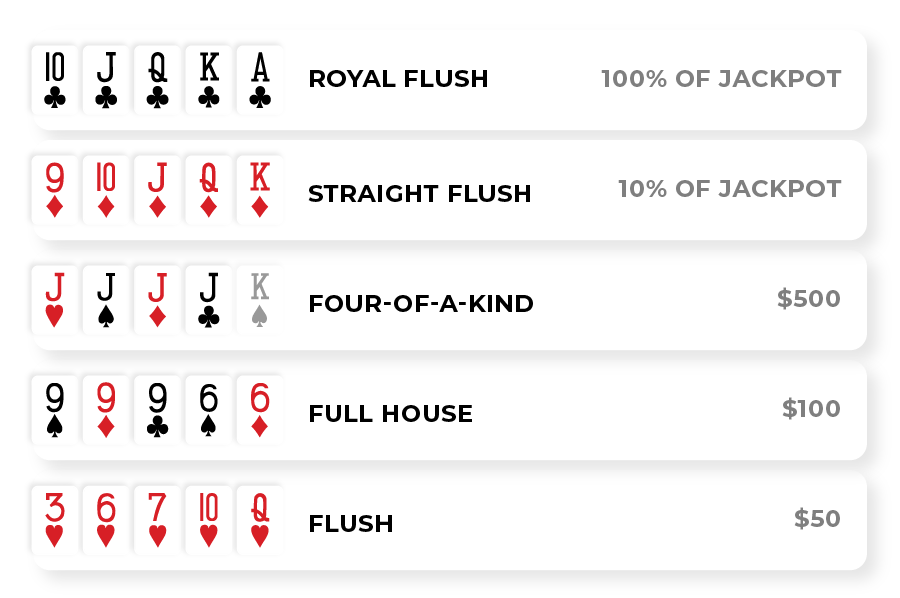
- Royal Flush: 100% of Jackpot
- Straight Flush: 10% of Jackpot
- Four-of-a-Kind: $500
- Full House: $100
- Flush: $50
Caribbean Stud Paytable in US Casinos
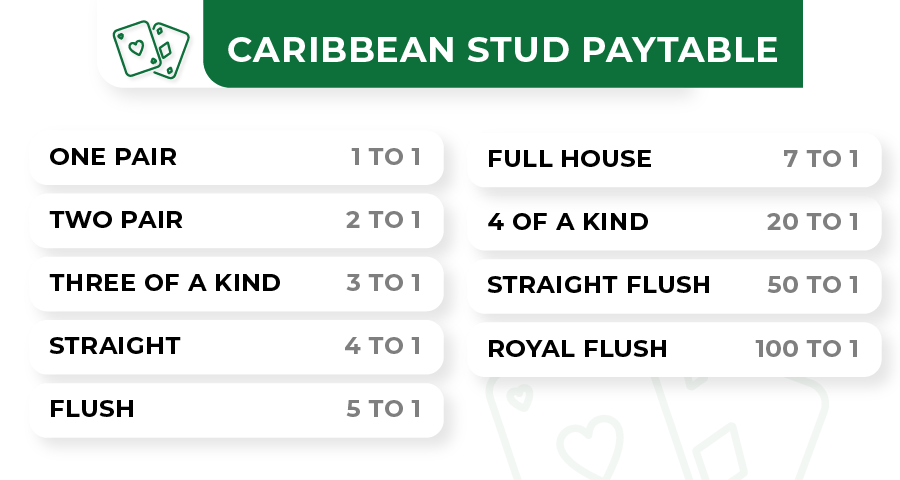
- One pair or less: 1 to 1
- Two Pair: 2 to 1
- Three of a Kind: 3 to 1
- Straight: 4 to 1
- Flush: 5 to 1
- Full House: 7 to 1
- 4 of a Kind: 20 to 1
- Straight Flush: 50 to 1
- Royal Flush: 100 to 1
Please note
Pay tables are different in non-US casinos and in on-line casinos. Check the payouts of all online casinos, as they differ greatly. Some may be significantly less disadvantageous than the one listed above.
Betting Strategy for Caribbean Stud Poker
Here are some key takeaways:
- Ante is required. You must place it if you wish to play the game;
- Raise is discretionary.
There is no way for a player to gain an advantage over the house.
This means that no matter how you manage your money, how you construct an escalating or de-escalating betting system, or change your bets based on prior results, you will always have an immutable disadvantage against the house.
Over time, it is a mathematical certainty that if you play long enough you will lose all your money.
Even so, in Caribbean Stud, there are ways to lose your money more slowly, so it will last longer.
Instead of playing every hand for a raise, players can cut the house advantage from roughly 16.6% to a little worse than 5% by choosing to fold certain hands, and to raise only with hands of a certain value.
If players play every hand, by placing a raise each time they are dealt a hand, and never make the choice to fold, the house retains a 16.6% advantage.
That is to say that, on average, if a player were to bet $1,000, they would lose $166, retaining $834 of their initial bankroll.
If they were determined to keep playing until they lost all of their money, and they wagered $1,000 every 10 minutes for example, then, theoretically, they would lose their $1,000 in an hour – having cycled through $1,000 six times in an hour.
Their Individual results would vary, of course, with players having the chance of winning or losing. But, on average, that’s how they would do.
You can cut that house advantage substantially, by electing to fold certain holdings.
For example
If you folded all cards that were not pairs, raising all hands with a pair or stronger poker hand, the house would only have a 5.5% advantage.
My advice
A more finely-tuned strategy, raising with some AK hands, could cut the advantage down to only 5.224%. If they lost their money at the rate of 5.224%, instead of losing $166 per $1000 wagered, they would lose only $52.24 per $1,000 wagered.
Accordingly, at that rate, playing at the same pace of $1,000 in 10 minutes, as before, it would take them roughly three hours to lose all of their money.
Strategy for Jackpot (How Much is Big Enough to Warrant a Bet)

The jackpot bet itself is generally a terrible bet, with an average house advantage of roughly 25%. This is because the house typically funds the jackpot with only $.75 or so for every $1.00 jackpot bet (retaining the rest for the house).
This makes the jackpot bet typically an extremely disadvantageous (read “sucker”) bet.
Even so, like a lottery ticket, the progressive jackpot is an alluring wager, as it offers the possibility (however remote) of winning a large amount of money, sometimes over a million dollars, for wagering a very small amount.
Experts who have analyzed these jackpots have concluded that, generally speaking, for a jackpot to payout enough to make a $1 bet have a positive expected value, it must be $250,000 or so.
The Best Strategy: Money Management

There are endless systems designed to somehow diminish the house advantage in Caribbean Stud and other dealer-banked games like roulette, craps, or baccarat.
These systems are all illusory, as the house advantage is completely immutable.
Over time, no matter how players increase, decrease, parcel out, or otherwise alter their betting frequency, they will eventually lose their money at these games if they play it long enough.
There are generally a few rules of thumb that may contribute to a more pleasant gambling experience. Most of them are related to bankroll management:
- Set aside a budget for your gambling. Once you spend that money, quit your play.
- Divide up your gambling money for a trip into amounts for each individual day that you wish to gamble. When you lose your bankroll for the day, or reach a pre-set win for the day, quit until the next day.
- Only play with cash you have at the beginning of your gambling session.
- Do not go to a money machine, cash a check, or use your credit card to get money to play.
- Do not borrow money.
- Do not increase your bets to recover money you have lost.
Comps/Players Cards/Free Drinks/Free Room/ Free Food
There are many different comps that are used to entice players to continue to play.
Casinos may offer:
- free food;
- drink;
- rooms;
- even some return of losses to players whom they believe will eventually lose money to the casino.
Clever, disciplined, and otherwise well-informed players, who hunt for specials of this type, and who play selectively based on these comps, may occasionally be able to “beat” the casino at their own game, by securing more in the way of comps, points, and the like than they lose to the casino in wagers on house advantage games.
A word of caution
The lavish casinos that we now see dotting the world and the Internet have been built with centuries of experience in this regard. They have earned many hundreds of billions of dollars by offering comps to entice players.
They know what they’re doing!
Cheating Possibilities of Caribbean Stud

The rules of Caribbean Stud prohibit players from sharing hand information with other players. Plus, they prohibit players from “peeking” at the cards of other players.
Each player is to view only their hand when deciding whether to fold or whether to raise.
Even so, it is certainly possible for players to view the cards of other players, as this rule is often not rigidly enforced in brick-and-mortar casinos.
And it cannot be enforced in online casinos, where players could surely share hand information with other players at the same virtual table.
The less scrupulous gamblers among us may want to know how this information, though prohibited in the rules of the game, might be able to alter the advantage that the house has over the player in Caribbean Stud.
He writes:
According to the paper “An Analysis of Caribbean Stud Poker” by Peter Griffin and John M. Gwynn Jr., which appears in the book Finding the Edge, in the perfect situation of having seven colluding players, it would be possible to narrow down the dealer’s unseen cards to just 16 possible cards. Using a computer to analyze all 1,820 possible 4-card sets out of 16, the player would have an advantage of 2.3%.
In a six player game the house would still have an edge of 0.4%
My suggestion is that if you elect to play this game, you do so honestly and with the knowledge that it has a negative expectation for the player.
Bonus: Tipping in Caribbean Stud

If you play it in a brick-and-mortar casino, it may be expected that you leave a tip for the dealer. (There’s no tipping online of course.) There is never a requirement to tip. But you may want to leave one nevertheless.
In other gambling games, like blackjack for example, players tip by making a bet for the dealer, and having them retrieve their winnings if the bet wins.
In Caribbean Stud it’s difficult to place a bet for the dealer, since, in a US casino, the jackpot bet, if hit, is taxable, creating an awkward situation. You might owe taxes on the winnings of a bet that you placed for a casino employee. Some casinos ban the practice outright.
Accordingly, the simplest and most typical way to tip in Caribbean Stud is just to tip the dealer when coloring up at the end of a playing session.
If you have winnings, it’s typical to tip 2% to 10% of your winnings, rounded up according to the chips you were betting.
But, obviously, what you tip and whether you tip these generally underpaid and hard-working employees who rely on their tips to eat, is completely up to you!
Expert’s Advice: Why Play This Game?

Many poker players might wonder why anyone would play a house-banked game like Caribbean Stud (or any of the many other games in a casino), that has an immutable and built-in house advantage.
For those of us who play poker in order to win money, we might look at this game and say, “What’s the point?”
Even so, playing Caribbean Stud is enormously popular.
The allure of Caribbean Stud, with both the regular game and the extra progressive jackpot bet may stem from the fact that it is really three games in one.
One game is the ante game. It features frequent and small wins. The second game is the raise game, that combines some element of decision making with the possibility of winning bets of differing sizes, some quite large, based on your poker hand.
And finally, there is the very seductive progressive jackpot bet. It offers the dream of lifechanging money for a very small wager.
Though there is no way to beat Caribbean Stud in the long run, these three factors combine in Caribbean Stud to give gamblers many different ways to win.
They win regularly enough to stay engaged in the game, while holding out the hope that they may eventually win really big!
Conclusion
There you have it - the complete guide on how to play Caribbean Stud Poker.
While the odds might favor the casino, smart play can extend your fun. But remember, if you’re tempted by the jackpot, tread wisely.
For those eager to sharpen their skills, the Poker Academy awaits with even more actionable guides.
Dive in and deal yourself a winning hand!
 1
1 0
0 Thank you for voting.
Ashley Adams
Vlad Mihalache
Explore More Poker Guides


Poker Q&As





 Level 12
How do you get the password for the poker tournament at 1win online casino?
I asked support on live chat but they have no idea what is happening around them.
 7 Need Answer
 1 Answers


 Level 9
What is the best free no deposit bonus poker casino?
15 Need Answer14 Answers


 Level 4
which is better Blackjack tournaments or Poker tournaments for recreational players ?
I think Blackjack tournaments give you more opportunity to win using Blackjack Strategy against other players. Card counting does not give you edge in Blackjack tournaments. Not enough hands to get a good card count. Poker is a skill of reading other players bets and body emotion language. I think being agressive or passive in BJ makes a difference in a short round, say 10 hands. What do you think?
2 Need Answer2 Answers