 Level
Level 


 Casinos
  Bonuses


How to Play 3 Card Poker and Win: A Player's Handbook

Ashley Adams
Professional Poker Player


- Author of 3 poker strategy books, including "Winning Poker in 30 Minutes a Day" (D&B Poker, 2020) and Winning No-Limit Hold’em;
- Over 5 decades of playing poker, starting in 1963 and turning pro in 1993;
- Prolific poker writer with over 1,000 poker articles to his name for well-known publications like 888 and PokerNews;
- Has played poker in all 50 US States and 27 countries;

Vlad Mihalache
Online Gambling and Crypto Casinos Specialist
- Accomplished content strategist and editor with over 8 years of experience in the iGaming industry;
- Certified Cryptocurrency Expert (CCE);
- Specializes in blackjack strategies, slots, crypto casinos, and gambling addiction;
- Bitcoin casino expert with extensive knowledge of crypto trading and blockchain gaming;
- Online gambling expert with 7,000+ articles written and reviewed;
- Strong advocate for responsible gambling with complex knowledge of the latest trends;
 100%
100% 9 min
9 min Updated on Aug 14, 2023
Ready to dive into 3 Card Poker? This fast-paced, easy-to-learn game is a casino favorite, and this guide is here to up your ante.
Master the ins and outs of the game with Ashley Adams, professional poker player as he takes you on an exciting journey into the depths of three card poker, based on his personal experience.
Here’s what you’ll learn:
- What is Three Card Poker?
- 3 Card Poker Basics
- 3 Card Poker Hand Rankings
- Additional Bets
- The Only Three Card Poker Strategy You'll Need
- Advantage Play
- Expected Return in 3 Card Poker
Get ready to shuffle up and become a 3 Card Poker pro!
What is 3 Card Poker?
Three Card Poker is a casino game played against the house. You don’t compete against other players as in standard poker games.
In that sense, it is much more like Let It Ride, Caribbean Stud, Roulette, Blackjack, and Craps than it is to a “real” player-versus-player poker game like Texas Hold’em, Omaha, or 7-card Stud.
Nevertheless, like other house-banked games, Three Card Poker provides amusement for many. There is also a small element of skill that you need to exercise to minimize the house advantage and increase the possibility that you will have a winning session.
What to expect from this guide
I will explain precisely how the game is played and what a skilled player can do to minimize the house advantage, increasing the possibility that you will have a winning session. I will also provide you with an understanding of how much of an advantage the house will have, even if you play perfectly.
3 Card Poker Basics
You play against the dealer heads up. There may be other players in the game with you. But you are not competing against them, just against the dealer.
Here's how to play 3 card poker, step-by-step:
- First, you ante. Your ante can be for any amount within the limits of the game. If the minimum bet is $5 and the maximum is $100, you may ante from $5 to $100.
- Once ante, you and the dealer are dealt three cards. You look at your hand and cannot see the dealer’s cards.
- You then decide whether to play your cards or fold them. If you play them, you must place an additional bet equal to the ante. If you fold them, you lose your ante and have no further play.
- Once you and every player have placed a bet or folded, the cards are revealed and compared.
- The first action is checking whether the dealer has a qualifying hand. They must have a Queen-high or better. If they do, the dealer hand is compared to your hand.
- If your hand is better than the qualified dealer hand, you win your bet, and your ante – paid out 1 to 1. So, for example, if the dealer has the qualifying hand of A-high and you have a pair of 2s, and you anted $5 and bet $5, then you get $20 (your own $5 bet and $5 ante plus the winning $5 bet and $5 ante).
- On the other hand, if the dealer does not have a qualifying hand, you win your ante, but your bet is a push. You get it back but don’t win a bet from the dealer.
For example
If your bet and ante were $5 each, and the dealer has a Jack-high (not high enough to qualify), then you get $15 back (your $5 ante and the dealer’s $5 ante and your $5 bet but not $5 more from the dealer).
That’s it! Simple.
That’s all there is to the game. You ante, you see your hand, you decide whether to bet or fold, you know the dealer’s hand, if it doesn’t qualify you win your ante bet and get your play bet back; if it does qualify you compare it to yours, and you win your bet if your three-card poker hand is better than the dealer’s hand.
If there’s a tie, no one wins. It’s a push, and the wager stands for the next hand (or you can take it back and not play again).
There is also the ante bonus. If you are dealt a straight or better, this is paid out on your ante wager. It pays out according to the hand you get, typically 1 to 1 for a straight, 4 to 1 for three of a kind, and 5 to 1 for a straight flush. The payouts are listed with the game for you to see.
Be aware
Some places change these payouts. Make sure you know what the payout is where you are playing. You do not have to beat the dealer with the hand; you just have to be dealt it.
Some dealers do not pay you this bonus if your hand does not beat the dealer’s hand.
For example
If you have a straight and the dealer has a three-of-a-kind, you should still receive a payout of even money, even though your hand loses to the dealer’s.
Correct this error if it is made, and get your ante bonus with all qualifying hands, even if you don’t beat the dealer’s hand!
If the dealer disagrees with you, you are right and they are wrong; so call over the floor supervisor!
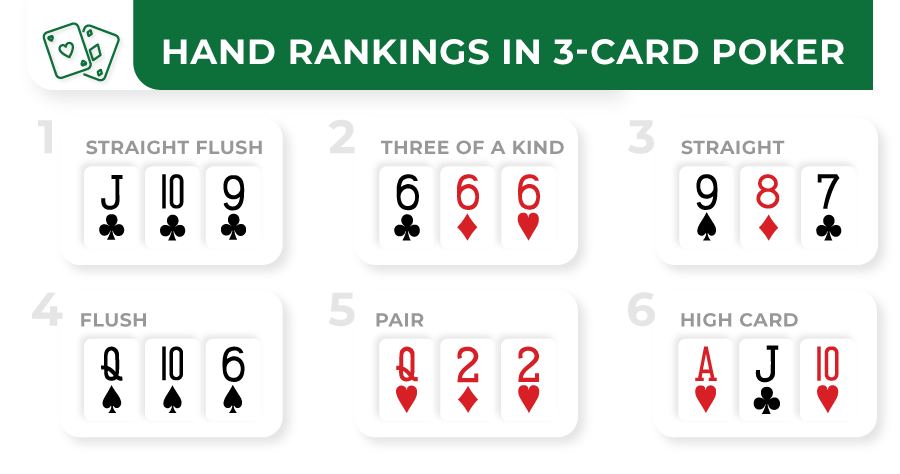
Here’s the list of three card poker hands in order of what beats what. It’s adjusted because only three cards are in hand, changing the relative value of straights and flushes.
3 Card Poker Hand Rankings
In 3 card poker, there are 6 possible hands you can get, including:
- Straight Flush
- Three of a Kind
- Straight
- Flush
- Pair
- High Card
Additional Bets
In addition to the regular betting I’ve described above, you sometimes have additional bets that you can make, irrespective of how you bet on your hand.
You can bet that you will get dealt at least a pair. This is called the Pair Plus wager. You win this bet if you have at least a pair of 2s. You win whether or not you beat the dealer’s hand.
In some places, there is also the option of The Prime wager. This may be placed before the cards are dealt. It pays out based on the color of the cards. If they are all the same color the payout is 3 to 1 on your wager. If all six cards of the dealer’s and the player’s hands are the same color, the payout is 6 to 1.
You may also encounter another option bet called "six card bonus." This allows players to make a five-card poker hand out of both their three cards and the dealer’s three cards, with payouts based on what hand they can make. Payouts typically range from paying out 5 to 1 for three of a kind to 1000 to 1 for a royal flush.
Pro tip
All of these other bets should have pay tables visible. Make sure you see what they are before you play.
The Only Three Card Poker Strategy You'll Need
The strategy for three-card poker is straightforward:
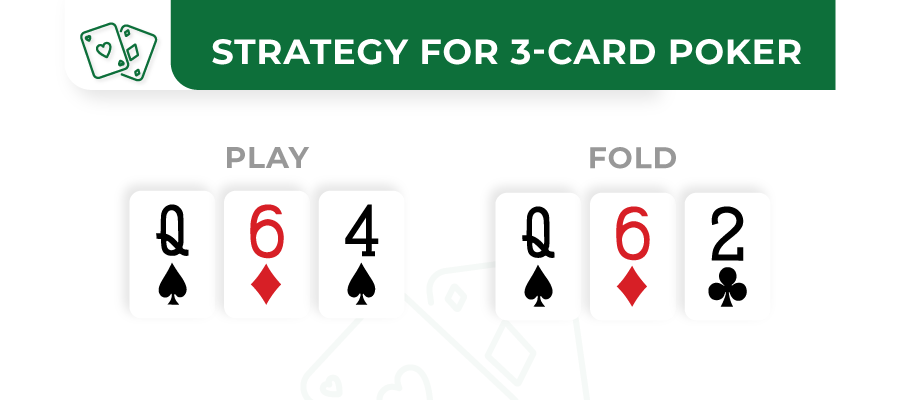
Only play if your hand is Q 6 4, or better. Fold all other hands.
For example
If you have a Jack-high hand fold. Suppose you have King High play. If you have Q J play. If you have Q 5 fold. If you have Q 6 2 fold. If you have Q 6 4 or better play.
Simple.
The other wagers are not favorable to the player. Nevertheless, they will provide additional ways to win and may add excitement to your playing session.
Advantage Play
Though the game's structure gives the house a built-in advantage over the player, there may be unusual and unplanned circumstances when you can overcome that advantage because of sloppy dealing. Some dealers unwittingly but occasionally expose their down cards when they deal.
They are not supposed to do this.
But human error being what it is, this sometimes happens inadvertently. When that is the case, it is possible to gain an advantage over the house by altering your strategy accordingly.
Recommendation
Advanced Advantage Play, by Eliot Jacobson, addresses how to take advantage of errors like these in games like Three Card Poker.
Expected Return in 3 Card Poker
As mentioned before, Three Card Poker is a house-banked game with a built-in house advantage.
Assuming you are playing the correct basic strategy, by only playing hands of Q 6 4 or higher, and folding all other hands, the house has between a 2% and a 7% advantage, depending on the pay table for the Ante Bonus.
If you gamble $1000, you can expect the house to win $20 to $70 of that $1,000 on average. Of course, you might win in any individual playing session, or the house may win any amount of money you wager.
But, over time, you’ll lose between $20 and $70 for every $1,000 you wager. That makes it among the better values of the house-banked games – better than roulette, much better than Keno or BINGO, and nearly as good as baccarat or playing perfect basic strategy at Blackjack.
Though, over time, you will probably lose to the house; with comps, free drinks, and the pleasure you derive from playing this game, it may well be worthwhile.
Final Thoughts
This marks the end of our guide on 3 Card Poker.
Mastering the game requires understanding its unique blend of speed, strategy, and excitement.
Remember, improvement comes with time and practice.
If you've enjoyed this guide and wish to delve deeper into the vibrant world of poker, I suggest exploring my other Poker Academy guides. They offer invaluable insights into all available poker games, helping you broaden your skills and deepen your appreciation for this classic card game.
Keep playing, keep learning, and enjoy every hand.
Good luck!
 4
4 0
0 Thank you for voting.
Ashley Adams
Vlad Mihalache
Explore More Poker Guides


Poker Q&As





 Level 12
How do you get the password for the poker tournament at 1win online casino?
I asked support on live chat but they have no idea what is happening around them.
 5 Need Answer
 1 Answer


 Level 9
What is the best free no deposit bonus poker casino?
15 Need Answer14 Answers


 Level 4
which is better Blackjack tournaments or Poker tournaments for recreational players ?
I think Blackjack tournaments give you more opportunity to win using Blackjack Strategy against other players. Card counting does not give you edge in Blackjack tournaments. Not enough hands to get a good card count. Poker is a skill of reading other players bets and body emotion language. I think being agressive or passive in BJ makes a difference in a short round, say 10 hands. What do you think?
2 Need Answer2 Answers