


 Casinos
 Bonuses


What Are the Best Stablecoins for Crypto Gambling?

Vlad Mihalache
Online Gambling and Crypto Casinos Specialist


- Accomplished content strategist and editor with over 8 years of experience in the iGaming industry;
- Certified Cryptocurrency Expert (CCE);
- Specializes in blackjack strategies, slots, crypto casinos, and gambling addiction;
- Bitcoin casino expert with extensive knowledge of crypto trading and blockchain gaming;
- Online gambling expert with 7,000+ articles written and reviewed;
- Strong advocate for responsible gambling with complex knowledge of the latest trends;
 100%
100% 8 min
8 min Updated on Sep 02, 2026
The best stablecoins for crypto gambling are USDT on Tron for universal acceptance, USDC on Base for clean regulation, and DAI for censorship resistance.
Each one comes with trade-offs in fees, transparency, and casino coverage that matter more than most players realize.
Stablecoins solved the biggest practical problem with crypto gambling: volatility during play. A 5% drop in Bitcoin during a 20-minute session can erase the bonus you just won. A stablecoin keeps your $100 deposit worth $100 from deposit through wagering to withdrawal.
Below, I’ll explain the major options and tell you which stablecoin I recommend using for what.
Key Takeaways
- USDT and USDC together account for the majority of stablecoin volume at crypto casinos;
- USDT on the Tron network has the lowest fees and is accepted at nearly every crypto casino worth playing at;
- USDC casinos offer slightly better transparency and regulatory standing, but can be pricier to transact;
- DAI is the largest decentralized stablecoin and works well for players who avoid centralized issuers;
- Always match your stablecoin's network to the casino's deposit network. USDT-ERC20 and USDT-TRC20 are not interchangeable.
Why I Recommend Stablecoins for Gambling
Stablecoins outperform Bitcoin and Ethereum as gambling currencies, and that’s not just based on my experience. Let me explain the main reasons:
Value Stability Is the Obvious One
Your deposit is denominated in dollars. Whether you win, lose, or draw, the dollar value of your balance doesn't move because of market chaos. For session gambling, this is exactly what you want.
Bonus Clearance Protection Is the Less Obvious One
When you're rolling over a bonus, you're committed to a wagering volume. If the underlying crypto drops 10% mid-rollover, you've effectively lost value even if your bets break even.
Stablecoins make wagering requirements a pure mathematical problem instead of a market-timing problem.
Faster, Cheaper Withdrawals Round Out the Case
Casino withdrawal queues are often shorter for stablecoin transactions because the casino doesn't need to deal with conversion risk on its end. Many fast-payout crypto casinos process stablecoin withdrawals in minutes, compared to 30+ minutes for Bitcoin.
Honest Assessment: The Trade-off Is Regulatory Exposure
Stablecoins like USDT and USDC have issuers with legal teams and compliance frameworks. In rare cases, they can freeze addresses. We'll cover that risk per stablecoin below.
Quick note
The fundamentals of how a stablecoin maintains its peg are covered in our stablecoin explainer, which is worth a read if you're new to the concept.
The Major Stablecoins, Broken Down
Three names dominate crypto gambling: USDT, USDC, and DAI. Together, they handle the vast majority of stablecoin volume on every major casino.
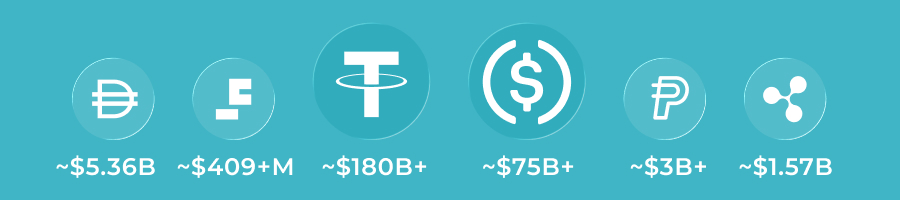
Each option offers a different issuer model, network coverage, and risk profile that compound over hundreds of deposits a year. Here's how they compare.
USDT (Tether): The Industry Standard
USDT is the dominant stablecoin by market cap and the most widely accepted at crypto casinos. Issued by Tether, headquartered in the British Virgin Islands and Hong Kong.

Why players use it: universal acceptance, lowest fees on Tron network, fastest confirmations. If your casino accepts only one stablecoin, it's almost certainly USDT. See USDT crypto casinos for the platforms that support it natively.
Networks: USDT runs on Tron (TRC-20), Ethereum (ERC-20), BNB Chain (BEP-20), Solana, Polygon, Arbitrum, Avalanche, and several smaller chains. The Tron variant dominates for gambling because transaction fees are typically under $1 and confirmations land in seconds.
Risk factors:
- Tether has faced criticism over reserve composition for years. The current reserve attestations show a mix of US Treasuries (the largest portion), cash equivalents, secured loans, and some Bitcoin;
- Attestations are conducted by BDO Italy, though full audits in the strictest accounting sense remain debated by analysts;
- Tether has frozen addresses in cooperation with law enforcement before, but such freezes are rare and typically involve criminal investigations or sanctioned addresses.
Best for: the default choice for nearly any gambling use case. Universal coverage, lowest practical fees on Tron, and highest liquidity.
USDC (Circle): The Regulated Alternative
USDC is the second-largest stablecoin and has the cleanest regulatory profile. Issued by Circle in the United States, fully regulated and subject to US oversight.

Why players use it: stronger reserve transparency than USDT. Monthly attestations published by Deloitte. Reserves held in US Treasuries and cash with major US banks.
For risk-averse players, USDC reduces issuer-collapse tail risk relative to USDT, at the cost of greater regulatory exposure if you're in a sanctioned jurisdiction.
Networks: USDC runs on Ethereum, Base, Arbitrum, Optimism, Polygon, Solana, and Avalanche. Base and Arbitrum are the lowest-fee options for casino deposits, often under $0.10 per transaction. The USDC payment casinos list covers platforms that accept it directly.
Risk factors:
- The 2023 Silicon Valley Bank failure briefly knocked USDC's peg to around $0.88 because Circle held a portion of reserves there;
- The peg recovered within 48 hours, and Circle has since diversified reserves across more banks, but the incident showed that even "safe" stablecoins carry banking system exposure;
- USDC has also frozen addresses at the US Treasury's direction, with the Tornado Cash sanctions case in 2022 being the most prominent example.
Best for: players who prioritize regulatory clarity and reserve transparency. Common at casinos that target US-adjacent markets. If you're stuck between the two main stablecoins, our USDT vs USDC for gambling head-to-head covers the decision in detail.
DAI (MakerDAO / Sky): The Decentralized Option
DAI is the largest decentralized stablecoin, issued by the protocol formerly known as MakerDAO (which rebranded to Sky in 2024). DAI is overcollateralized by other crypto assets and stablecoins rather than backed by fiat reserves sitting in a bank.

Why players use it: no central issuer means no single entity can unilaterally freeze your DAI. The contracts are open-source and auditable. For players who value censorship resistance, DAI is the obvious choice.
Networks: primarily Ethereum, with native support on Polygon, Arbitrum, and Optimism. Slightly less casino coverage than USDT or USDC but established platforms like those on our crypto casinos list usually accept it.
Risk factors:
- DAI's stability depends on the underlying collateral, which includes a significant portion of USDC. A USDC depeg propagates partially into DAI, as happened briefly in March 2023;
- Also, the MakerDAO/Sky protocol has been gradually shifting toward more centralized backing assets (including real-world assets such as US Treasury-backed instruments), which somewhat dilutes the original decentralization argument.
Best for: players who want censorship resistance, plus convenience without a centralized issuer.
The Newer Stablecoins: FDUSD, PYUSD, RLUSD
From my research, there are three notable newer entrants worth knowing about.

- FDUSD (First Digital USD) is issued by First Digital Trust in Hong Kong. Backed primarily by US Treasury bills and cash. Gained traction on Binance after BUSD was wound down in 2023. Decent casino acceptance on BNB Chain;
- PYUSD (PayPal USD) is issued by PayPal in partnership with Paxos. Backed by US dollar deposits, US Treasuries, and cash equivalents. Currently runs on Ethereum and Solana. Growing acceptance, but not yet universal at crypto casinos;
- RLUSD (Ripple USD) launched in late 2024. Runs on the XRP Ledger and Ethereum. Designed for institutional payments and cross-border transfers. Casino acceptance is still emerging.
Quick note
The newer stablecoins offer some diversification of issuer risk but have less liquidity and casino acceptance than USDT and USDC. They're worth using when a specific casino prefers them or when you want to spread your stablecoin exposure across multiple issuers.
Stablecoin Networks: Where to Actually Use The Coins
In my experience, here are the cheapest, fastest deposit paths by stablecoin and network combination.
| Stablecoin | Network | Typical Fee | Speed |
|---|---|---|---|
| USDT | Tron (TRC-20) | $1-2 | 1-3 minutes |
| USDT | BNB Chain (BEP-20) | $0.20-0.50 | seconds |
| USDT | Polygon | $0.10-0.30 | seconds |
| USDC | Base | $0.05-0.30 | seconds |
| USDC | Arbitrum | $0.10-0.40 | seconds |
| USDC | Solana | $0.001 | seconds |
| DAI | Polygon | $0.10-0.30 | seconds |
Avoid the Ethereum mainnet for any of these unless your casino specifically requires it. Mainnet fees for USDT or USDC transfers commonly hit $5-20 even after the merge and the Dencun upgrade that lowered some costs.
For most gamblers, USDT on Tron is the most pragmatic default. It's universally accepted, fees are low, and the network is fast. USDC on Base or Arbitrum is the close second, particularly for European or US-based players who want stronger regulatory grounding.
Pro tip
Stake, BC.Game, and most major crypto casinos accept all three major stablecoins. Platform-level support is covered in our Stake-style casinos and BC.Game-style casinos breakdowns.
What Are the Risk Factors of Each Stablecoin
A quick comparison of the major risks.
USDT carries issuer reserve transparency questions, occasional frozen addresses for law enforcement cooperation, and geographic exposure to BVI regulatory regime. The biggest tail risk is a confidence crisis around Tether's reserve composition.
USDC carries banking system exposure (as the SVB incident showed), US Treasury sanctions compliance (Tornado Cash freezes), and strong but US-concentrated regulatory framework. The biggest tail risk is regulatory action that affects Circle directly.
DAI carries collateral concentration in USDC, which creates indirect USDC exposure. There's also governance risk if Sky protocol shifts further toward centralized backing assets.
The newer stablecoins (FDUSD, PYUSD, RLUSD) have less audit history, shorter issuer track records, and lower secondary-market liquidity.
My recommendation
For a deeper look at the broader crypto gambling environment, our Ethereum casinos guide covers the network-level considerations across all of these stablecoins.
My Verdict: The Best Stablecoins for Gambling
The best stablecoins for crypto gambling remain USDT on Tron for daily gambling, USDC on Base or Arbitrum if you want a slightly cleaner regulatory profile, and DAI if you specifically want censorship resistance.
On Chipy, we constantly list new crypto platforms by accepted stablecoins, so you can match your wallet to your casino in one click. If you're still working out how to get your first stablecoin balance, our fiat to USDT walkthrough covers the buying side end-to-end.
 1
1 0
0 Thank you for voting.
Vlad Mihalache
Explore More Crypto Gambling Guides




Crypto Gambling Q&As
Got questions about Crypto Gambling?
Ask a Question