


 Casinos
 Bonuses


Blackjack Surrender Strategy: The Game’s Best-Kept Secret

Peter Nairn
Casino Operations Specialist

- Over 3 decades of experience in casino operations management, with a focus on Table Games and Slots;
- Senior executive positions in both Native American and traditional casino markets for companies like Harrah’s New Orleans and Minnesota-based Grand Casinos;
- Hands-on experience as trainer and dealer of multiple casino games including: Blackjack, Roulette, Craps, and more;
- Profound knowledge of Title 31 regulations, State compacts, and Federal MICS.

Vlad Mihalache
Online Gambling and Crypto Casinos Specialist
- Accomplished content strategist and editor with over 8 years of experience in the iGaming industry;
- Certified Cryptocurrency Expert (CCE);
- Specializes in blackjack strategies, slots, crypto casinos, and gambling addiction;
- Bitcoin casino expert with extensive knowledge of crypto trading and blockchain gaming;
- Online gambling expert with 7,000+ articles written and reviewed;
- Strong advocate for responsible gambling with complex knowledge of the latest trends;
 100%
100% 10 min
 Updated on Mar 24, 2025
Blackjack Surrender - Perhaps the most under-utilized opportunity in Blackjack. Dive into the advanced strategies and learn more!
In today’s article, we’re going to explore that opportunity and discover from blackjack expert Peter Nairn himself when to surrender in Blackjack and why it can be a good thing for you to do.
You can also watch our informative video on what is Surrender in Blackjack below:
Here’s what you’ll uncover:
- What is Surrender in Blackjack?
- How to Surrender in Blackjack
- Early Surrender vs. Late Surrender: What is The Difference?
- How to Play Using Surrender in Blackjack
- Total Dependent vs Composition Dependent
- When to Incorporate Surrender if You’re Card Counting
- Blackjack Surrender Online: Is It Possible?
- Expert Advice: The Strategy Behind Surrendering
- Key Takeaway - Is Surrendering Worth it?
Let’s get started.
What is Surrender in Blackjack?
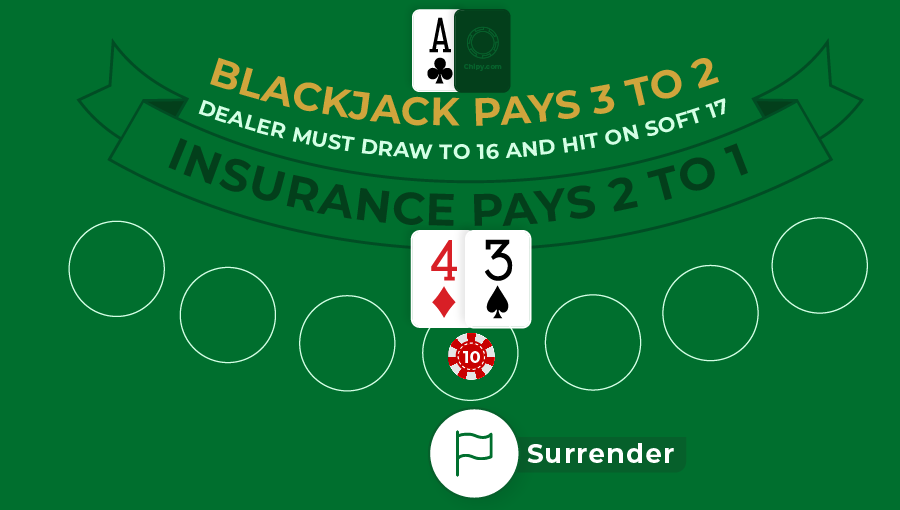
It’s a strategy that allows the player to give up half of their bet by folding their hand. It’s used when the player has a weak hand, and the dealer has a strong hand.
There are two options for surrendering your hand:
- Late Surrender
- Early Surrender
Both options occur after all the players and the dealer have been dealt their initial two cards, and before any further cards have been dealt.
This article is for the Basic Strategy player although it works for the seat-of-the-pants player too.
I’m going to go through the various options and give you a detailed blackjack surrender strategy that you can use going forward.
Pro tip
If you’re not familiar with Basic Strategy, then please read my dedicated guide for some incisive information about what it is, and why it’s a good thing for all serious blackjack players to know.
Later in the article we’re going to discuss how to make deviations to your surrender strategy based on the count, for the card counters out there.
Want to know more about counting cards?
I have created a detailed guide on how to count cards. This article will take you from the basic concepts to a seriously in-depth description of how to do it, how to avoid detection and what the casinos look for to try and stop you from being a successful card counter.
How to Surrender in Blackjack
Well, it’s a bit like being on Tinder (ahem … well, so I’m told)! Don’t like your hand and want to get rid of it?
Swipe Left!
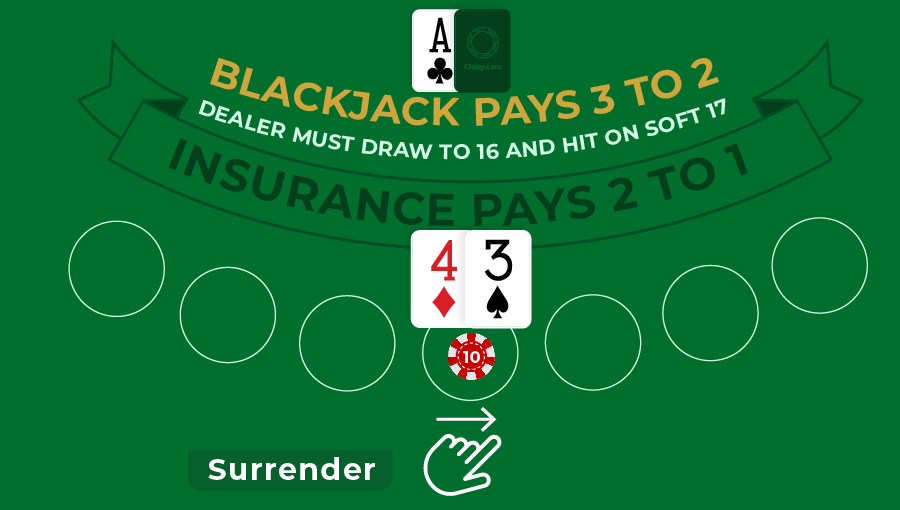
Make a right to left straight line about 6 inches (15 cms) behind your bet with your fingers while simultaneously saying ‘Surrender’ loud enough for the dealer to hear you.
Make sure your signal isn’t going to be confused with a ‘Hit’ or ‘Stand’ signal.
The dealer will return half of your bet to you, take the other half and then place your cards in the discard rack.
Done - surrendered!
Early Surrender vs. Late Surrender: What is The Difference?
Early Surrender was instituted in Atlantic City in the late 1970s/early 1980s, and it quickly became apparent that it was not such a good idea from the casino’s point of view.
It is perhaps the perfect example of what happens when people with good intentions, but little gaming knowledge, are allowed to make the rules for casinos to follow.
Here’s the problem:
In a game that typically has a House Advantage of about 0.75% (yes, that’s ¾ of one percent), Early Surrender gave up to 0.60% back to the players.
Consequently, it didn’t last very long, and has essentially disappeared from the game completely.
Let’s just put it this way - in 35 years and as a consultant in more than 15 casino openings in 8 jurisdictions and three countries, I’ve never seen Early Surrender offered on any blackjack game.
If you ever see it and are tempted to play, take a close look at the other rules in place.
It’s almost certain that where the casino is giving you that big chunk, they are taking it back by adjusting the rules somewhere else.
Late Surrender, on the other hand, is still offered in many jurisdictions in the USA and abroad. It offers a viable strategy for the player and can be part of an overall way to play that helps reduce the house advantage against you.
Key Takeaway
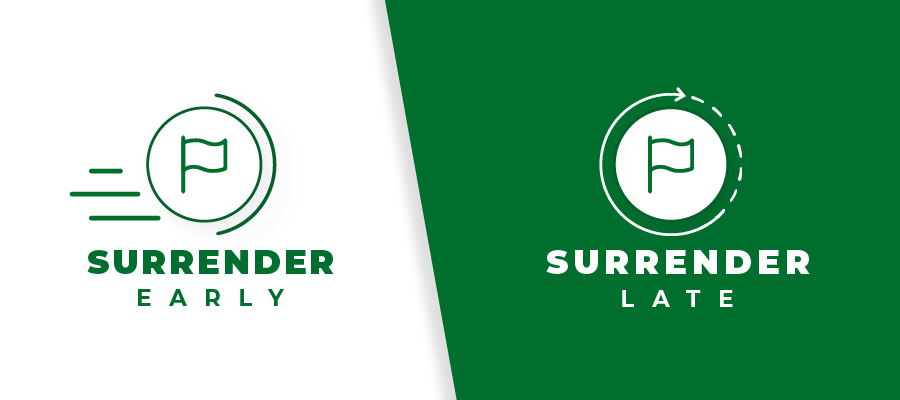
The difference between the two is simply that Early Surrender is offered before the dealer checks their hole card for blackjack, and Late Surrender is offered after the dealer checks for blackjack.
Because you’re much more likely to find a game that offers Late Surrender, let’s look at how to play that version of Surrender first.
I’ve included the strategies for double deck and 6-deck shoe which pay 3 to 2 for a blackjack.
Side note
I’ve not included the strategy for surrendering on a single deck game here because it’s almost impossible to find a single deck game that pays 3 to 2.
The casinos have all moved to 6 to 5 for a blackjack on a single deck game, and you’re simply not going to play a game that offers that.
The reason is that a 6 to 5 blackjack payout increases the House Advantage by a whopping 1.39% - which is too much to overcome.
So you’re not going to play a 6 to 5 game, are you? No, of course you’re not.
Good decision!
How to Play Using Surrender in Blackjack
Let’s explore some scenarios where using surrender may actually make sense:
Late Surrender
The hands to surrender in Late Surrender blackjack are:
| 6-deck shoe, dealer hits a Soft 17 | ||
|---|---|---|
| Player hand | Dealer up card | Action |
| Hard 17 | Ace | Surrender if allowed, otherwise Stand |
| Hard 16 | 9, 10, Ace | Surrender if allowed, otherwise Hit |
| Hard 15 | 10, Ace | Surrender if allowed, otherwise Hit |
| 8,8 | Ace | Surrender if allowed, otherwise Split |
| Double deck, dealer hits a Soft 17 | ||
|---|---|---|
| Player hand | Dealer up card | Action |
| Hard 17 | Ace | Surrender if allowed, otherwise Stand |
| Hard 16 | 10, Ace | Surrender if allowed, otherwise Hit |
| Hard 15 | 10, Ace | Surrender if allowed, otherwise Hit |
| 8,8 | Ace | Surrender if allowed, otherwise Split |
As you can see, the only difference between the 6-deck shoe and the double deck is that when playing the shoe, if you have a hard 16 vs. a 9 you should surrender, but on the double deck, you should not.
Early Surrender
If you happen to find a game with early surrender (and some online games do offer it), here is how you play it
I’ve included some single deck information here, because if they’re offering Early Surrender and you’re comfortable with the other rules, you may want to give it a go.
| Player Hand | Dealer up card | Action |
|---|---|---|
| Hard 5 - 7, 12 - 17 | Ace | Surrender |
| Pair 3s, 6s, 7s, 8s | Ace | Surrender |
| Hard 14 - 16, Pair 7s or 8s | 10 | Surrender |
| Pair 2s | Ace | Surrender if dealer hits a Soft 17 |
| 10 + 4 | 10 | Don't Surrender on double deck |
Single deck variances:
| Player Hand | Dealer up card | Action |
|---|---|---|
| 4 + 10, or 5 + 9 | 10 | Do Not Surrender |
| 8 + 8 | 10 | Surrender |
| Hard 14 - 16, Pair 7s or 8s | 10 | Do Not Surrender if double after split is OK |
There are some variables that may be taken into consideration in Early Surrender and Late Surrender.
Whether the dealer stands or hits a Soft 17, the number of decks in play, and the composition of the player’s hand are all potential factors in the ‘Surrender’ decision.
Here’s a chart that shows when you should surrender. This is for those who play Basic Strategy.
Total Dependent vs Composition Dependent
Now we’re getting into the really deep waters of playing blackjack. Total Dependent means it’s the total of your first two cards.
For example
If you have a 9 and a 7, your total is 16.
Composition Dependent means the cards that make up your 16.
Is it 9 + 7? Or 10 + 6? Or Ace + 5? Or 8 + 8?
There are different ways to play them, based upon the composition of your hand. It only matters when playing a single deck, and even then, it is a miniscule difference.
The difference in the above example can be as small as 0.036% - which translates into one additional bet every 2,800 hands.
And for more decks, the amount drops like a stone.
So it’s really more trouble than it’s worth.
When to Incorporate Surrender if You’re Card Counting
Don Schlesinger, a highly respected gaming mathematician and member of the Blackjack Hall of Fame, published a book called ‘Blackjack Attack: Playing the Pro’s Way’ that listed how to change the Surrender decision based on the count.
They are called ‘The Fab Four’.
They’re called ‘count adjusted deviations’, and here they are:
| Your hand | Dealer's Up Card | True Count | Surrender Action to Take |
|---|---|---|---|
| 14 | 10 | +3 | Surrender at +3 or more, hit at +2 or less |
| 15 | 10 | 0 or more | Surrender at 0 or more, hit at -1 or less |
| 15 | 9 | +2 | Surrender at +2 or more, hit at +1 or less |
| 15 | A | +2 | Surrender at +2 or more, hit at + 1 or less |
Blackjack Surrender Online: Is It Possible?
When playing online, Surrender may be offered as part of the software suite that allows you to play blackjack online.
Simply select the ‘Surrender’ button and the program will take 50% of your bet, return the other 50% to your balance and remove your cards from play.
It is possible to find an online game that includes Early Surrender. Be aware that to offer that, the online casino will probably be taking back some of their House Advantage by changing the other rules.
Expert Advice: The Strategy Behind Surrendering

Many players like to think that Surrender is an admission of failure, or perhaps ‘I’m not trying hard enough’. Nothing could be further from the truth.
The casino has a suite of rules in place to arrive at their House Advantage that suits their marketing positioning plan and competitive edge.
By not surrendering when you should, you’re knowingly increasing the House Advantage against you, and giving up a piece of the pie that the casino has already given to you.
There are some hands that you have little opportunity to win, and it makes sense to surrender those hands and accept a 50% loss, rather than try to win a hand where you have (for example) a 20% chance to win.
Pro Tip
Surrender should be one of your strategic plays when playing Blackjack.
Fun Fact
Better to accept a 50% loss than to continue to play and lose 80% or more.
Key Takeaway - Is Surrendering Worth it?
Surrender is an underappreciated opportunity for the players to reduce the House Advantage against them. Often the player doesn’t even know that Surrender exists, or what hands should be surrendered.
When I was working the casino floor in Las Vegas, I rarely saw anyone surrender - perhaps once or twice, and that was in more than seven years.
Look at the hands that I recommend should be surrendered in this article and start doing so when you’re playing blackjack.
They will help you and improve your odds of winning when playing blackjack.
We have many articles about how to improve your overall blackjack play in the Academy, from learning Basic Strategy to How to Count Cards.
There are also some in-depth articles that focus on one specific part of the game, including Doubling Down, Splitting Pairs, and Insurance
Final Thoughts
There you have the details about how to play Surrender in blackjack.
It can be a good thing to do in the right circumstances and should be one of the tools at your disposal when you’re playing blackjack.
And good luck.
 4
4 0
0 Thank you for voting.
Peter Nairn
Vlad Mihalache
Explore More Blackjack Guides


Blackjack Q&As





 Level 4United States
I don't know what that means.
 4 Need Answer
 3 AnswersLevel 1
I mostly play slots and sometimes blackjack. Any real experiences here? Would love to hear from actual players before I dive in. Thanks in advance!
2 Need Answer5 AnswersLevel 2Which do you think wins more or is more likely to win?
2 Need Answer7 Answers