 Level
Level 


 Casinos
  Bonuses


Hard vs Soft Blackjack Hands: How They Impact Your Strategy

Peter Nairn
Casino Operations Specialist

- Over 3 decades of experience in casino operations management, with a focus on Table Games and Slots;
- Senior executive positions in both Native American and traditional casino markets for companies like Harrah’s New Orleans and Minnesota-based Grand Casinos;
- Hands-on experience as trainer and dealer of multiple casino games including: Blackjack, Roulette, Craps, and more;
- Profound knowledge of Title 31 regulations, State compacts, and Federal MICS.
 100%
100% 4 min
4 min Updated on Mar 28, 2025
Welcome to our article on Soft vs Hard Blackjack. Playing blackjack is a fun and exciting way to spend an evening, but one of the things that may be a bit of a challenge for a new player is in determining if you have a hard vs soft hand, and if so, how do you play each of them.
When you have finished reading this article, you will know exactly what to do with a soft hand and a hard hand and why there is a difference in how you play each of them.
What is a soft hand?
A soft hand is any hand that contains an Ace that counts as 11. As I’m sure you know, an Ace can count as 1 or as 11. If it counts as 11, then you have a soft hand.
Why is that a soft hand? Because no matter what you hit it with, it will not bust. If you hit it with a card that takes the total over 21, you simply change the value of the Ace to a 1 instead of 11, and now you have a hard hand.
Let’s take a look at a couple of examples:
What is a hard hand?
A hard hand can have two components.
If it doesn’t have an Ace, it can be any two (or more) cards. Queen 3 is a hard 13. 8 and 7 is a hard 15.
If it does have an Ace, the Ace must count as 1, not 11. So Ace 6 is always going to be a soft 17. Ace, 6 and 7 is always going to be a hard 14, because if we count the Ace as 11, the hand is over 21 as 6 + 7 + 11 = 24.
How to play a soft hand
And this is where it gets interesting. Good Basic Strategy has a clearly defined way to play all the soft hands, based upon the player’s hand value, and the dealer’s up card.
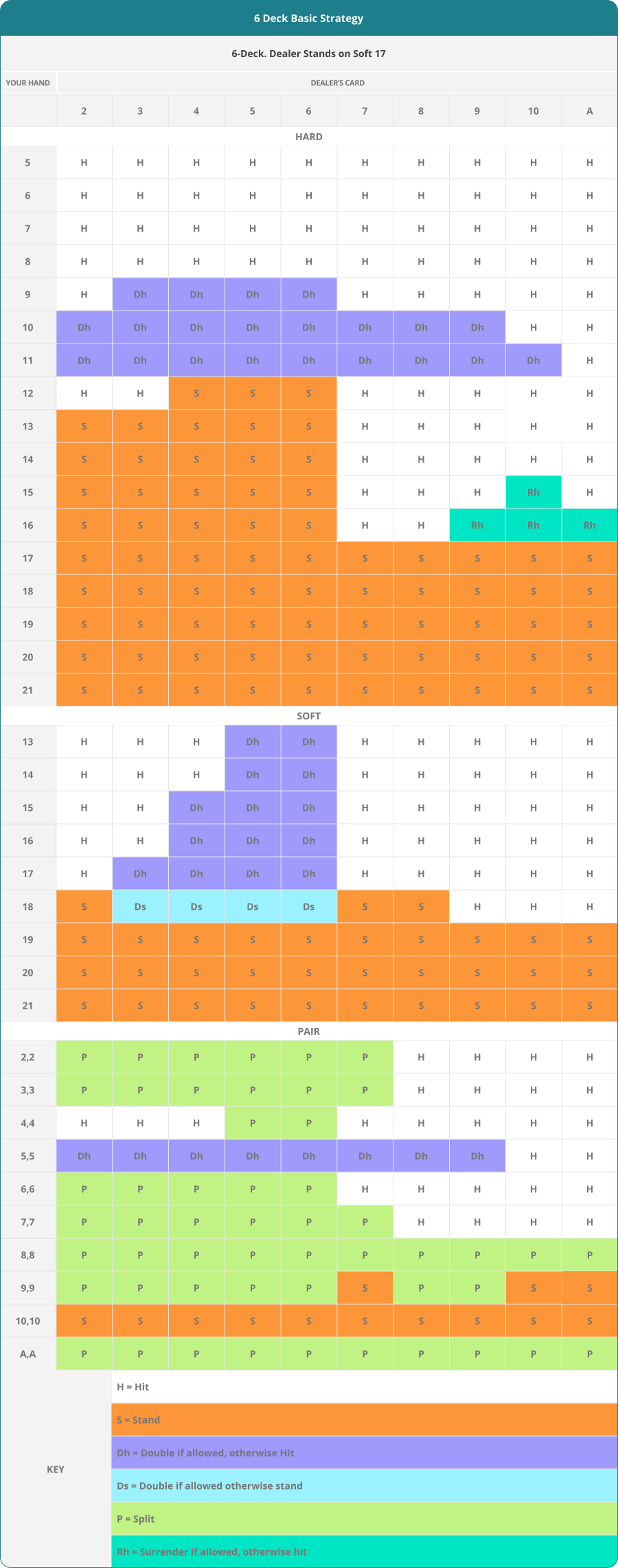
Let’s take a look for a 6-deck shoe where the dealer hits a soft 17 (H17).
Here is the ‘how to play the soft hand and the hard hand’ information, and then the Basic Strategy chart.
How to Play Each Soft Hand
| Your hand | Dealer has | Action to take |
|---|---|---|
| Soft 20 | Any up card | Stand |
| Soft 19 | 6 | Double if allowed, Stand with everything else |
| Soft 18 | 2 through 6 | Double if allowed, otherwise Stand |
| Soft 18 | 7, 8 | Stand |
| Soft 18 | 9, 10, Ace | Hit |
| Soft 17 | 3, 4, 5, 6 | Double if allowed, otherwise Hit. All other up cards, Hit |
| Soft 14, 15, 16 | 4, 5, 6 | Double if allowed, otherwise Hit. All other up cards, Hit |
| Soft 13 | 5, 6 | Double if allowed, otherwise Hit. All other up cards, Hit |
| Soft 12 | Any up card | A Soft 12 is a pair of Aces, so always split them |
How to Play Each Hard Hand
| Your hand | Dealer has | Action to take |
|---|---|---|
| 18+ | Any up card | Stand |
| 17 | Ace | Surrender if allowed, otherwise Hit. Stand on everything else |
| 16 | 2 through 6 | Stand, Hit against a 7 or 8 |
| 16 | 9, 10, Ace | Surrender if allowed, otherwise Hit |
| 15 | 2 through 6 | Stand, Hit against a 7 or 8 |
| 15 | 10, Ace | Surrender if allowed, otherwise Hit |
| 13, 14 | 2 through 6 | Stand, Hit against everything else |
| 12 | 4, 5, 6 | Stand, Hit against everything else |
| 11 | Any up card | Double if allowed, otherwise Hit |
| 10 | 2 through 9 | Double if allowed, otherwise Hit |
| 9 | 3 through 6 | Double if allowed, otherwise Hit |
| 4 - 8 | Any up card | Hit |
6 Deck Basic Strategy, Dealer Stands on Soft 17
6 Deck Basic Strategy, Dealer Hits on Soft 17
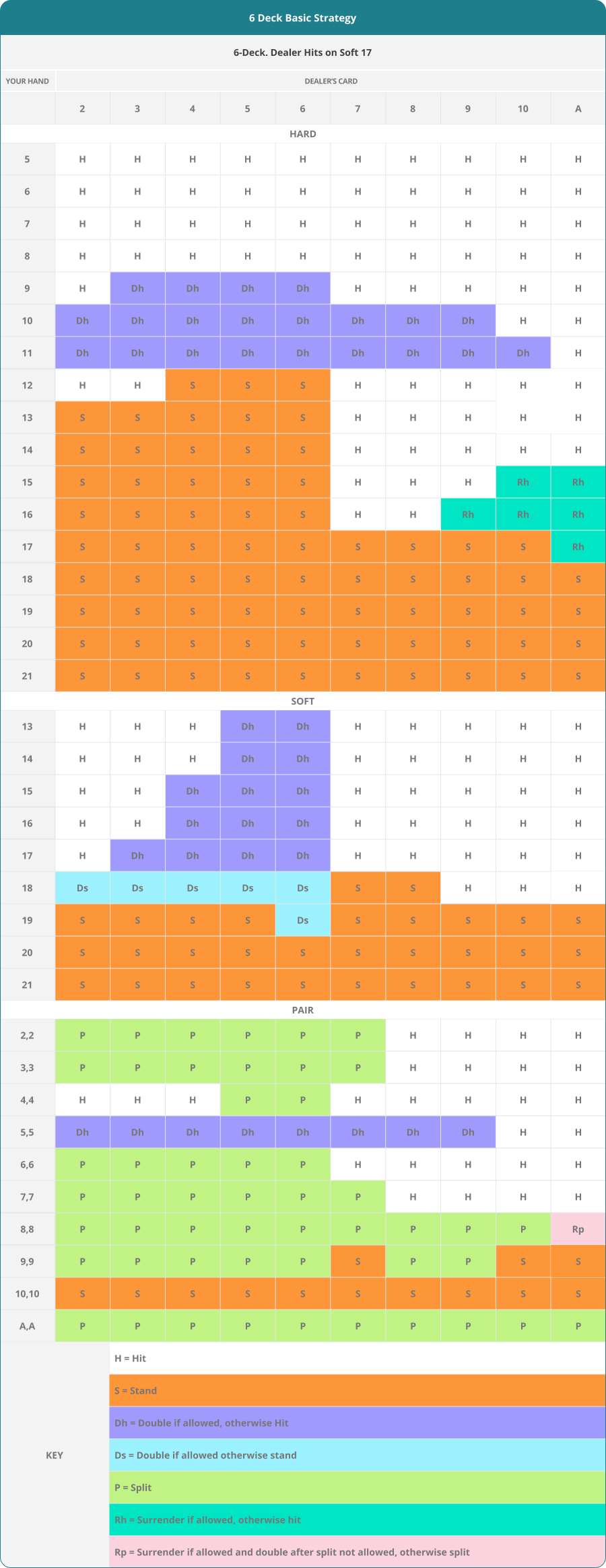
Here’s the table that lists the differences between the dealer hits a soft 17, and the dealer stands on a soft 17.
| Your Hand | Dealer's Hand | Dealer Hits Soft 17 | Dealer Stands Soft 17 |
|---|---|---|---|
| 11 | Ace | Double down if allowed, otherwise Hit | Hit |
| 15 | Ace | Surrender if allowed, otherwise Hit | Hit |
| 17 | Ace | Surrender if allowed, otherwise Stand | Hit |
| Ace, 7 | 2 | Double if allowed, or Stand | Stand |
| Ace, 8 | 6 | Double if allowed, or Stand | Stand |
| 8, 8 | 10, Ace | Surrender if allowed, otherwise Split | Split |
You will notice that there are only a few differences between the two. It may make more sense for you to learn one Basic Strategy chart extremely well, and then only learn the differences between the two so you can easily slip between the S17 and H17 if you need to.
Conclusion
It may seem quite complicated at first, but once you play a little, it becomes very clear how to play a soft hand versus how to play a hard hand.
My suggestion is to you that to start, find an online site that allows you to play for free. Please insert a link to the online sites that allow the players to play blackjack for free here.
That will allow you to practice as much as you want and it doesn’t cost you anything to learn.
Take as much time as you need to get really comfortable with the Basic Strategy charts.
And once you can easily make the decisions of how to play the soft and hard hands, you may be ready to play for real money.
And as always, good luck out there.
 9
9 0
0 Thank you for voting.
Peter Nairn
Explore More Blackjack Guides


Blackjack Q&As





 Level 3United States
I don't know what that means.
 4 Need Answer
 3 AnswersLevel 1
I mostly play slots and sometimes blackjack. Any real experiences here? Would love to hear from actual players before I dive in. Thanks in advance!
1 Need Answer5 AnswersLevel 2Which do you think wins more or is more likely to win?
2 Need Answer7 Answers