


 Casinos
 Bonuses


Blackjack Hand Signals Explained

Peter Nairn
Casino Operations Specialist

- Over 3 decades of experience in casino operations management, with a focus on Table Games and Slots;
- Senior executive positions in both Native American and traditional casino markets for companies like Harrah’s New Orleans and Minnesota-based Grand Casinos;
- Hands-on experience as trainer and dealer of multiple casino games including: Blackjack, Roulette, Craps, and more;
- Profound knowledge of Title 31 regulations, State compacts, and Federal MICS.

Liliana Costache
Online Gambling Content and Localization Manager- Over 10 years of experience in the iGaming sector, including 5 years as a Content Manager.
- Holder of certifications in German, Swedish, and the EU Gambling Regulatory Framework from the iGaming Academy.
- Over 15 years of specialization in creating compelling and SEO-optimized content.
- Brings 25+ years of experience in translation and localization.
- Over four decades of fluent French proficiency.
 100%
100% 8 min
8 min Updated on Mar 03, 2025
Welcome to Blackjack Hand Signals, the latest in our series of articles about how to be a better blackjack player.
What are the blackjack signals is an interesting question, so we’re going to explore the what, why, and how of it today.
When you finish reading this article, you will know how to let the dealer know what you want to do, why you need to use hand signals, and what the differences are between a shoe game and a pitch game, where you may actually pick up the cards and use them to signal what you want to do.
Let’s get started.
Why do we need hand signals at all?
Isn’t it possible for the player to tell the dealer what they want?
Hit me, double down, split this pair?
Yes, it is, but there are some limitations to that system.
Casinos can be quite loud places, and with hundreds or sometimes thousands at stake, it’s important to get it right first time, so the hand signals became a way to ensure that there were no misunderstandings.
In addition to that, every blackjack table has at least one camera over the game recording everything that happens on the table, so if there is a mistake made, it’s easy to run back the video and see what the hand signal was.
It would be a very unusual step for a casino to have an audio recording of a game, and certainly not multiple games.
There’s also the benefit that the game runs faster with hand signals. There’s no conversation or clarification needed about what the player wants if they use the hand signal to the dealer.
Expert Tip
We have many articles about blackjack and the other popular casino table games, including roulette, craps, and baccarat, as well as slots and other casino-related subjects. Written by experts and covering everything from beginners to experts, you will always find something interesting that will allow you to expand your gaming knowledge. And it’s all free! Go here.
Hand signals in blackjack
Two different kinds of game, two different kinds of signals
There are two different styles of blackjack played in casinos worldwide.
You identify them by how the dealer gives you your cards.
One is called a pitch game, which is mostly face down. The dealer delivers your cards to you by physically pitching them over your bet and gently dropping them face down in front of you. You are then free to pick them up (using only one hand) and then playing your hand.
The second is called the shoe game, which is face up. A shoe is a box that holds the cards, and the dealer pulls the cards out of the shoe and places them on his side of your bet, face up. You don’t touch the cards at all.
Usually, pitch games consist of one or two decks, with a shoe game being played with anything from 4 to 8 decks.
I have seen a shoe being used to play a double deck game, but that’s very unusual to see.
The Pitch Game – Face Down
You use the first two cards that you are dealt to help give the hand signals to the dealer on a pitch game.
Signal for Hit (Face Down)
Hit – means you want another card, so you motion towards yourself with a scratching motion on the tabletop with the cards. Be careful not to bend the cards.
Signal for Stand (Face Down)
Stand – means you’re happy with the cards you have and don’t want another card, so you place your cards face down under your bet. The easiest way to do it is to slide a corner of the cards under your chips. Don’t touch the chips.
Signal for Double Down (Face Down)
Double Down – which means you want to double your bet and receive one card. You would gently toss your cards face up on the dealer’s side of your bet.
Place the additional chips next to your original bet, then hold up your index finger to the dealer indicating that you only want one card. The dealer will know you want to double down. You may bet less than your initial bet if you like.
The dealer will tuck your hit card face down on your side of the bet. You can look at it if you would like to. Don’t touch the chips and try not to bend the cards if you look at it.
Signal for Split (Face Down)
Split – which means you want to take your pair and change your hand into two hands.
Again, gently toss your cards over so they're face up on the dealer’s side of your initial bet.
Add the additional chips beside but separate from your initial bet.
Make a motion with your hand to indicate you want two hands by making a V sign with your first and second fingers using your hand palm down to indicate two hands.
A split bet must match your initial bet.
Signal for Insurance (Face Down)
Insurance – the dealer will loudly say ‘Insurance’ and move their hand in an arc from (her) left to right.
Simply place the additional chips (50% of your initial bet) on the Insurance line on the table.
Signal for Surrender (Face Down)
Surrender – This is when you have the opportunity to give up half of your bet and get out of the hand.
The signal is to draw a horizontal line with your finger behind your bet.
Draw the line about 6 inches (15 cms) behind the betting circle – and the line should be about 9 inches (23 cms) long.
Loudly announce to the dealer that you want to surrender and make sure your signal is not mistaken for a signal to hit.
The Shoe Game – Face Up
The first two cards you are dealt on a shoe game are face up on the table and you can’t touch them, so you use a hand signal to let the dealer know what you want to do.
Signal for Hit (Face Up)
Hit – Tap the table close to the bet, but behind the betting area.
Signal for Stand (Face Up)
Stand – Wave your hand face down over your bet.
Signal for Double Down (Face Up)
Double Down – Place the additional chips beside your original bet, then hold up your index finger to the dealer indicating that you only want one card.
The dealer will know you want to double down.
You may bet less than your initial bet if you like. The dealer will place your hit card face up and perpendicular to your initial two cards.
Signal for Split (Face Up)
Split - Add the additional chips beside but separate from your initial bet.
Make a motion with your hand to indicate you want two hands by making a V sign with your first and second fingers using your hand palm down to indicate two hands.
A split bet must match your initial bet.
If the opportunity to double down after a split is available, you can indicate to the dealer that you would like to.
Signal for Insurance (Face Up)
Insurance - the dealer will loudly say ‘Insurance’ and move their hand in an arc from (her) left to right.
Simply place the additional chips (50% of your initial bet) on the Insurance line on the table.
Don’t worry if you put the bet in the wrong place, the dealer is there to help, and will place it correctly for you - just like in the video.
Signal for Surrender (Face Up)
Surrender - Draw a horizontal line with your finger behind your bet.
Draw the line about 6 inches (15 cms) behind the betting circle – and the line should be about 9 inches (23 cms) long.
Loudly announce to the dealer that you want to surrender and make sure your signal is not mistaken for a signal to hit.
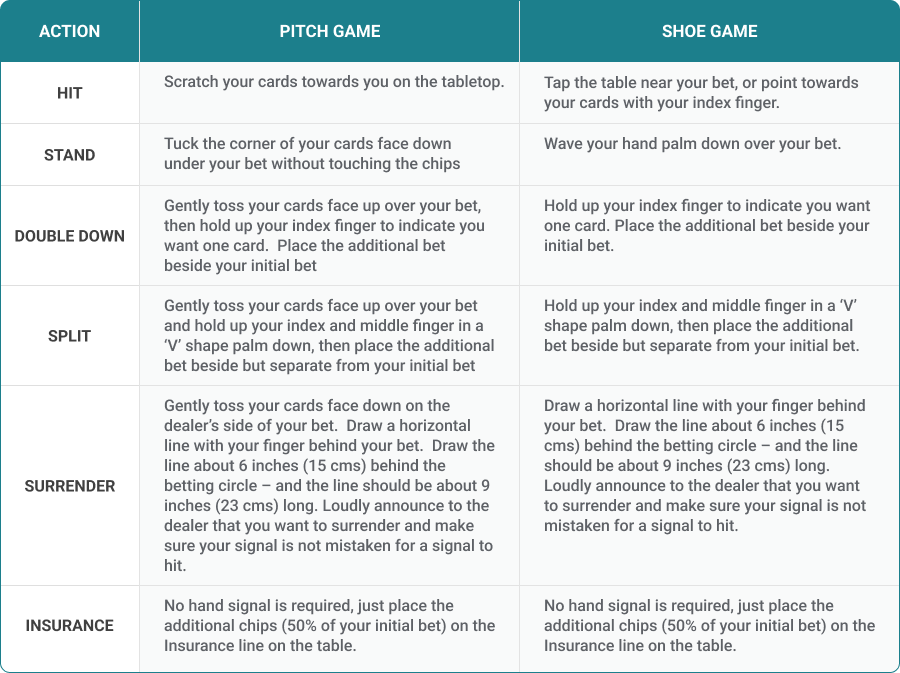
Here is a table presenting a summary of the gestures for both versions of blackjack for your convenience:
Online Blackjack Hand Signals
Online blackjack does not require any hand signal from the player. The software in both regular and live dealer blackjack acts as an intermediary between the player and the game, so no hand signals are required.
Expert Advice / Tips about hand signals
It’s important to make sure you communicate to the dealer what you want to do.
By watching the other players, you will quickly see how it is done, and just do what the other players do, and you’ll be fine.
It can be quite intimidating at first, but the dealer is there to help you, and you can talk to the dealer to make sure you get what you want.
 6
6 0
0 Thank you for voting.
Peter Nairn
Liliana Costache
Explore More Blackjack Guides


Blackjack Q&As





 Level 4United States
I don't know what that means.
 4 Need Answer
 3 AnswersLevel 1
I mostly play slots and sometimes blackjack. Any real experiences here? Would love to hear from actual players before I dive in. Thanks in advance!
2 Need Answer5 AnswersLevel 2Which do you think wins more or is more likely to win?
2 Need Answer7 Answers