Casinos
 Bonuses


Understanding Blackjack Deviations: Strategies for Game-Changing Results

Peter Nairn
Casino Operations Specialist

- Over 3 decades of experience in casino operations management, with a focus on Table Games and Slots;
- Senior executive positions in both Native American and traditional casino markets for companies like Harrah’s New Orleans and Minnesota-based Grand Casinos;
- Hands-on experience as trainer and dealer of multiple casino games including: Blackjack, Roulette, Craps, and more;
- Profound knowledge of Title 31 regulations, State compacts, and Federal MICS.

Vlad Mihalache
Online Gambling and Crypto Casinos Specialist
- Accomplished content strategist and editor with over 8 years of experience in the iGaming industry;
- Certified Cryptocurrency Expert (CCE);
- Specializes in blackjack strategies, slots, crypto casinos, and gambling addiction;
- Bitcoin casino expert with extensive knowledge of crypto trading and blockchain gaming;
- Online gambling expert with 7,000+ articles written and reviewed;
- Strong advocate for responsible gambling with complex knowledge of the latest trends;
 82%
82% 19 min
 Updated on Jun 03, 2025
In this guide, Peter Nairn, a professional Vegas dealer, will teach you all about blackjack deviations and how to use them to improve your game.
Here’s what you’ll learn:
- What are Blackjack Deviations? Do they matter?
- Why are Blackjack Deviations Important?
- Types of Blackjack Deviations
- When to Apply Blackjack Deviation
- The Impact of Deviations on Risk and Variance
- The Role of True Count in Blackjack Deviation
- Practicing Blackjack Deviations
- Real Life Examples of Blackjack Deviation
- Understanding the Mathematics of Blackjack
- Expert Advice: Mastering Blackjack Deviation
This information primarily benefits an experienced blackjack player who understands how to count cards.
You will get the most out of this article by using the deviations charts we have included here in coordination with their card-counting skills.
Let’s get started!
Author’s Recommendation
It goes without saying that you must play perfect Basic Strategy every hand, no exceptions, before the deviations become valuable to you.
If you’re unsure about your Basic Strategy skills, check out my dedicated guide.
What are Blackjack Deviations? Do They Matter?

‘Blackjack deviations’ are how you should adjust your Basic Strategy blackjack play based on the true count in a casino blackjack game.
With any given set of blackjack rules, there is a mathematically correct way to play every hand.
This is called Basic Strategy. Basic Strategy is not an opinion.
(Basic Strategy has been arrived at by experts running computer simulations of billions of hands to determine the correct way to play every possible hand).
Pro Tip
The way to learn Perfect Basic is to make yourself some flashcards with your hand and the dealer’s up card on one side, with the correct play on the other side.
Running through all the cards once every couple of hours every day for two weeks will get you to where you know the answers immediately with no thought involved.
At first, it will seem like there are a lot of flashcards to learn.
After a few run-throughs, however, you will quickly weed out the obvious plays and get down to the borderline plays.
Basic Strategy is the correct way to play with a neutral deck. But what about a non-neutral deck?
This is where the blackjack playing deviations come in.
Once you learn to count cards, you will quickly be able to identify a deck with a plus or minus True Count (a non-neutral deck).
Once you can do that, the blackjack card counting deviations will become a part of your arsenal of tools to swing the house advantage (HA) away from the casino and onto your side
Why are Blackjack Deviations Important?
Blackjack deviations are essential because they reduce the House Advantage against you to its absolute minimum.
How Deviations Can Increase Expected Value (EV)
Expected Value (EV) is the mathematical expectation of how much you will win or lose based on how you play within the rules of the blackjack game you are playing.
If you play Perfect Basic Strategy, you will generate EV based on that level of play.
The deviations from Basic are a way of fine-tuning the best plays to match the shoe's composition so that you adjust your play to take advantage of the fact that there are (for example) a lot of 10-value cards or many low-value cards left in the shoe.
By including the Blackjack Deviations in your playing decisions, you will increase the accuracy of your choices so that you are always getting the very best EV you can.
How Deviations Can Reduce Risk and Variance in Gameplay
Changing Basic Strategy to include the blackjack deviations lowers risk and variance because you’re always making the best and most accurate play.
Your bankroll will be better protected, and you will experience fewer volatile swings because you always make the correct decision.
Pro Tip
You would never split a pair of 10s, right? Based on the Blackjack Deviations, that may not always be true.
In the I-18 chart you will find below, you can see that if you have a pair of 10s vs the dealer’s up card of 5, and if the true count is +5 or higher, the correct play is to split the tens.
Fun Fact
And as a ‘true life experience’ tale, I did that once on a live blackjack table in Las Vegas. I thought the guy on third base was going to have a stroke!
And his outrage was loud and pointed directly at me. Which led me to a ‘fork in the road’ decision.
Should I tell him I was counting cards and knew it was the best play, or keep quiet and let him (and the floorman) think I didn’t know what I was doing?
I solved my dilemma by acting like an innocent tourist and split them. I got an 18 and a 20, and the dealer turned over his 15, and busted.
The third base still wasn’t happy.
Types of Blackjack Deviations
There are two main types of deviation: Playing Deviation and Betting Deviation.
The Playing Deviation
Blackjack Hall of Famer Don Schlesinger has published several playing guides and two excellent blackjack books. He is a world-renowned gaming mathematician, highly skilled blackjack player, and authority on casino blackjack.
In his book ‘Blackjack Attack: Playing the Pro’s Way’, he includes two tables listing correct, true count blackjack deviations.
I have consolidated the two tables into one table for this article.
This table includes ‘The Illustrious 18’, and ‘The Fab Four’.
The Illustrious 18 (I-18) lists the eighteen most commonly seen deviations from Basic Strategy that should be made based on the true count with a non-neutral deck.
The Fab Four are the last four entries in the table, and address when you should surrender based on the true count.
Here’s how to read the table:
The player’s hand is listed in the left-hand column with the dealer’s up card in the 2nd column.
The True Count is listed in the 3rd column, and the 4th column lists the correct variance from Basic Strategy based on the information in the other three columns.
Let’s say you have 16 vs the dealer’s up card of 9. Basic Strategy says you should just hit. But with a True Count of +5 or more, you should stand, because the deck is rich in 10-value cards and you’re more likely to bust if you hit.
Another example is if you have a 10, vs the dealer’s up card of an Ace. Ordinarily, you would just hit, but if the true count is +4 or more, then doubling down is a better option because there are so many 10s in the deck.
(Before you can make this play, the dealer will have already checked for a blackjack.)
Blackjack Playing Deviations Table
The lower part of the table includes the count adjusted deviations you should make on the Basic Strategy ‘Surrender’ plays.
Pro tip
If you can’t play Basic Strategy perfectly every time, you’re not ready to use the count or the deviations in your live blackjack play.
Betting Deviations
There is a second type of deviation that you need to include, and that is the Betting Deviations.
Below is a table of the betting changes that should be made based on the true count.
Once the True Count goes plus, you can adjust the amount you bet per hand to maximize your advantage.
The philosophy here is to bet more when the shoe is plus (i.e., in your favor), and less when it is minus, which is in the casino’s favor.
Fun fact
J. L. Kelly was a 1950’s scientist who came up with a table similar to this one to assist people with investing in the stock market. It allowed them to limit their investments to a small percentage of their overall investment portfolio, while maximizing their gains and minimizing their losses.
It happens to work very well for betting deviations, too.
Blackjack Betting Deviations Table
| True Count (TC) | Units to bet in a 1 – 12 spread game | Units to bet in a 1 – 8 spread game |
|---|---|---|
| 0 or negative | 1 | 1 |
| +1 | 1 | 1 |
| +2 | 2 | 2 |
| +3 | 4 | 4 |
| +4 | 8 | 8 |
| +5 and up | 12 | 8 |
The left column of the table indicates the true count, and the middle and right columns include the number of each betting unit to be wagered depending on the true count and the betting spread system being used.
When to Apply Blackjack Deviation
Betting deviations should be applied when the true count goes plus.
A 1 – 12 bet spread is more aggressive than the 1 – 8 spread but comes with the additional risk of being discovered as a card counter and barred from playing.
The number of units bet in each system doesn’t change until the count goes up to +4 or higher.
How much risk are you willing to entertain?
Guidelines on When to Apply Playing Deviation
Playing deviations should be applied based on the player’s hand, the dealer’s up card and the true count. As you can see from the table (above), there are several variances to be accounted for before making your decisions.
Again, you need to have this information at your fingertips.
Unlike a Basic Strategy card, you cannot have this chart at the table, so you must learn it by heart.
The best way to do that is to use flashcards.
On one side you have the player’s hand, the dealer’s up card and the True Count, and on the other side you have the variance to Basic Strategy taken.
The Impact of Deviations on Risk and Variance
If you always take Insurance at a +3 (or more) True Count, you will lower your risk because the dealer is more likely to make their blackjack because there are more 10-value cards available to her.
And you protect your bankroll and minimize the risk by making that Insurance bet when it’s more likely to happen.
The Role of True Count in Blackjack Deviation
What is True Count, and why is it important?
When counting cards in blackjack, there are two counts that are important.
One is called ‘Running Count’, and it is the sum of high (minus 1) and low (plus 1) cards that have been removed from the shoe.
The second count number is the ‘True Count’. The True Count is the number of cards that have been removed from the shoe, divided by the number of decks remaining in the shoe.

For example
If the Running Count of the shoe is +6 and there are three decks remaining in the shoe, the True Count is +6 divided by 3 = +2.
How True Count Influences the Decision to Deviate from Basic Strategy
As the shoe progresses, cards are removed and change the composition of high and low value cards in the shoe.
Let’s say we are halfway through the shoe and there are 6 more low-value cards out than high value cards out. That would make the Running Count +6.
That means that within the three decks remaining in the shoe, there are 6 more 10-value cards than low value cards so there is a greater likelihood of a 10-value card coming out than of a low value card.
We adjust our play based on this fact, increasing our bets, doubling down and hitting when it is to our advantage to do so.
And if the opposite was true, that there are more low-value cards in the remaining decks in the shoe than high-value cards, we would reduce our bets and be more cautious about putting more money into action by splitting or doubling down.
Practicing Blackjack Deviations
You can practice and master both the playing and betting deviations by creating flashcards with the information in the Blackjack Playing Deviations Table and the Blackjack Betting Deviations Table. Using flashcards to learn is a process of simple repetition.
Having created your flashcards, go through them once every couple of hours, perhaps five times every day.
It will take 10 minutes every two hours, and then it won’t take very long before you will have it all memorized – perhaps a week or ten days will be enough.
It may be that the Betting Deviations Table is simple enough to learn just by looking over the table and learning it.
Essentially it comes down to +1 is 1 unit, +2 is 2 units, +3 is 4 units and then +4 is 8 or 6, and +5 is 12 or 8.
And that can be further simplified with 3 is 4, 4 is 8/6, and 5 is 12/8.
Done!
The role of Basic Strategy, Counting, and True Count conversion in mastering deviations
Basic Strategy is a ‘must-have’ skill before you can progress to the more sophisticated tools available. Without Basic Strategy, you’re not going to be able to make the best use of the deviations.
And your Basic Strategy must be perfect.
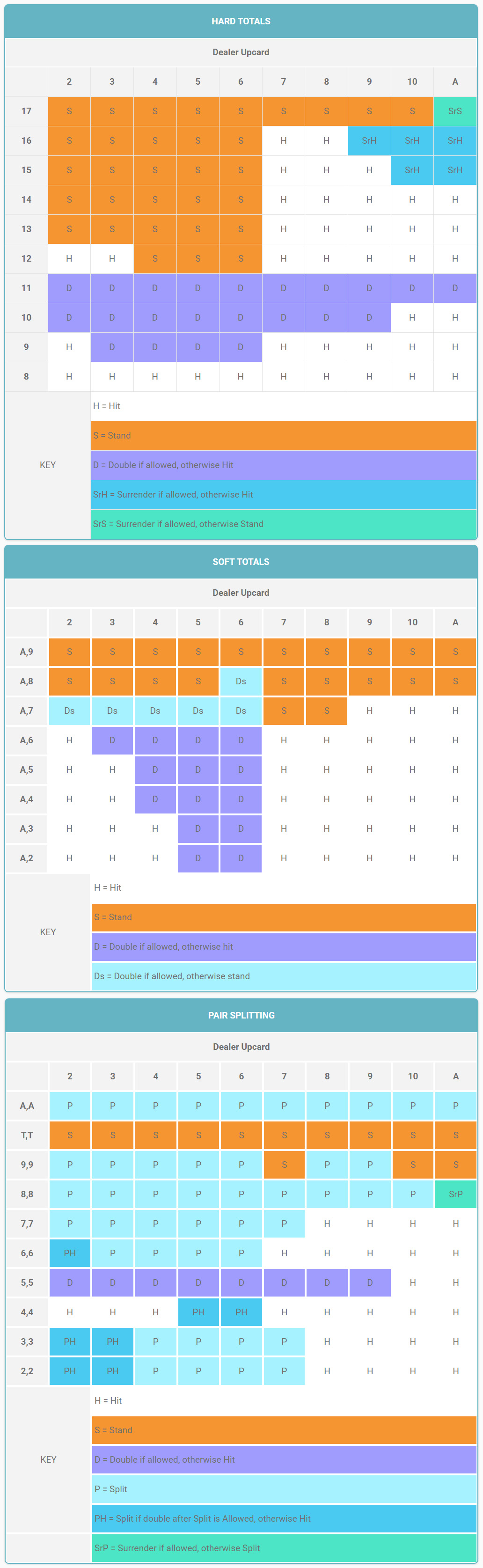
Please use the Basic Strategy Chart below and the blackjack simulator to learn how to play perfect Basic Strategy.
This chart is for a 6-deck shoe and the dealer hits a Soft 17.
| Hard Totals | ||||||||||
|---|---|---|---|---|---|---|---|---|---|---|
| Dealer Upcard | ||||||||||
| 2 | 3 | 4 | 5 | 6 | 7 | 8 | 9 | 10 | A | |
| 17 | S | S | S | S | S | S | S | S | S | SrS |
| 16 | S | S | S | S | S | H | H | SrH | SrH | SrH |
| 15 | S | S | S | S | S | H | H | H | SrH | SrH |
| 14 | S | S | S | S | S | H | H | H | H | H |
| 13 | S | S | S | S | S | H | H | H | H | H |
| 12 | H | H | S | S | S | H | H | H | H | H |
| 11 | D | D | D | D | D | D | D | D | D | D |
| 10 | D | D | D | D | D | D | D | D | H | H |
| 9 | H | D | D | D | D | H | H | H | H | H |
| 8 | H | H | H | H | H | H | H | H | H | H |
| KEY | H = Hit | |||||||||
| S = Stand | ||||||||||
| D = Double if allowed, otherwise Hit | ||||||||||
| SrH = Surrender if allowed, otherwise Hit | ||||||||||
| SrS = Surrender if allowed, otherwise Stand | ||||||||||
| Soft Totals | ||||||||||
|---|---|---|---|---|---|---|---|---|---|---|
| Dealer Upcard | ||||||||||
| 2 | 3 | 4 | 5 | 6 | 7 | 8 | 9 | 10 | A | |
| A,9 | S | S | S | S | S | S | S | S | S | S |
| A,8 | S | S | S | S | Ds | S | S | S | S | S |
| A,7 | Ds | Ds | Ds | Ds | Ds | S | S | H | H | H |
| A,6 | H | D | D | D | D | H | H | H | H | H |
| A,5 | H | H | D | D | D | H | H | H | H | H |
| A,4 | H | H | D | D | D | H | H | H | H | H |
| A,3 | H | H | H | D | D | H | H | H | H | H |
| A,2 | H | H | H | D | D | H | H | H | H | H |
| KEY | H = Hit | |||||||||
| S = Stand | ||||||||||
| D = Double if allowed, otherwise hit | ||||||||||
| Ds = Double if allowed, otherwise stand | ||||||||||
| Pair Splitting | ||||||||||
|---|---|---|---|---|---|---|---|---|---|---|
| Dealer Upcard | ||||||||||
| 2 | 3 | 4 | 5 | 6 | 7 | 8 | 9 | 10 | A | |
| A,A | P | P | P | P | P | P | P | P | P | P |
| T,T | S | S | S | S | S | S | S | S | S | S |
| 9,9 | P | P | P | P | P | S | P | P | S | S |
| 8,8 | P | P | P | P | P | P | P | P | P | SrP |
| 7,7 | P | P | P | P | P | P | H | H | H | H |
| 6,6 | PH | P | P | P | P | H | H | H | H | H |
| 5,5 | D | D | D | D | D | D | D | D | H | H |
| 4,4 | H | H | H | PH | PH | H | H | H | H | H |
| 3,3 | PH | PH | P | P | P | P | H | H | H | H |
| 2,2 | PH | PH | P | P | P | P | H | H | H | H |
| KEY | H = Hit | |||||||||
| S = Stand | ||||||||||
| D = Double if allowed, otherwise Hit | ||||||||||
| P = Split | ||||||||||
| PH = Split if double after Split is Allowed, otherwise Hit | ||||||||||
| SrP = Surrender if allowed, otherwise Split | ||||||||||
Download the Blackjack Strategy Chart
Card counting’s role in mastering the deviations is that to use the deviations, you must know what the correct True Count is at all times.
And to do that, you need to be able to count cards.
As part of card counting, being able to do a Running Count to True Count conversion quickly and accurately is also a critical skill. Often, you will need to do a True Count conversion every hand and you’ve got to get it right – so it’s worthwhile to practice this skill until it becomes second nature to you.
It may be that a trip to your local bricks and mortar casino is what you need.
Not to play, but simply to practice doing count conversions.
Stand and watch a blackjack game. Check the discard rack. Estimate how many decks are out. Therefore, how many decks remain in the shoe. Do the calculations. Every hand the composition of the shoe will change.
Keep practicing.
Real Life Examples of Blackjack Deviation
Let’s say you have a hard 12 against a dealer’s up card of 2. With a neutral deck, you would Hit this hand. But the playing deviation says that if you have a True Count of +4 or more, then you would Stand with this hand.
Perhaps you have a 16 vs. the dealer’s up card of 10.
Not using any deviations, you would ordinarily Hit this hand. But based on the playing deviations, if the True Count is 0 or more on the plus side, you would Stand.
Both examples are based on a plus True Count and illustrate how the count affects the decisions you make.
As the shoe is plus, it means that more low cards have come out, and therefore there are more high cards remaining in the shoe as a percentage of all the cards that remain in the shoe.
With more high cards remaining, it’s more likely that a 10 or face card will show up, and so you take the position that you don’t want it.
And Stand.
Understanding the Mathematics of Blackjack
Probability in blackjack (and in all casino games) is expressed as a ratio between the likelihood of the chosen possible event occurring, vs. all possible events occurring.
For example
You have a King and a 4 and the dealer has a 9 as an up card, and you want to know the probability of you making your hand into a 20 or 21 with one card.
You would add the number of cards left in the deck that could make your hand a 20 or 21 (there are 8 cards – the 6 and 7 of each suit) and express that as a percentage of remaining possible outcomes. There are 49 possible outcomes (because there are already 3 exposed cards) and 52 minus 3 = 49.
So the probability is 8/49 = 0.1632 = 16.32%
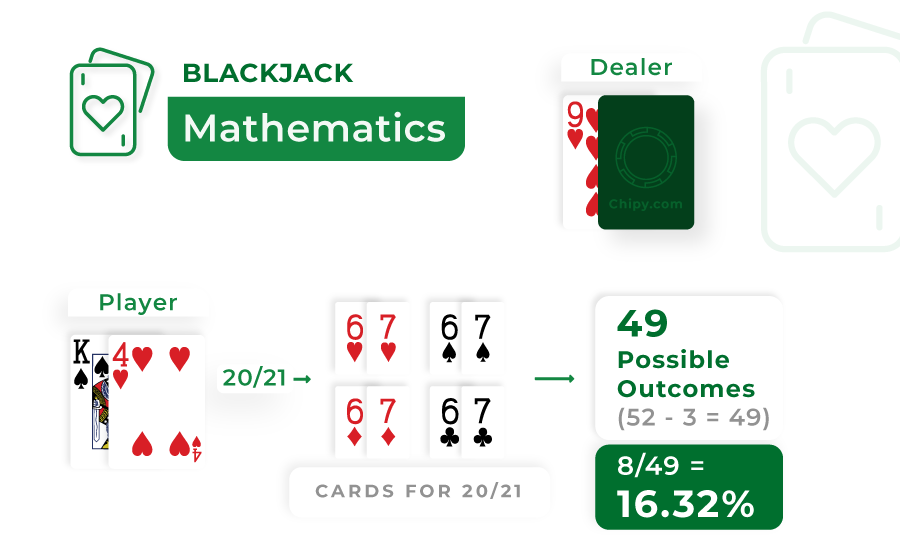
Understanding how the math works can improve your play and how the deviations work. By understanding the math, you will be able to make better decisions about how to play the deviations charts.
Game math, statistics and probabilities can be a fascinating subject if your brain works that way.
We have an excellent article about that. Check out ‘Blackjack Odds and House Edge Explained: A Mathematical Perspective’ by Dr. Catalin Barboianu here.
Expert Advice: Mastering Blackjack Deviation

It’s important to understand card counting to be able to master Blackjack deviations.
Without using the True Count, the deviations can’t be applied correctly, so being able to accurately compute the Running Count and then convert it to the True Count is of paramount importance.
The Betting deviations are a part of using the deviations process.
You must have a clear idea of the system that you intend to use, whether it’s a 1 to 12 units system, or a 1 – 8 units system, or a system of your own design, and it must be applied consistently to work.
Common Mistakes to Avoid When Applying Blackjack Deviation
The table we have included from Don Schlesinger is easy to understand and read.
The most common mistake is failing to accurately learn the table.
You cannot keep a copy of the deviations table with you at a blackjack table, so it must be committed to memory.
Not learning it properly means you will not be able to make the correct play every time.
And that’s a recipe for disaster.
Consistently betting the correct amount based on the count is also important.
Without perfect Basic and an accurate count, the deviations table offers no help at all, so it’s critical that you can keep track of the count with spot-on accuracy and play perfect Basic Strategy every hand.
Conclusion
Blackjack Deviations can improve your play significantly, but there are a couple of caveats that you need to be aware of.
If you can’t play perfect Basic Strategy every hand, or you sometimes lose the count, or you don’t know the deviations from Basic perfectly, then you’re not ready to put the deviations to work for you.
It really is that simple.
You must have your tools down perfectly. There can be no excuses and no explanations.
Perfectly!
We have a lot of tools to help you win at Blackjack in my Academy guides.
Basic Strategy, Card Counting, Blackjack Math, detailed information about doubling down and splitting are all available on our website.
You can continue to improve your game by visiting us more often for more information.
And good luck!
 9
9 2
2 Thank you for voting.
Peter Nairn
Vlad Mihalache
Explore More Blackjack Guides


Blackjack Q&As





 Level 4United States
I don't know what that means.
 4 Need Answer
 3 AnswersLevel 1
I mostly play slots and sometimes blackjack. Any real experiences here? Would love to hear from actual players before I dive in. Thanks in advance!
2 Need Answer5 AnswersLevel 2Which do you think wins more or is more likely to win?
2 Need Answer7 Answers