


 Casinos
 Bonuses


How to Manage Your Blackjack Bankroll

Peter Nairn
Casino Operations Specialist

- Over 3 decades of experience in casino operations management, with a focus on Table Games and Slots;
- Senior executive positions in both Native American and traditional casino markets for companies like Harrah’s New Orleans and Minnesota-based Grand Casinos;
- Hands-on experience as trainer and dealer of multiple casino games including: Blackjack, Roulette, Craps, and more;
- Profound knowledge of Title 31 regulations, State compacts, and Federal MICS.

Liliana Costache
Online Gambling Content and Localization Manager- Over 10 years of experience in the iGaming sector, including 5 years as a Content Manager.
- Holder of certifications in German, Swedish, and the EU Gambling Regulatory Framework from the iGaming Academy.
- Over 15 years of specialization in creating compelling and SEO-optimized content.
- Brings 25+ years of experience in translation and localization.
- Over four decades of fluent French proficiency.
 100%
100% 14 min
 Updated on Mar 11, 2025
Welcome to Blackjack Bankroll Management. Today, we’re going to look at one of the most important, but least well-known parts of what it takes to be a solid blackjack player.
Most experienced players know about Basic Strategy, they know you should never take Insurance, they know you should never stand on a Soft 17 (you do know that, right?), when to hit, when to double down, and what to do with the ‘seam’ hands.
What they often don’t realize is that blackjack bankroll management is one of the most important facets of being a successful player.
Once you’ve read through this guide, you will know how to take care of your blackjack bankroll, how to assess how much your bankroll should be, how to determine what your bet should be, and how to avoid Risk of Ruin.
Let’s get started.
The Basics of Blackjack Bankroll Management
Let’s start here:
You cannot win with frightened money.
What does that mean?
It means that blackjack bankroll management starts with having a separate amount of money that is for casino play only. It cannot be mixed in with your rent money, the food budget, or the car insurance payment that’s coming due, because you cannot afford to lose money that is committed somewhere else.
Your blackjack bankroll must be completely separate.
If you’re concerned about losing a bet, you won’t be able to make the best gambling decisions – and sometimes there are some tough decisions to be made.
Bottom line? Do not bet more than you can afford to lose!
Good – now we’ve established that, let’s move on.
This article is for anyone who wants to be a better blackjack player.
- It may be that you’ve played a few times and you’ve heard about Basic Strategy and card counting, and you’ve decided to learn how to be a much better player.
- Or perhaps you’ve seen the movie about the MIT card counting team, and thought, ‘I could do that’.
- Or been playing for years and have decided that it really is time to learn how to play properly instead of winging it.
Whichever it is, you’re in the right place.
What is a good bankroll?
Generally, you need to have two parts to your blackjack bankroll. There is the lifetime bankroll, and then there is the session bankroll.
The lifetime bankroll is the amount of money you are willing to put at risk playing blackjack in a land-based or online casino. It’s called ‘lifetime’ but in fact it’s what you have available to play for the foreseeable future.
Of course, you can always refresh the bankroll, adding to it as you see fit.
Some folks like to think of it as money that’s available to pay bills and they also like to work towards a specific goal such as putting together a deposit for a new car and so on – but that’s not a good idea.
Your lifetime blackjack bankroll should be completely separate from your day to day, living expenses bankroll.
The session bankroll is how much you have available to play in today’s session.
Your session bankroll should be 100 times your base unit.
So if your unit is $10, your session bankroll should be 100 times that, which is $1,000.
If your unit is $25, your session bankroll should be $25 x 100, which is $2,500.
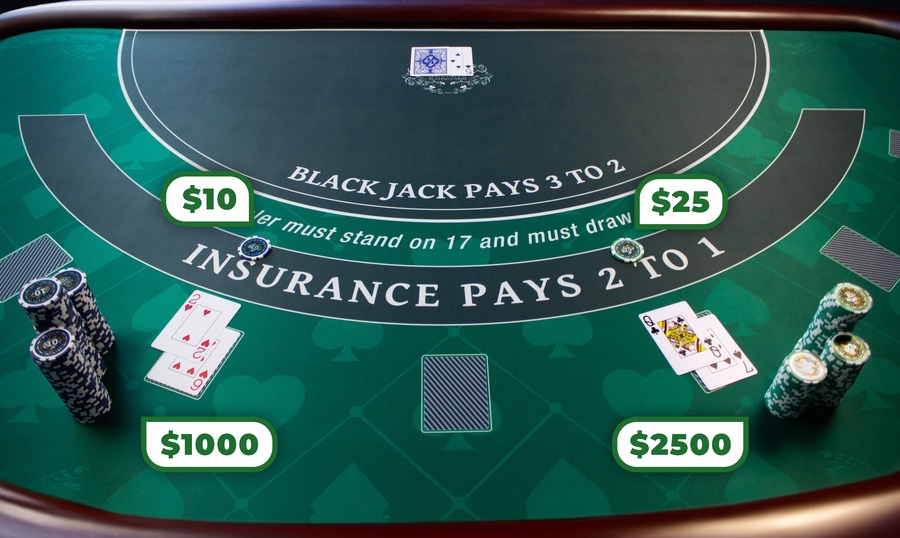
Your session bankroll should be somewhere between 1/4 and 1/3 of your lifetime bankroll. And I would always err on the side of 1/3 – because I did not want to possibly run out of money when things started looking good.
How to choose the right bankroll amount
Different players will have a different amount that they are comfortable with.
Elon Musk’s bankroll will be a lot different to the guy who works part-time at the library on Thursdays.
You have to decide what’s comfortable for you and go with that.
Here’s what’s important:
- Don’t over bet – which means make sure you’re playing within the 1 to 12 units that you’ve decided is the right betting range for you.
- Don’t under bet – which means when you have the advantage, don’t be cautious and make sure you get the money on the table to make the most of the opportunity.
How to decide on the number of betting units
There’s no real formula for this, but here’s what I’ve learned over the years...
My take is that I’m comfortable with a $10 unit and going from $10 to $120 works for me.
So 1 to 12 units is the range I like.
It may be that you’re more comfortable with $10 to $80.
So a 1 to 8 unit spread works for you.
Maybe it’s a 1 to 6 unit spread, and your base unit is $25.
So $25 to $150 works for you.
And that’s okay too.

The one thing to be aware of is that being consistent is important.
Bring 100 betting units to the casino as your session bankroll – you don’t need to bring all your bankroll.
And think about this – it’s always better to have more ‘ammunition’ than you need, rather than being underfunded.
Imagine this scenario - you’ve been playing for three hours out of your planned four-hour session, and it’s been really choppy.
Now you find yourself a deck into a great shoe – but you’re running out of money!
That’s a terrible place to be – it really is a sickening feeling where you see this shoe shaping up to be really profitable, but you don’t have the bullets to get to where you want to be.
Let’s talk about bet spread
A typical bet spread is 1 to 12 units.
If your base unit is $10, that means that your bets will range from $10 to $120.
As a card counter, if the True Count is +1 or less, then your bet is 1 unit, so $10.
If the count is +2, then you bet $20. At + 3, it’s $30 and so on, up to a maximum of $120.
And if the count goes below zero, so at -1 or worse, don’t play through the negative count.
Go and find another table. (Sitting out until it gets better is an option, but there is a significant downside to that - which is that it may identify you as an advantage player!!).
Advanced bankroll strategies
I have deliberately not included card counting as a part of your blackjack bankroll management strategy yet. And that’s because card counting is a very big step into a different universe.
A card counter has a very different view of the world. It is much more structured world, and a lot less casual than the world of the recreational gambler.
Please view my article on ‘How to Count Cards’. It’s designed to take you from being a beginner to an expert card counter and covers everything you’ll need to know to get you there.
So let’s explore that now.
This is where we need to talk about Risk of Ruin (ROR)
What is Risk of Ruin? It’s the likelihood that you will lose your entire bankroll.
Most professional blackjack players want their ROR to be 2% or less. 1% or less is even better.
Some highly skilled and respected guys will take the position that a 5% or less ROR is acceptable. And that’s fine for them. It’s an aggressive stance and they’re comfortable with that.
But 5% certainly doesn’t work for me. Less than 2% is where I want to be.
When I first started trying to figure all this stuff out, the only way (that I knew of, anyway) was to go to the Gambler’s Bookstore in Las Vegas and try to find a book that had the information that I was looking for. This is pre-internet, no YouTube, no Blackjack Forums, no Amazon and so on.
And I found it!
Don Schlesinger is a renowned author, mathematician, and member of the Blackjack Hall of Fame. His book ‘Blackjack Attack - Playing the Pros’ Way’ may be the most complete ‘how to’ book since Ed Thorp’s ‘Beat The Dealer’.
First published in 1997, it is one of the few gold standard books on how to play blackjack and how to be a successful card counter.
It contains everything you will ever need to know about how to count cards and be an expert blackjack player – including all the tables and calculations you will ever need including Risk of Ruin.
That was then.
These days there are several excellent (and relatively inexpensive) software programs that will do all the calculations for you.
The one I’ve seen and can recommend is called Casino Verite CX (or CVCX).
It’s written by Norman Wattenberger, and does everything you need it to.
Just enter the data and hit ‘calculate’ and it does the rest.
Fun fact
As a VP of Casino Operations, I would always set up my blackjack shoes as 6-decks, dealer stands on Soft 17, cut 1.5 decks off the back of the shoe – so 75% penetration, and allow a double down after a split. Blackjack pays 3 to 2. And no surrender.
My goal was to provide a generous suite of rules for our players that would give them a fair game and a good gamble. Looking back, it seems I was adopting the Binion’s Horseshoe philosophy, which is to give the players a good and fair gamble, while making sure the casino isn’t giving the house away.
The House Advantage on this game is 0.36% for a knowledgeable player.
Of course, many players will be looking at the wrong end of a bigger House Advantage because they don’t play very well.
I learned to count cards using Lawrence Revere’s Hi-Lo system from his book ‘Playing Blackjack as a Business’ – so I like to use the Hi-Lo count as my reference point.
I’ve always been a fan of a 1 to 12 unit spread and using $10 as my base unit.
Having set the stage for how the game I’m looking for should run, let’s say you have $2,000 as your ‘lifetime’ bankroll.
Enter the information into the CVCX online calculator and here’s what it tells you:
With a $2,000 bankroll and a win rate of 2 hands per 100, a Standard Deviation of 27.72, your ROR is 35.24%.
What does that actually mean?
It means that if you have 100 players playing this game with the same bankroll, more than 35 of them will go broke.
Ouch! Way too risky for me!
So let’s play with the numbers and try to get them where I want to be.
What if your bankroll was $5,000?
Now we’re getting somewhere – the ROR with a $5,000 bankroll given the same game rules is 7.37%. Still too risky for me but getting closer.
How about a $6,000 bankroll? 4.38% ROR. If you’re one of those guys who is comfortable at 5% or less, then a $6,000 bankroll with a base unit of $10 gets you there.
$7,500 bankroll? ROR is exactly 2%. As a 2% ROR guy, the $7,500 bankroll gets me there.
I can live with that and be comfortable knowing that it’s highly unlikely that I will go broke.
But I don’t have $7,500. I only have a $2,000 lifetime bankroll.
What are my options?
- I can go ahead with my $2,000, maintain my $10 per unit value and swing for the fences. Maybe I’ll be okay and won’t go broke. After all, if 35 guys out of 100 go broke, it means that 65 guys don’t go broke, right?
- Or I can keep saving my money until I have the $7,500 I need to be at 2% ROR.
- Or I can play using a smaller unit spread. If I take my base unit down to $2.50, it means I will be using a bet spread of $2.50 to $30 for my 1 to 12 unit spread. And my ROR becomes 1.54%. Very doable, and now I can slowly build up my bankroll using smaller stakes to get me there.
And option 3 is what I would ultimately do if I was faced with this dilemma.
What’s most interesting about this is how the card counters’ philosophy has changed over the last 15 years or so. I remember having a conversation with a well-known card counting team leader, who used to come into Grand Casino Gulfport when I was based at the corporate office there.
His philosophy was to be very aggressive in his bet spreads, which was a surprise to me.
Here’s why.
It used to be that card counters had very few places to play, and consequently were extremely cautious about being spotted – and that was what I expected to hear from him.
Here’s what he told me:
These days, with all the Tribal casinos that have opened up, plus many traditionally-owned casinos in multiple states, there are literally hundreds of places to play blackjack across the country.
And the experienced casino operations guys who can recognize what the counters are doing are spread much thinner on the ground.
So the card counters are much more likely to have an aggressive bet spread than they used to have. Which of course makes them much easier to identify if you know what you’re looking for, but you also need to be well-trained and understand what they’re doing in order to spot them.
So they’ll often be able to get ahead before the casino can get a handle on what they’re up to.
And the beat goes on . . .
Expert Advice / Tips
- Never mix your day-to-day expenses with your gambling bankroll. They must be separate.
- Always have 100x your unit bet as a session bankroll.
- Your session bankroll should be between 1/4 and 1/3 of your lifetime bankroll.
- If you have a losing session that depletes your bankroll, reduce your base unit size to keep your ‘100x your base unit bet as a session bankroll’ intact.
- Keep your Risk of Ruin at or below 2% of your lifetime bankroll.
- Play perfect Basic Strategy for the game you’re playing. No excuses, no explanations. Learn how to master some game specific Basic Strategy charts to help you become a better player.
- Make sure you set a daily loss budget number for the day’s session and if you get there, you must walk away.
Not everyone knows that you must also have a ‘I’m willing to win this today’ number, too.
- And when you hit that number, you must walk away. We’ve all had the friend come up to us and say ‘Man, I was winning $600 and gave it all back’. Don’t be that guy!
- Learn to count cards. It’s not difficult to do. No, really, it’s not! But it takes discipline and a lot of practice to play perfectly. And that’s what it takes to be a successful card counter.
Final thoughts
So that’s my take on blackjack bankroll management. It is a vital piece of your skill set if you want to be a successful blackjack player.
And good luck at your next blackjack session.
 5
5 0
0 Thank you for voting.
Peter Nairn
Liliana Costache
Explore More Blackjack Guides


Blackjack Q&As





 Level 4United States
I don't know what that means.
 4 Need Answer
 3 AnswersLevel 1
I mostly play slots and sometimes blackjack. Any real experiences here? Would love to hear from actual players before I dive in. Thanks in advance!
2 Need Answer5 AnswersLevel 2Which do you think wins more or is more likely to win?
2 Need Answer7 Answers